
“If the Australians in conditions very like ours had done it, so could we.” — Field Marshal Sir William Slim, on the news from Milne Bay
Recently, I published an article here that explored failure in military operations. Using the 1932 Emu Wars as a low-stakes example of military incompetence and failure, I explored how individual and institutional pathologies had an impact as well as the lessons were for contemporary leaders.
In this article, I examine at failure from a different perspective. I will explore a military operation that succeeded after a long line of military failures. The core message is that even when facing an adversary that has generated successive victories over time, and suffering multiple failures, people and organisations can still change their fortunes.
That is what occurred at the Battle of Milne Bay in 1942.
By mid-1942 the Japanese had swept through South-East Asia and the South-West Pacific in an unbroken string of victories. Malaya and Singapore had fallen, the Philippines had capitulated, the Dutch East Indies had been captured, and Japanese forces were pushing south along New Guinea’s northern coast and over the Kokoda Track towards Port Moresby.
After the fall of Rabaul in January and the Japanese advance down the Solomons and along New Guinea’s north coast, Port Moresby was under threat from the overland axis via Kokoda, and potentially by sea via Milne Bay. The Japanese Imperial General Headquarters had already committed to the Kokoda operation and viewed Milne Bay as a secondary, low-risk addition to it. They aimed to secure it employing the same amphibious, seize-and-exploit tactics that had worked everywhere else for the Japanese in 1941 and early 1942.
At the same time, General Douglas MacArthur had moved to Australia and established the new Southwest Pacific Area command, a combined U.S.-Australian command. One of MacArthur’s first directives was that a passive defence of Australia could not work and that the allies, despite resource shortfalls, would henceforth conduct offensive operations against the Japanese. As part of this strategic direction, orders were issued to build a new airbase and logistics hub in eastern New Guinea.
Milne Bay was chosen as it offered a deep, sheltered harbour on the eastern tip of New Guinea. Construction began in June 1942, and by late July the first of three planned airstrips was operational, with two Royal Australian Air Force (RAAF) Kittyhawk squadrons in residence. Throughout August the garrison grew steadily, to two Australian infantry brigades, American engineer and anti-aircraft units, and a scratch two-star headquarters known as Milne Force, under Major General Cyril Clowes.
The Japanese, confident after eight months of unbroken victory in their rampage through Southeast Asia, regarded the seizure of Milne Bay as a straightforward component of their larger plan to capture Port Moresby. On the night of 25 August, around 2,000 troops of the Kure and Yokosuka Special Naval Landing Forces came ashore on the northern side of the bay, about 11 kilometres east of the airfields. Despite landing in the wrong place, the Japanese ground troops commenced advancing west along the coastal track toward the Allied airstrips.
What followed was thirteen days of close, jungle fighting and air-land manoeuvre in some of the worst terrain Australian and American troops encountered anywhere during the Second World War. They contended with waist-deep mud, torrential rain, jungle so dense that fields of fire were measured in metres, and endemic malaria.
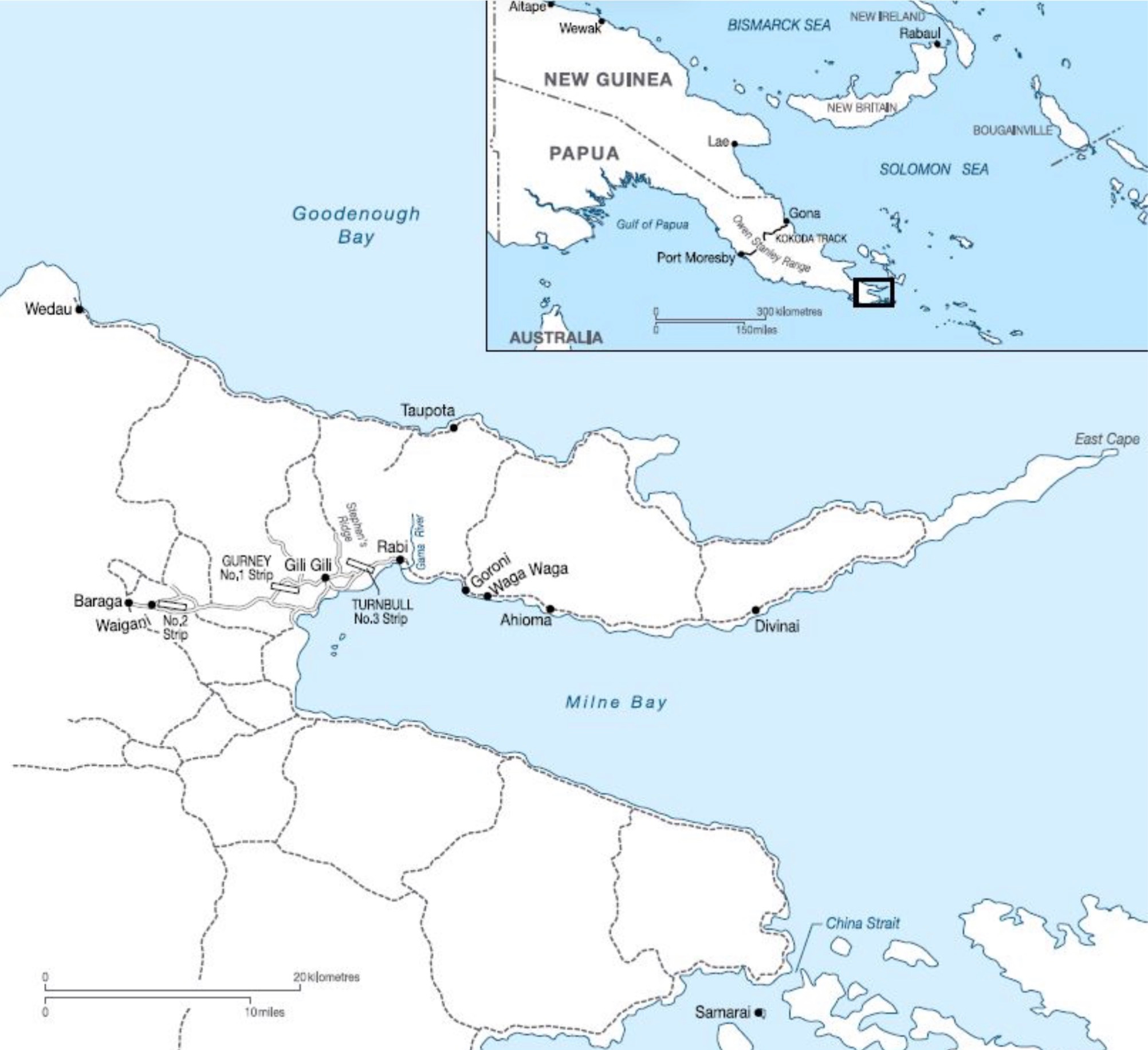
Map of eastern New Guinea and Milne Bay at the time of the battle. Source: Department of Veterans Affairs, Australian Government.
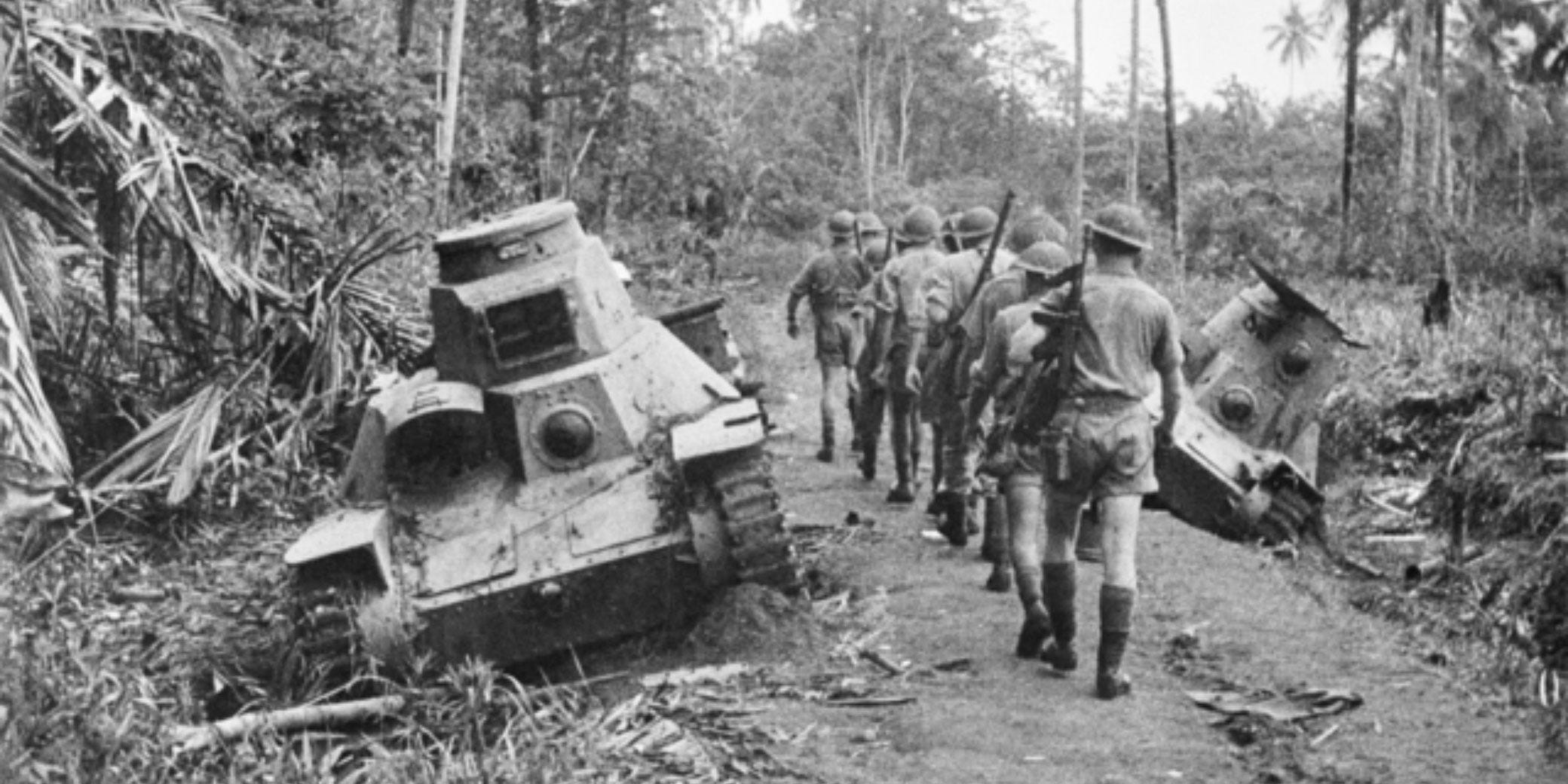
Japanese light tanks led the Japanese advance west early in the operation before bogging down and being abandoned. In the face of these early Japanese advances after their landings, Australian infantry conducted a staged withdrawal towards the unfinished No. 3 Airstrip.
On the morning of 31 August, the Japanese advance was halted when they walked into a well-prepared Australian engagement area of two battalions, artillery, mortars and American-manned machine guns. In doing so, the Japanese had made a similar assumption to their operating method all the way down the Malayan Peninsula: assume the objective is lightly held, and attack directly into it. This time the objective was not lightly held, and several Japanese assault waves foundered.
It was the culminating point of the Japanese operation. From that morning onwards, the Japanese were in retreat, harried by Australian infantry and Kittyhawks operating almost continuously overhead. Desperate, close-quarters fighting continued along the northern shore for days, including bayonet charges as Australian battalions pressed the Japanese withdrawal.
By 5 September the Japanese high command had cancelled further reinforcements for the Milne Bay operation and ordered evacuation. The last remaining Japanese troops were evacuated on 8 September by the Imperial Japanese Navy. Of roughly 2,800 Japanese troops landed, only 1,318 re-embarked.
A crucial part of the Allies victory was the gap between Japanese assumptions about Allied capabilities, and the reality on the ground. By the time the Japanese landed, the defending forces at Milne Bay consisted of approximately 10,000 Australian and American soldiers and airmen. Japanese intelligence had estimated around 1000. It was just one of the asymmetries between the two forces during the battle.
The single largest asymmetry between the two sides at Milne Bay was not force size, firepower or air power; it was intelligence. Codebreakers working for MacArthur’s headquarters in Australia had, by mid-July, already informed him that the Japanese were planning to attack Milne Bay towards the end of August. Their intercepts were even able to provide specifics on the likely units and ships that would be involved. Intercepted and decrypted Japanese signals traffic was a crucial Allied asymmetry. By mid-1942 this was giving MacArthur’s Southwest Pacific headquarters an informed window into Japanese intentions and decision-making.
Comments
Nothing yet. Say the first thing.
Sign in to join the conversation.