
Most owners know where to look for waste.
Labor.
Materials.
Overhead.
Maybe the software nobody uses.
That’s the obvious stuff.
The more expensive problem usually isn’t sitting on its own line. It’s spread out across the business. A ten-minute delay here. A reopened issue there. A commitment that got softened in conversation. Cash sitting still because nobody triggered the next step. A manager burning expensive time translating what the business never took the time to define.
I call that the Invisible Tax.
It’s the margin that disappears when a business runs on memory instead of structure.
Most owners don’t call it that, obviously. They say things like:
“We’re busy, but not really getting ahead.”
“We’ve got good people, but things still slip.”
“We make money, but it feels harder than it should.”
That feeling isn’t random.
That’s the tax getting collected.
The most dangerous operating state isn’t chaos.
It’s experienced and consistent.
That’s where a lot of growing businesses live for a while. The team knows the work. Customers are mostly satisfied. Jobs keep moving. Revenue comes in. From the outside, and honestly from the inside too, the machine looks like it works.
And it does.
That’s what makes it dangerous.
Because consistency can be carried by people just as easily as by systems. Sometimes more easily. A strong PM knows the client’s quirks. A senior admin knows which document actually matters. A superintendent knows when “done” isn’t really done. A controller knows which balances need a nudge. Over time the business starts confusing reliable people with reliable design.
It feels fine right up until something shifts.
One key person leaves.
One role turns over.
One quarter gets overloaded.
One more layer of growth gets added.
One customer pushes harder than usual.
Then the business finds out that what looked like stability was really talent absorbing structural weakness. That discovery usually hits margin and cash before anybody is willing to call it a systems problem.
A memory-driven business is not a business with no process.
It’s a business where the process is real, but trapped in people.
The work still gets done. That’s why this gets missed.
The subcontract gets issued.
The crew gets scheduled.
The invoice gets approved.
The closeout gets pushed through.
The exception gets handled.
But ask where the real operating logic lives and you get some version of:
“She knows how we do that.”
“He usually catches that.”
“We don’t really have a process, but everybody kind of knows.”
That’s tribal knowledge functioning as the operating system.
And the cost is not philosophical. It’s financial.
Memory doesn’t scale.
Memory drives exception rates up.
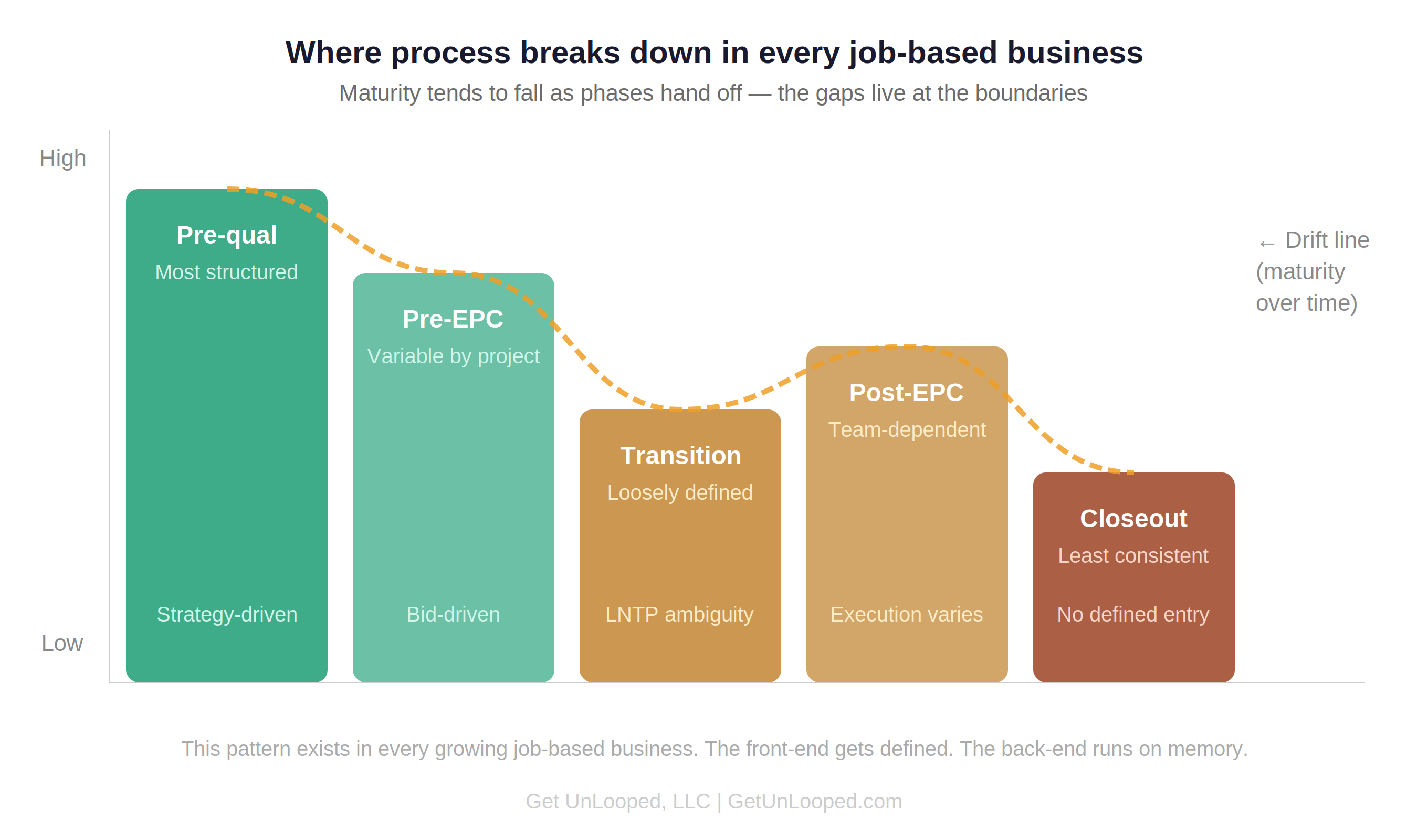
Memory creates maturity drift.
Memory weakens handoffs.
Memory slows cash movement.
Memory eats management attention.
Every time the next step depends on somebody remembering what usually happens, the business pays for it. Rework. Delay. Idle cash. Weaker negotiating position. Extra management time. It all comes out of net margin and working capital whether anyone labels it or not.
Start with communication.
One person is emailing the subcontractor about the contract.
Another is calling about the schedule.
A third may be texting about site conditions.
Everyone thinks they’re just doing their job.
Nobody is trying to create risk.
But now the subcontractor is getting multiple signals from the same company, and nobody inside the company really owns the full record. One instruction is formal. Another is practical. A third is implied. Later, when something gets disputed, people go looking for a clean sequence and there isn’t one. The record is fragmented because the signal was fragmented first.
This matters more than most teams think.
When communication ownership is vague, scope starts getting interpreted instead of enforced. Dates get softer. Verbal accommodations sneak in. The subcontractor stops reacting to one controlled signal and starts reacting to a blend of messages.
That is not a communication problem. It’s a control problem.
And it costs money quietly. Not all at once. In small concessions nobody meant to make.
The fix is not “communicate better.” That’s mush.
The fix is structural: one communication owner per external party, one defined channel that creates the official record, and a same-day requirement that field calls changing scope, sequence, or commitment get logged back into that record. If the field needs speed and the office needs control, then design both. Don’t let them collide and call it normal. Otherwise the business keeps paying for fragmented signal in weaker commercial position and thinner margin.
This is the one a lot of owners underestimate.
The job feels basically done.
The crew wants to move.
The subcontractor wants to move.
The PM wants it psychologically off the board.
So capacity gets released.
Then the owner comes back with the punch list.
Not two or three obvious items.
Twenty-three.
Or forty.
Or just enough unfinished edges to drag the last part of the job into an ugly tail.
And now the economics are different than they were the day before.
Yesterday, the subcontractor still needed final release.
Today, you need them to come back.
Yesterday, your schedule had leverage.
Today, their urgency dropped.
Yesterday, the remaining work was still part of the main job.
Today, it’s re-entry.
That shift matters.
Most project businesses treat closeout like admin. It isn’t. It’s a leverage event.
There are really two completions that matter:
The client accepts the GC’s work.
Then the GC releases the subcontractor’s work.
Reverse that order and the economics change immediately. The last two percent becomes the most expensive work on the job because now it’s being done under weaker leverage, broken urgency, and a moving definition of “done.”
This is where a lot of owners lose profit without really realizing where it went.
Not in the estimate.
Not in procurement.
Not in the middle of execution.
At the tail.
The job looks 98% done. Everybody talks like the money is basically earned. Then the last 2% starts eating 100% of the profit because downstream capacity was released before upstream acceptance was actually real.
That isn’t sloppiness. It’s a failure to protect commercial position at the exact point where it still matters.
The fix here has to be more than a slogan.
You need a closeout gate that actually controls something: client acceptance criteria defined in advance, punch resolved and documented, upstream acceptance explicitly verified, then and only then downstream release. “Looks done” is not a control. “Feels done” is not a control. Capacity should not be released on sentiment.
Release capacity too early and the tail starts billing itself straight against your margin.
Retention is one of the cleanest examples of the Invisible Tax because the money is easy to see.
Five to ten percent gets held back.
Milestone passes.
The job keeps moving.
And the money gets released when somebody remembers.
That isn’t a system. That’s a reminder pretending to be one.
In one version of this, the PM emails AP when the condition is met. AP processes the release. No trigger. No alert. No checklist showing what crossed the line this week. Just a person who has to notice and do something.
At low volume, maybe that limps along.
At real volume, balances sit.
Not because leadership intentionally decided to hold them.
Not because finance made a strategic choice.
Not because the subcontractor failed a condition.
They sit because memory is acting as workflow.
That creates a double tax. Cash stays idle, and supplier trust erodes. Subs start asking where their money is. AP gets dragged into reactive cleanup. The company creates friction around something that should have moved cleanly. Over time that friction becomes behavior. Vendors get more cautious. Pricing gets less friendly. A cash-flow drag turns into a relationship cost, and that relationship cost eventually turns into a margin cost.
The fix is operational. Define the release event in writing. Tie it to a visible milestone instead of a person’s email. Generate a pending-release list on a fixed cadence. Force each balance into one of two statuses: approved hold or ready to release.
No gray zone.
That’s how you stop money from just sitting there because nobody touched it.
If money only moves when someone remembers, the business is financing its own unfinished system out of cash flow.
One of the fastest ways to diagnose a weak system is just to listen to how people answer process questions.
“How does this work?”
“Well, it depends…”
“Sometimes we…”
“In that case…”
A few answers like that are normal. Businesses need judgment.
But when almost every answer starts with a condition, that usually means the standard path has never been defined clearly enough for people to describe it. They’re answering from memory. From examples. From the weird case last month. From the workaround they learned by surviving.
I call that the exception rate.
A high exception rate doesn’t mean there’s no process. Usually it means there is a default path, but nobody has ever forced it into the light.
That has a management cost.
Senior people become interpreters.
They route work.
Clarify expectations.
Translate between teams.
Answer the same baseline questions again and again.
The business calls that leadership.
A lot of the time it’s just expensive people compensating for an undefined default path.
That’s the leak.
If a high-value leader is spending major chunks of the week acting as air-traffic control for normal work, the business is burning leadership capacity on ambiguity it should have removed already. That time should be going to pricing, staffing, risk, growth, actual strategic decisions. Instead it gets consumed by mediating a process that should already know how to route the standard case.
The fix is not “document everything.” That turns into bureaucracy in a hurry.
The fix is to pull the baseline out of the noise: map the 80% path, identify the real decision points where judgment is actually needed, and put explicit thresholds around those decisions so they stop floating upward. For example: estimator approves change orders under $10K, PM approves schedule moves under three days, anything outside those bounds goes to the commercial owner. Once the normal path is explicit and decision authority is assigned, leaders stop spending their time refereeing work that should have routed itself. Until then, management drag keeps leaking straight into net margin.
The signal drift leak, the capacity leak, the working capital leak, and the management leak all come from the same place.
The business hasn’t clearly decided what belongs to memory and what belongs to the system.
That’s why two simple questions reveal so much:
Is this process driven by a system, or by someone’s memory?
Does it execute consistently, or does it vary depending on who is doing it?
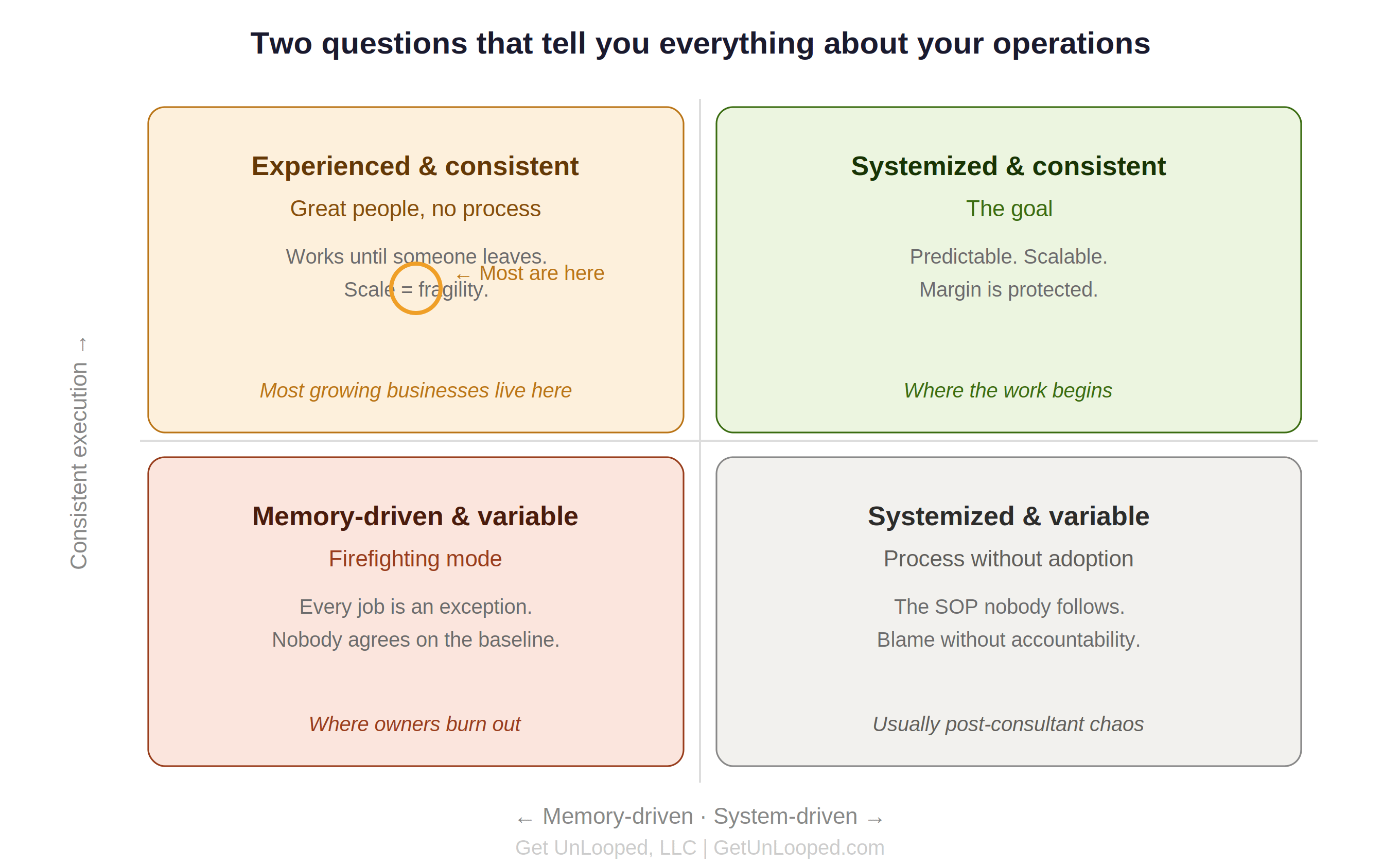
Those two questions create four operating states.
Memory-driven and variable is firefighting. Every job feels different. Nobody agrees on the baseline. Owners get pulled into everything. Margin gets chewed up by rework and interruption. Cash gets tighter because unpredictability multiplies the small misses.
Systemized and variable is the weird middle state where the process exists on paper but not in practice. The SOP is there. The behavior isn’t. The business pays to create process and still loses money to inconsistency.
Systemized and consistent is the goal. Predictable. Scalable. Margin protected because execution isn’t depending on heroics anymore. Cash steadier because handoffs and triggers are visible.
And then there’s experienced and consistent.
That’s the deceptive quadrant.
It feels healthy because the customer experience is mostly intact. The owner sees proof that the team can deliver. Nothing looks broken enough to justify stopping and rebuilding. But what’s actually holding that quadrant together is skill, tenure, memory, and informal coordination.
Stable-looking fragility.
You usually don’t discover you were in that quadrant while things are calm.
You discover it after turnover.
Or overload.
Or growth.
Or one demanding customer.
Or one missed handoff that exposes how much of the business was living in a person instead of a system.
That’s why it’s dangerous. The tax is already there. Talent is just hiding it. And eventually the overstatement gets paid for in thinner margins and tighter cash.
Owners resist system work because the cost is visible.
Documentation takes time.
Checklists feel administrative.
Triggers and dashboards look like overhead.
Defined handoffs feel slower than just asking somebody who already knows.
The system looks expensive because you can see the effort.
The leak looks cheaper because it’s distributed.
A missed trigger here.
An extra call there.
A PM spending twenty minutes clearing up something that should have been obvious.
A controller chasing a release that should have surfaced automatically.
A superintendent negotiating re-entry on work everybody thought was done.
A senior leader burning an hour translating an exception that only exists because nobody defined the baseline.
That spending hides inside normal operations. That’s why it survives.
One path creates an asset.
The other creates recurring drag.
If you fund the system, you get repeatability, cleaner handoffs, faster cash movement, and better protection at the exact points where margin is fragile.
If you refuse to fund the system, you are still spending the money. You’re just spending it as rework, delay, idle cash, management drag, and weaker commercial position at the moments where the economics of the job can still turn against you.
That’s the Invisible Tax.
It doesn’t show up on the P&L as one neat category. It’s spread across enough small failures to look normal. But in aggregate it is one of the most expensive things in the business because it drains both net margin and cash flow without ever announcing itself as a line item.
Stop using payroll to fund your lack of process.
Build the controls that let margin survive ordinary work.
That’s where the money is.
No posts
Comments
Nothing yet. Say the first thing.
Sign in to join the conversation.