
I was in a small engineering shop a few weeks ago.
Two people on the floor.
Oscilloscopes on the benches.
A half-assembled rack sitting there waiting on one more subsystem before it could move.
The founder was walking me through their last few projects.
Each one was solid.
Not flashy. Just… right.
The kind of work where you can tell someone actually had to think.
They’d been around a long time.
Good reputation.
Customers kept coming back.
We got into the numbers.
And the tone shifted a little.
Not dramatically. Just enough.
Projects were going out.
Invoices were getting sent.
There were moments where things felt okay.
But it never seemed to accumulate into anything.
At one point he said:
“We’re always busy… but I don’t think we’re getting ahead.”
I’ve heard that exact sentence in a lot of these shops.
From the outside, it usually gets explained away.
You need more sales.
You need better marketing.
You need another engineer.
But if you sit with it for a while, it doesn’t quite line up.
These aren’t companies that can’t sell.
They’re usually overloaded.
They’re not lacking capability either.
They’re solving problems most companies won’t touch.
And still — something doesn’t translate.
Work goes in.
Stress goes up.
Revenue moves.
But the bank balance just kind of hovers.
I heard from someone recently who had been running a shop like this.
Custom equipment. Small team.
Good work.
Busy enough that from the outside you’d assume things were fine.
Then it wasn’t.
A couple projects slipped.
Cash got tight.
Everything started depending on everything else.
He ended up shutting the shop down.
Not because the work disappeared.
Because it all became too fragile at the same time.
When he talked about what he’d do differently, it wasn’t a big strategic answer.
It was simpler than that.
“I’d only take on work that’s close to what we’ve already built.”
That was it.
No big shift in capability.
Just less variation.
If you follow a single job all the way through one of these businesses, something starts to show up.
Not immediately.
Usually halfway through.
The quote looked reasonable.
The plan made sense.
Then a few things stretch.
Engineering takes longer than expected.
Something doesn’t integrate cleanly.
A change gets made that’s too small to fight but still takes time.
Nothing dramatic.
Just… drift.
And by the time the job is done, it doesn’t quite behave like the quote anymore.
That gap is easy to explain away in the moment.
Harder to see when it’s happening over and over again.
Over a few jobs, that drift stops looking like an exception.
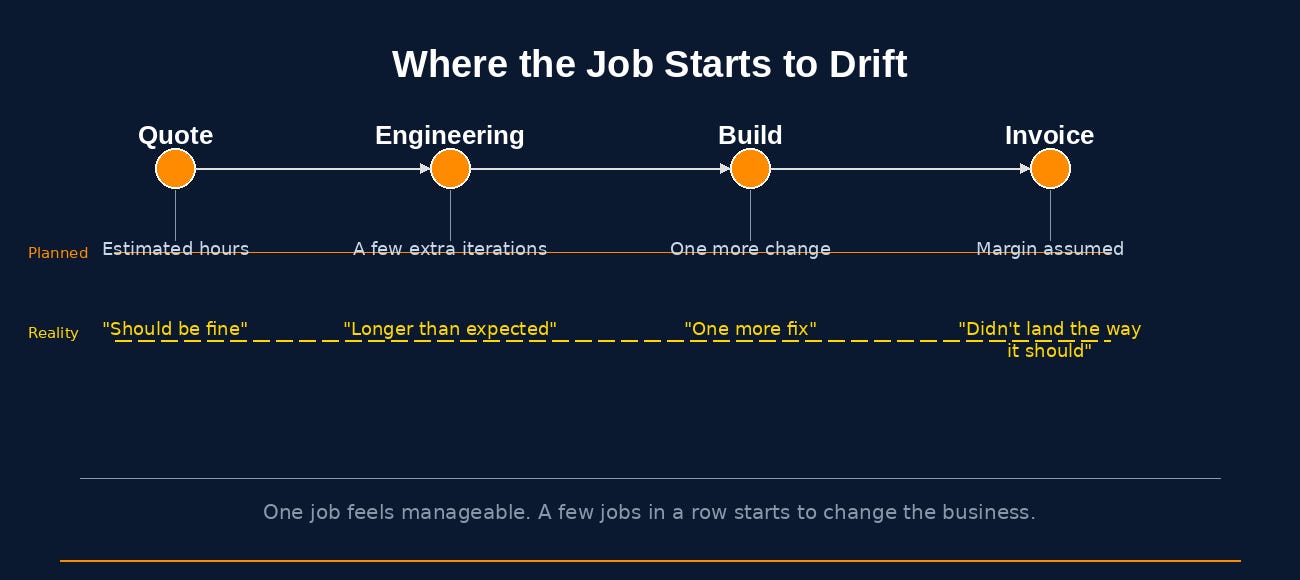
Most of these companies carry more variation than they realize.
Every job is a little different.
Sometimes a lot different.
New decisions.
New unknowns.
New problems that don’t show up until you’re already into the build.
It doesn’t feel like a choice while you’re in it.
It just feels like the work.
The kind of work where you’re solving things from first principles every time.
There’s another version of these shops that looks almost the same from the outside.
Same customers.
Similar equipment.
But when you look closer, something’s different.
You start seeing the same subsystems show up again.
Same patterns.
Same decisions, reused instead of reinvented.
The work still requires skill.
But it’s not starting from zero every time.
It moves faster.
Feels lighter.
Less is riding on any single job.
Most founders don’t decide between those two approaches.
They just take the next job.
And then the next one.
Somewhere along the way, the mix shifts.
A big custom project.
Then a smaller one.
Then something in between.
Over time you end up carrying both.
The work that pulls you into new problems…
and the work that actually stabilizes things.
They don’t behave the same.
One tolerates variation.
The other quietly depends on not having much of it.
When you try to run both, nothing looks obviously broken.
It just becomes fragile.
The shops that find their footing don’t necessarily get smarter.
They get narrower.
Not in what they can do.
In what they’re willing to take on.
You start seeing more reuse.
More decisions made ahead of time.
More things that are known before the job starts.
It doesn’t look like a breakthrough.
It looks like constraint.
The ones that don’t make that shift usually don’t fail all at once.
They absorb it.
Project by project.
Until something forces the issue.
A delay that pushes billing out.
A stretch where everything overlaps a little too tightly.
A job that doesn’t land the way it needed to.
And suddenly there’s no room left in the system.
If you’re in one of these businesses, you can usually feel where this shows up.
In how you quote.
In how much of the design is known before you start.
In how often something “unexpected” appears halfway through a job.
Most people don’t stop there.
They just push through the next one.
That works for a while.
Until it doesn’t.
The founder I mentioned is still working.
Still building.
Just differently now.
Closer to what he already understands.
Less exposed.
It’s quieter.
But it’s not fragile in the same way.
There’s usually a version of that decision sitting somewhere in the business already.
Not written down.
Just felt.
What you take on.
What you avoid.
What always seems to go smoothly…
and what always seems to fight back.
If you want to look at it more clearly, you don’t need to map the whole business.
Just take one recent job.
Start at the quote.
Then walk it forward.
Where did it start to drift?
Where did it take longer than expected?
Where did the work stop matching what you thought it would be?
Don’t fix anything.
Just trace it.
That’s usually enough to see what the system is actually doing.
No posts
Comments
Nothing yet. Say the first thing.
Sign in to join the conversation.