
How oddly interesting that the Lord, or a deep guardian wisdom, allows us to remain blind to things our frail minds are not capable of handling. Once, when my daughter was quite pregnant, a tree-trimmer fried up from touching the wrong wire on an electric pole outside our window. We heard the noise, saw the commotion outside, but when we looked out the window, we saw only a shape resembling a utility box that appeared to have fallen over. My girl stayed inside. But I went outside to get the skinny on what had happened. There, at close quarters, the utility box transformed shockingly into a very unfortunate man. But we had been shielded from that vision—and my daughter remained so, by the grace of God.
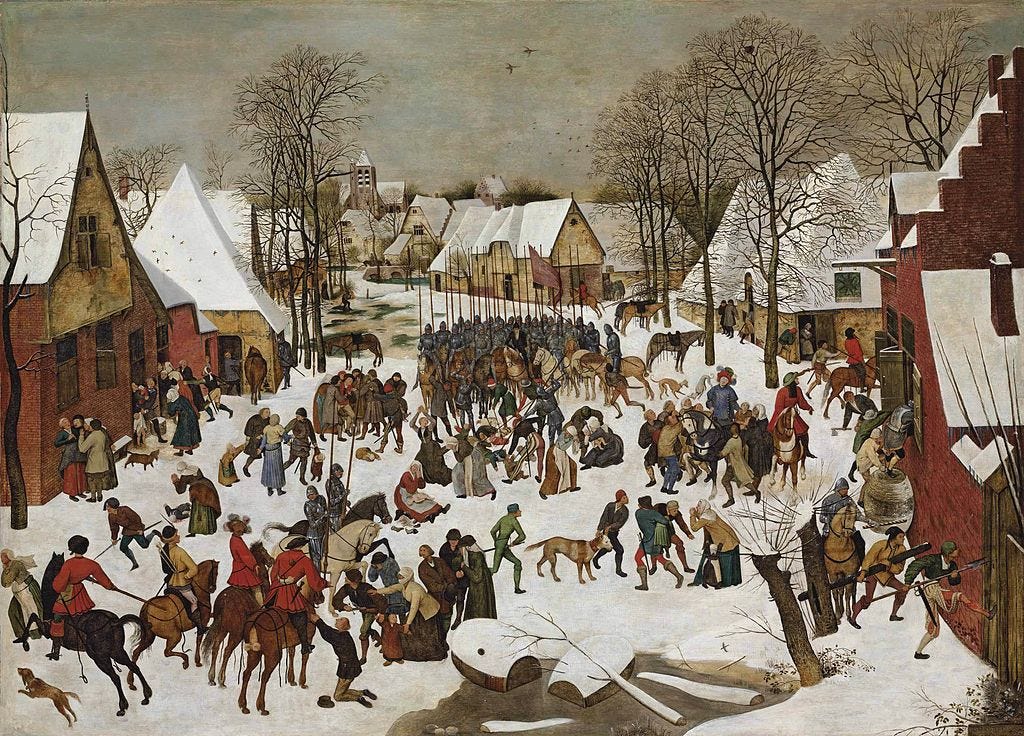
When my mother took me to her hometown of Vienna, she was eager to show me her favorite childhood haunts. As an art-lover from an early age, she adored the quiet endless halls of the Vienna Art History Museum, the Kunsthistorisches Museum, located near enough to her home that she could hop over there anytime she wanted. And of all the rooms in that palace, she was eager to show me her favorite room: the Breugel Room. And of all the paintings in the Breugel Room, her favorite Breugel: “The Massacre of the Innocents.”
This painting depicts the biblical story of the slaughter of all children under the age of two in Bethlehem, ordered after the birth of Jesus by King Herod to ensure that the coming King who was foretold by the prophets would not ascend and threaten his power. This story can be found in Matthew 2:16–18. Breugel interprets the scene in his contemporary context as a Flemish village invaded by the Spanish occupying soldiers, a common occurrence during his day and one worthy of recognition for the cruelty and suffering the people endured at the hands of the Spanish.
The original painting lives in the Royal Collection Trust in London, but a copy was made either by the artist himself, Breugel the Elder, or by his studio under his supervision, or by his son, Breughel the Younger. When the original came into the hands of Holy Roman Emperor Rudolf II, he had the images of slaughtered babies painted over such that the scene represented more of a plundering than a horrific massacre. Babies were painted over to look like bundles of cheese and loaves of bread. Children were covered over with images of birds or packages—a cluster of livestock being jabbed by spears from all sides, a boar, a jar, a sack, a bundle tied with string. No babies. No barrened mothers. This was the willful blindness of one for whom the true story of what occurred was too offensive.
But it is the copy of this painting that is in the Breugel Room of the Kunsthistorisches Museum in Vienna, and that version was not tampered with like the original. The copy tells the whole horrid story in gruesome detail. No hiding here. No euphemisms. No allowances made for the sensitive eye. And that is the version that my mother loved.
This is where I come up against that oddly interesting phenomenon of the mind. When my mother showed me her favorite Breugel in the Breugel Room, I asked her if she knew the Bible story. She did not. I asked how such a horrific scene could be her favorite, and she looked at the painting as if for the first time. She had looked at it countless times without recognizing the story that was told in it. She had seen Breugel’s wonderful way of treating snow. The wintry trees and rooftops, the horses in motion, captivating faces, leaping dog, gleaming armor, the sweet-faced fellow in the plumed hat, Breugel’s sheer brilliance with a brush. But not the dead babies. She saw them for the first time with me.
My mother had to flee from Vienna as a young girl with her family to escape the Nazi Holocaust. She was careful never to call herself a Holocaust survivor because she got out before the worst of the atrocities occurred. Her family escaped to Trinidad, where they were interned but not by the Nazis. They were held in an Allied camp as enemy aliens until my mother married my father, an American soldier stationed in Trinidad, and the whole family immigrated to the U.S. They lost everything they had, but they escaped the horrors taking place in Europe.
The children in Bethlehem were martyrs for Christ. When I see “The Massacre of the Innocents,” I think of the children of the Holocaust who died as martyrs because the Nazis hated the God of the Jews. When I consider the history of this painting and how its truth was too awful to gaze upon, I think of the willful blindness of those who don’t wish to see the horror of sexual violence against girls that took place on October 7. The strangled Bibas babies. Or how about the horror of abhortion? What is it that happens in the mind of an abhortionist when he goes from being at peace with his work to having his eyes opened to see the horror? Or assisted suicide? Or organ harvesting off living humans?
That oddly interesting mental trick that protects us from horrors we cannot handle can slip into an embrace of falsehood and an evasion of responsibility.
Do we want to see and truly face the wretched heart of humanity? If we don’t see, how will we have the courage to vanquish evil?
Comments
Nothing yet. Say the first thing.
Sign in to join the conversation.