
Just as the Jewish fall festival of Sukkot—the most joyous feast in God’s annual calendar for Israel—is now colored by the tragedy that took place on that date in 2023, Chanukah has been darkened now by the murder on Bondi Beach in Sydney. A celebration of rededication to God has become instead a time to lament.
There is an appointed time for everything. And there is a time for every event under heaven—a time to give birth and a time to die; a time to plant and a time to uproot what is planted. A time to kill and a time to heal; a time to tear down and a time to build up. A time to weep and a time to laugh; a time to mourn and a time to dance. (Eccl 3:1–4)
Let’s reflect on lament. Abraham suffered the loss of his beloved wife, Sarah, and he took care to prepare for her burial:
Then Abraham rose from before his dead, and spoke to the sons of Heth, saying, …“If it is your wish for me to bury my dead out of my sight, hear me, and approach Ephron the son of Zohar for me, that he may give me the cave of Machpelah which he owns, which is at the end of his field; for the full price let him give it to me in your presence for a burial site.”… Abraham weighed out for Ephron the silver which he had named in the hearing of the sons of Heth, four hundred shekels of silver, commercial standard. So Ephron’s field, which was in Machpelah, which faced Mamre, the field and cave which was in it, and all the trees which were in the field, that were within all the confines of its border, were deeded over to Abraham for a possession in the presence of the sons of Heth, before all who went in at the gate of his city. After this, Abraham buried Sarah his wife in the cave of the field at Machpelah facing Mamre (that is, Hebron) in the land of Canaan. So the field and the cave that is in it, were deeded over to Abraham for a burial site by the sons of Heth. (Genesis 23:3, 8–9, 16–20)
When Abraham died, his estranged sons came together to bury their dad. Where were they to bury him? In the cave of Machpelah.
These are all the years of Abraham’s life that he lived, one hundred and seventy-five years. Abraham breathed his last and died in a ripe old age, an old man and satisfied with life; and he was gathered to his people. Then his sons Isaac and Ishmael buried him in the cave of Machpelah, in the field of Ephron the son of Zohar the Hittite, facing Mamre, the field which Abraham purchased from the sons of Heth; there Abraham was buried with Sarah his wife. (Genesis 25:7–10)
We learn from Jacob’s words that Isaac and Rebekah were also buried in the cave at Machpelah. And Jacob requested that he be buried there also:
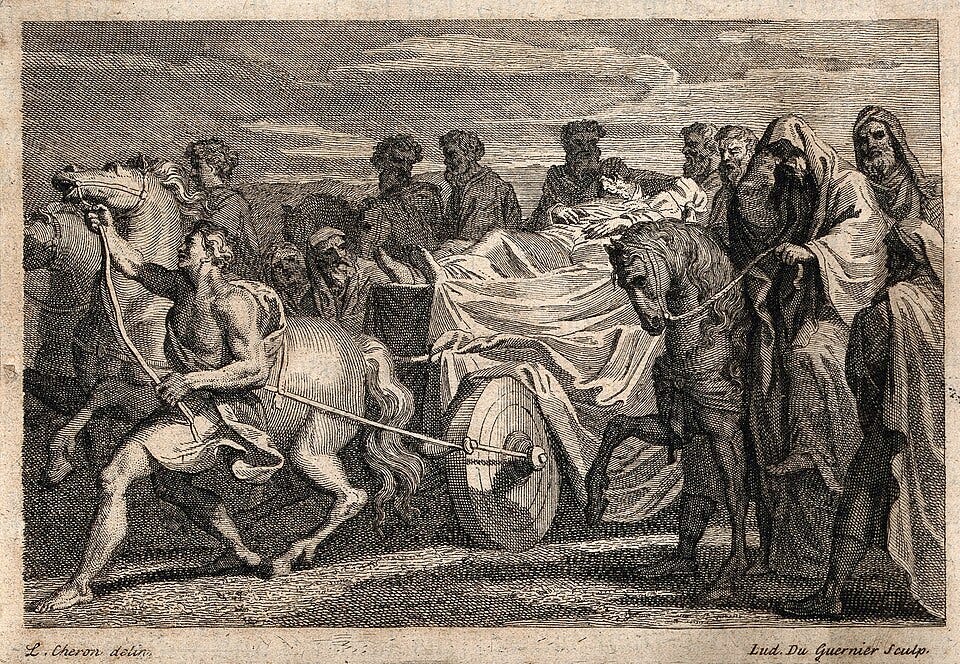
Then he charged them and said to them, “I am about to be gathered to my people; bury me with my fathers in the cave that is in the field of Ephron the Hittite, in the cave that is in the field of Machpelah, which is before Mamre, in the land of Canaan, which Abraham bought along with the field from Ephron the Hittite for a burial site. There they buried Abraham and his wife Sarah, there they buried Isaac and his wife Rebekah, and there I buried Leah—the field and the cave that is in it, purchased from the sons of Heth.” When Jacob finished charging his sons, he drew his feet into the bed and breathed his last, and was gathered to his people…. Thus his sons did for him as he had charged them; for his sons carried him to the land of Canaan and buried him in the cave of the field of Machpelah before Mamre, which Abraham had bought along with the field for a burial site from Ephron the Hittite. (Genesis 49:29–33, 50:12–13)
So all the patriarchs—Abraham, Isaac, and Jacob and their wives, Sarah, Rebekah, and Leah—are buried in the same cave: the cave at Machpelah.
In Hebrew, the word Machpelah has its origin in the word kaphal, which means “doubled over,” or “folded double.” This word pictures for me the posture of lament. I can imagine Abraham and his kin at the cave of Machpelah, doubled over in grief, unable to stand, crushed by loss.
That doubled-over position is not just one of overwhelming grief but one of humility as well. As we are forced to surrender to the Lord, we bow before him, folded forward in reverence. The pain and helplessness of loss bring us to our knees, face to face with the awesome unknowable nature of our all-powerful and eternal God—the One who lives beyond time and puts death to death. He lends us His perspective, to the extent that we can comprehend it. A faint fragrance of eternity shifts our focus heavenward. This enables us to receive the comfort of God, by His Spirit. Blessed are those who mourn, for they shall be comforted (Matt 5:4). Our mourning brings us directly into the experience of praise and thanksgiving.
Oh come, let us worship and bow down; let us kneel before the Lord, our Maker! For He is our God, and we are the people of His pasture, and the sheep of His hand. (Ps 95:6–7)
Chanukah commemorates God’s victory over forces who sought to wipe out the Jews in 165 BC. It is the victory of God’s plan to bring a Savior into the world through the Jewish people, those chosen by Him to bless the whole world according to His promise to the patriarchs buried at Machpelah. Nothing can undermine His plans. Chanukah is the victory of God’s steadfast faithfulness to preserve the Jewish people.
The irony of the Bondi Beach Chanukah attack is lost on those who celebrate the attack—that God will never allow the Jews to disappear from the face of the earth (or “from the river to the sea”), and if ever there was proof of that fact, it is found in the events we commemorate at Chanukah. In other words, the God of Chanukah is the same God who has made possible our annual honoring of Chanukah despite all odds since 165 BC.
Thus says the Lord, who gives the sun for light by day and the fixed order of the moon and the stars for light by night, who stirs up the sea so that its waves roar—the Lord of hosts is His name: “If this fixed order departs from before Me, declares the Lord, then shall the offspring of Israel cease from being a nation before Me forever.” (Jer 31:35–36)
As we light our candles this Chanukah, we have many postures. We are doubled over in a posture of lament at the most recent murders in Sydney and not so long ago at the Nova festival in Israel. We fold forward in fear of and reverence for our God, whose loving presence comforts us and gives us a heavenly perspective.
The cave of Machpelah may have been a resting place for the bodies of the patriarchs, but it is as empty now as another expensive tomb from which the risen Messiah emerged. That is because God is God of the living, not of the dead. Jesus tells us: “Have you not read what was said to you by God: ‘I am the God of Abraham, and the God of Isaac, and the God of Jacob’? He is not God of the dead, but of the living” (Matt 22:31–32). Jesus’s empty tomb is the precious fruit of Chanukah. God preserved His people so all people could have life in Jesus. And His project will not be complete until Israel sees their Messiah. Yes, Israel lives, and one day, all Israel will be saved.
Now, we stand before a different tomb. Having doubled over and folded forward at Machpelah, God is taking our hands and urging us to stand, just as that special “man” helped the prophet Daniel to stand when he was too weak to do so on his own. The One who is “risen” from out of His tomb bids us to rise with Him. We rise and stand assured that “in Him was life, and the life was the light of men. The light shines in the darkness, and the darkness has not overcome it” (John 1:4–5).
Comments
Nothing yet. Say the first thing.
Sign in to join the conversation.