
Welcome to the latest edition of Branching Out, where works recently featured in Shades of Blue become your launching point for discovering more melancholy music that cultivates calm, connection, and healing. (If you’re a new subscriber — Welcome! 👋🏼 — head over here to explore previous installments.)
To grow our tree of classical music knowledge this month, we’ll explore works inspired by the moving hymn to divine love that closes Gustav Mahler’s Third Symphony, and the searing aria of grief and loss at the heart of Claudio Monteverdi’s opera L’Orfeo.
So let’s dig in and branch out …

If you were captivated by the way Mahler conjures the creation of our natural world — from the flowers in the meadows to the divine love that animates the universe — then listen to ...
When Darius Milhaud first encountered the sounds of American jazz, courtesy of a 1920 performance by Billy Arnold’s Novelty Jazz Band, he became obsessed with this musical export from across the Atlantic. The driving syncopations, the intimate interweaving of the band’s six voices, and the music’s breathtaking sense of freedom captured the French composer’s attention and refused to let go.
“Against the beat of the drums,” he later recalled, “the melodic lines criss-crossed in a breathless pattern of broken and twisted rhythms. … Such freedom creates the impression of an almost chaotic improvisation, whereas it was something remarkably precise.”
Hungry to hear more, Milhaud booked passage to New York, and in 1922 he toured Harlem’s network of jazz clubs and ballrooms to better understand the magic behind this mysterious music. By the time he returned to Paris — where audiences had caught the contagious fever of Le jazz hot — Milhaud was committed to merging the worlds of classical music and jazz in a new ballet inspired by African creation myths.
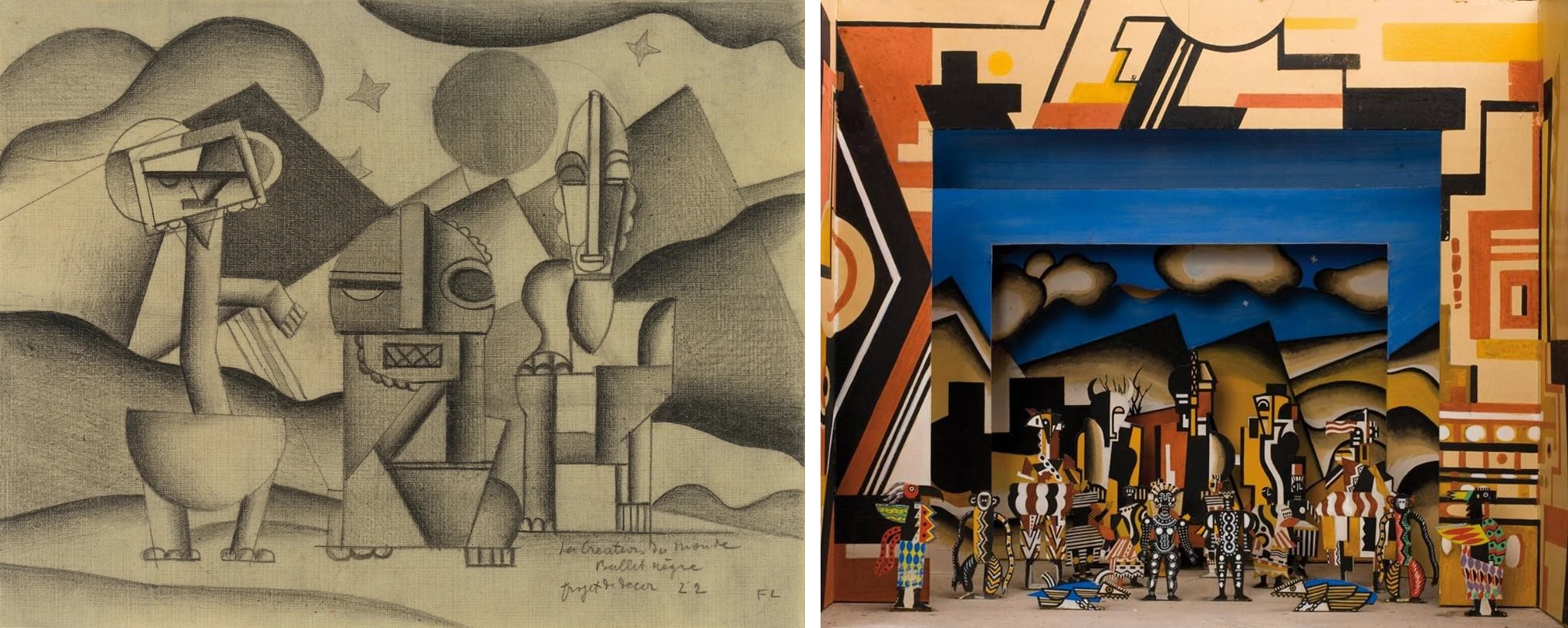
Premiered at Paris’s Théâtre des Champs-Élysées in a production featuring costumes and set designs by the Cubist artist Fernand Léger, La création du monde traces the evolution of life on earth, from a swirling cauldron of chaos to the conjuring of nature in all its spectacular diversity.
Front and center in Milhaud’s chamber orchestra is the melancholy wail of a solo alto saxophone, its blues-inflected song dominating the opening scene of cosmic desolation amid churning strings and seismic eruptions in the low brass. An angular melody rife with wild syncopations then emerges in the double bass, driving the orchestra to ecstatic heights as a trio of gods takes the stage to breathe life into the first birds and bees, trees and rivers.
With the creation of Man and Woman, the music turns to dances of seduction, led by the playful musings of a solo clarinet before the saxophone brings its opening aria back into the fold, now an expression of tenderness accompanying the pair’s first kiss. And as flutter-tongued flutes bring Milhaud’s ballet to a quiet close, we’re reminded that the ultimate act of creation is love.
Text within this block will maintain its original spacing when published
Cincinnati Symphony Orchestra
Louis Langrée, conductor
~~
If you were moved by Orpheus’s song of sorrow over the death of his beloved Eurydice, then spend some time with ...
Giacomo Puccini’s one-act opera from 1918 follows a day in the life of Sister Angelica, a nun in late 17th-century Italy trapped in a labyrinth of loss, faith, and doubt. Angelica hasn’t taken her place among the sisters out of profound religious devotion. Rather, her aristocratic family forced her into a life of Catholic service after giving birth to a son out of wedlock. Isolated from the world in the convent’s cloistered gardens, Angelica remains tormented by her family’s rejection, and unshakeable questions about the child she delivered seven years ago.
Angelica’s aunt appears at the convent that afternoon — not out of any loving concern for her niece, but to force her to sign away her stake in the family fortune to a younger sister who is about to be wed. Angelica signs the paperwork, but in turn demands to know what has become of her son. The aunt icily informs her that the child died of illness two years prior, and leaves the convent forever.
Alone with her grief, Angelica sings “Senza mamma,” an aria in which love and despair are intensely and inextricably woven. Her opening melody unfolds in sloping lines of sorrow, mirroring the shallow breaths taken between bouts of tears:
Text within this block will maintain its original spacing when published
Without a mother, oh child, you died!
Without my kisses, your lips are faded and so cold!
…
You’re unable to caress me,
you folded your little hands in a cross!
And you’re dead, without knowing
how much your mother loved you!
Comfort momentarily arrives as Angelica fields visions of her child among the angels, with blossoming strings and swirling chords of celestial radiance in the harp evoking the music of heaven. But an insistent and unsteady pulse, like the drumbeat of a broken heart, returns Angelica to her earthly reality. Desperate for reunion, she calls out to her child:
Text within this block will maintain its original spacing when published
When shall I kiss you?
When will I ascend with you to heaven?
Tell your mother, tender creature,
with a gentle sparkle of a star.
Speak to me, speak to me,
my love, my love, my love!
With the final word of her fervent prayer — love — Angelica reaches for the heavens, her voice seemingly suspended in infinity, as if time itself is standing still in devout reverence.
Text within this block will maintain its original spacing when published
Leontyne Price, soprano
Bavarian Radio Symphony Orchestra
Carlo Franci, conductor
(Follow along with the Italian text and English translation.)

I’d love to hear about your experiences listening to these works. Let me know — either by replying to this email or leaving a comment.
And if you enjoyed your time here today, why not share it with someone who would benefit from experiencing this music? 💙
Each edition of this newsletter reflects 20+ hours of research, writing, editing, and production. Shades of Blue is a 100% reader-supported endeavor — no ads, no algorithms, just one human inviting you to explore a deeper relationship with music.
If you look forward to reading my work when it hits your inbox, please consider a paid subscription …
Or making a donation to keep Shades of Blue running.
Comments
Nothing yet. Say the first thing.
Sign in to join the conversation.