
The Gallup polling organization released annual statistics of self-identified party identification among adults, showing a rather substantial shift towards the Democrats.
The most meaningful data for voting intentions is to combine self-identified partisans with respondents who identify as independents and on a follow-up question are asked if they “lean” towards one of the parties. These leaners tend to behave as partisans in their voting choices.
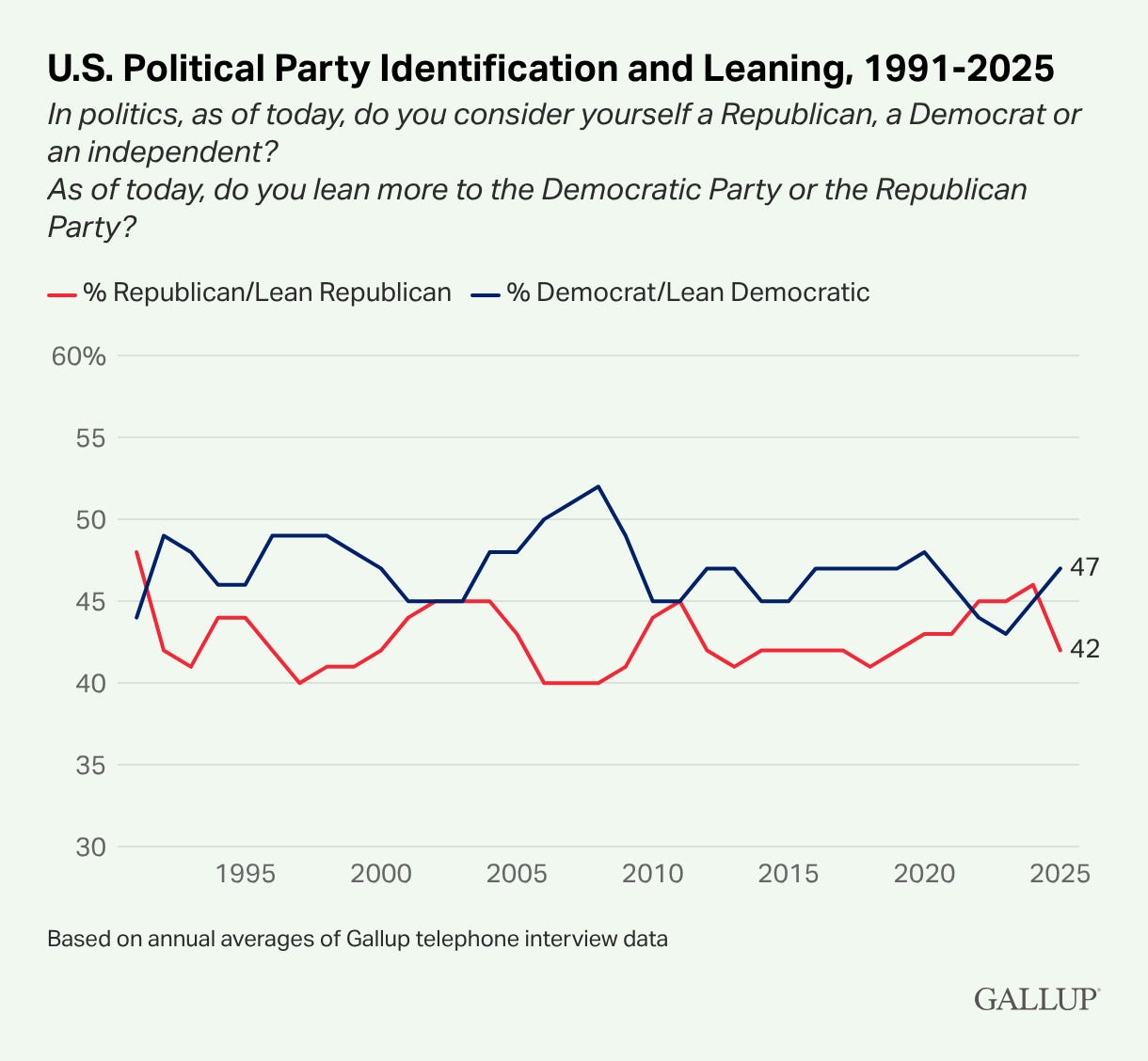
A virtue of these statistics is the large sample size. Gallup compiles surveys conducted throughout the year, with a total of approximately 13,000 respondents. The statistical random sampling error is thus smaller than typical polls with a about a +/- 0.9% margin of error.
A drawback is that these data reflect surveys conducted throughout the year, and thus do not capture trends weekly or monthly trends.
Comments
Nothing yet. Say the first thing.
Sign in to join the conversation.