

This morning I’m raising my coffee cup and toasting another important electoral victory for the left. This one in California, where state Sen. Aisha Wahab will serve out the rest of disgraced former Rep. Eric Swalwell's term after securing victory Thursday in a special election. Wahab defeated AIPAC-backed Melissa Hernandez despite a swell of negative ad spending by AIPAC and other outside groups. Wahab will be the first Afghan American to serve in Congress.
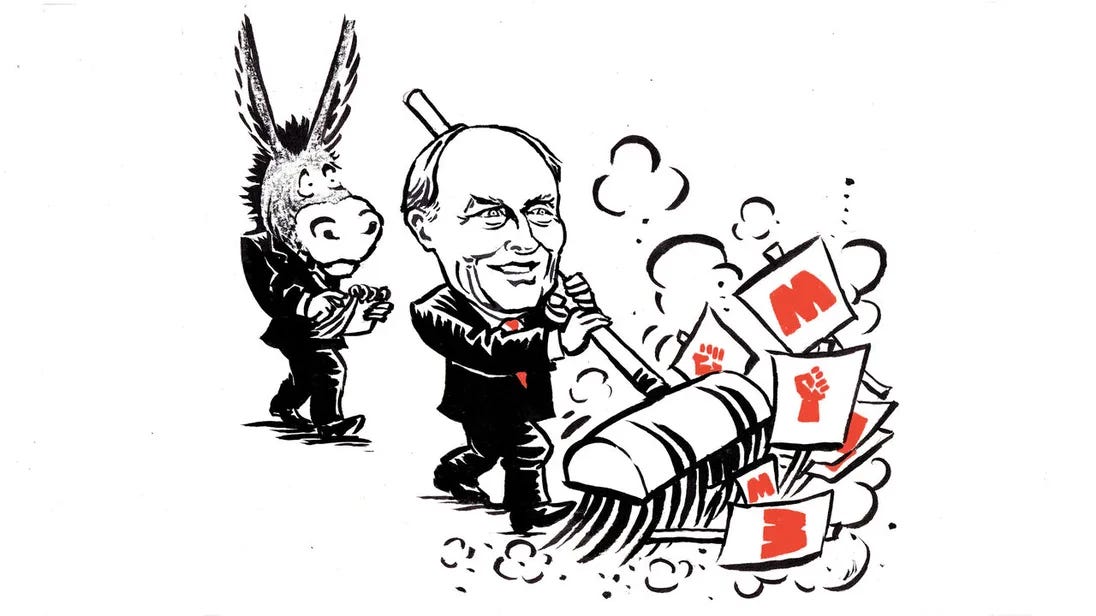
But the buzzkill came after reading this story in The Economist, the British journal which perpetuates the myth that lefty and progressive candidates can only lose in November.
When The Economist warns the British Labor Party about the radical left making a party unelectable, it’s hard not to hear the echo of our own leadership’s favorite cautionary tale. The magazine’s diagnosis of Labor—blaming its collapse on Jeremy Corbyn’s supposed ultra-leftism—mirrors a familiar American script in which progressives and socialists are cast as electoral poison, even as the party’s centrist establishment presides over working‑class defection, foreign‑policy hawkishness, and donor‑driven drift.
Why is The Economist suddenly sounding the alarm?
Because the story the magazine has been telling for years — that Keir Starmer “saved” Labor from the ultra‑left and permanently buried Corbynism — is being contradicted by very recent electoral reality. Not 2019. Not the 2024 general election. But the post‑landslide period, where Labor was supposed to be politically invincible and the left supposedly irrelevant.
Instead, the opposite happened.
Across 2025–26, left‑wing and anti‑war candidates have been beating Labor, humiliating Labor, or peeling off chunks of Labor’s core vote in places Starmer assumed were locked down. Independents running on Gaza, anti‑war, and anti‑austerity platforms have taken council seats in the boroughs of Birmingham, Bradford, Leicester, Manchester, Sheffield, and London. Greens have doubled their vote share in key urban wards. Progressive candidates have begun winning internal seats again. And Labor’s support among working‑class Muslim voters, once one of its most reliable blocs, has fractured dramatically.
Sound familiar?
In other words: the left is not dead. It’s re‑emerging in new forms, in new constituencies, and with new energy.
That’s the real reason The Economist is suddenly so gloomy. Not because the left is weak, but because the left is performing better than the centrist narrative allows — and because these gains expose the fragility of Starmer’s coalition and the limits of his rightward turn.
The Economist’s warning is straightforward: If Democrats in the U.S. allow their left wing to dominate the party’s messaging, they will repeat Labor’s 2019 collapse.
This comparison with Britain and Corbyn left me cold. For one thing, the U.S. left has never run the Democratic Party the way Corbyn ran Labor. The recent history of Democratic congressional defeats and the loss of the White House can only be pinned on the party leadership. The working‑class defection from the party actually began back during the Clinton era; during NAFTA and deindustrialization; during welfare retrenchment; during tough-on-crime politics; and during support for the Iraq and Afghanistan Wars. None of that was left-wing.
The economic agenda of socialist and progressive candidates polls better with working-class voters than the corporate Dems’ alternatives. Working-class voters (across race) consistently support unionization, taxing the wealthy, gay rights, abortion rights, and public health care. Left positions all. The same can be said for foreign policy, where voters oppose the Democratic leadership’s support for U.S. shipping arms and billions of dollars to Israel for its doctrine of perpetual war. The polling is clear: working‑class Americans are not the culturally conservative bloc pundits imagine.
Donald Trump is still the most hated man in the U.S. (the world?). His approval numbers have taken their deepest dive so far. But the Democratic Party’s current leadership’s approval numbers aren’t much better.
The current numbers (August 2026): Democratic Party favorability: 44% favorable / 52% unfavorable. Net: –8
Donald Trump favorability: 43% favorable / 55% unfavorable. Net: –12
That’s not the fault of the left either.
The Economist gets the story wrong because it begins with a faulty premise. Jeremy Corbyn was never an “ultra‑leftist.” He was a traditional Laborite in the lineage of Attlee and Benn — a social democrat who believed in public ownership of essential services, strong unions, and an anti‑war foreign policy. Branding him as an extremist was a factional maneuver, not an ideological assessment, and it mirrors the way Democratic leadership in the U.S. has spent years targeting its own progressive wing.
The deeper misreading is the claim that the left is responsible for the Democratic Party’s fall from grace. The working‑class defection, the foreign‑policy hawkishness, the donor‑class drift all happened under centrist stewardship. And the evidence simply doesn’t support the idea that socialists and progressives “can’t win.” The past few months of primaries have shown the opposite: left candidates can win, do win, and often outperform expectations in districts the establishment writes off as unwinnable. There is no empirical basis for the narrative that progressive nominees doom the party in November.
What is clear is that they cannot do worse than Democrats have done in recent years under the leadership of Schumer and Pelosi — a period marked by stagnation, strategic timidity, and a steady erosion of working‑class trust.
This is not to say the path to victory for leftists is assured or will be easy. Big money from AIPAC and corporate donors will be flooding the zone, and internal sectarian divisions could kill momentum before it matures. But none of that is a given. The Economist’s framing assumes the left is inherently self‑defeating. The evidence suggests the opposite. The real danger to Democrats isn’t an “ultra‑left” that exists only on the fringes. It’s a centrist establishment that fears the left more than it fears Trump, and keeps mistaking internal dissent for extremism.
Comments
Nothing yet. Say the first thing.
Sign in to join the conversation.