
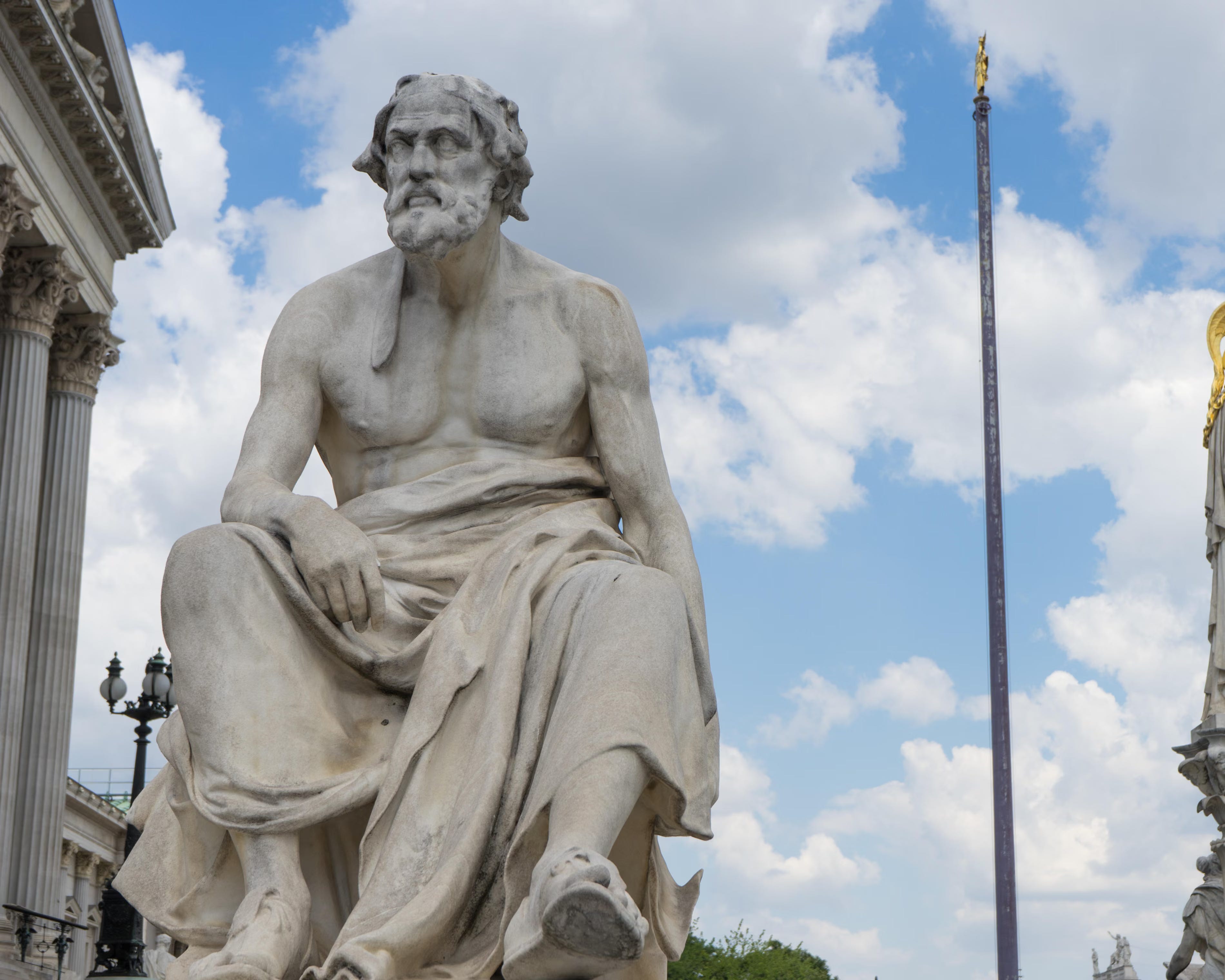
(Statue of Thucydides in front of the Austrian Parliament in Vienna)
According to a recent Chinese report, the sound that Xi Jing Ping and the Chinese leaders hear when they listen to America is “the heavy and haunting toll of an empire’s evening bell.” [1]
What does it mean for the stability of the world when a rising power hears only a melancholy echo of fading power from its once dominant rival? Will this encourage Xi Jing Ping to make a play for global dominance now, or will he bide his time and wait patiently for his rival to collapse?
What happens if America comes to believe its power is ebbing away? Does it make peace with its rival and accept genteel decline, or does it strike before it becomes too weak to avert its own fall?
These are questions as old as the Greek historian, Thucydides’ analysis of why the Peloponnesian Wars broke out in 431 BC. That was when, according to Thucydides, Sparta, a declining power decided to strike first to defeat Athens, a rising power. Xi Jing Ping has read his Thucydides, or at least the ‘Thucydides Trap’, Professor Graham Allison’s analysis of what the Greek historian’s message means for China and the United States. During President Trump’s visit to Beijing, Xi Jing Ping called on the President to work together to avoid the trap. Was this his way of warning the President that the only way to avoid the Thucydides trap is to let Beijing have its way on Taiwan?
President Trump seems to have come away reflecting on what Xi Jing Ping told him. On the plane home, Trump said he was now thinking twice about sending arms to Taiwan.
Is Xi Jing Ping going to risk taking Taiwan? Chinese sources claim that Xi Jing Ping has been re-reading an old text, from revolutionary days, written by Mao Tse Tung, in which that most ruthless of leaders actually counselled patience in the long march to power. But patience for how long? How long before China’s own internal problems—falling birth-rates, sluggish growth, enduring rural poverty—catch up with it and make it impossible to overtake its rival?
This language of the rise and fall of empires makes predictions, and these predictions—of who is rising, who is falling—can lure leaders into overestimating the strength of their opponents, while underestimating their own, or the reverse. In either case, the wrong prediction could lead one or the other to set the whole world alight.
In history, the mental images that strategic rivals have of each other help determine whether they take the dreadful risk of war. In the runup to the Second War, Hitler believed Western democracies were weak and feeble, and Soviet Communists were no better than sub-human barbarians. Carried away by these metaphors, Hitler led his country to disaster.
So where do today’s behemoths stand in their base case evaluation of the other? We know far more about the American side of the coin, because almost every day a free press reports competing estimations, some predicting the Chinese have already equaled the Americans in AI, green tech, military strength and manufacturing prowess, while others insist China’s military isn’t ready for war, its economy is stuttering, its official growth statistics are false, and it has no real overseas alliances. No American consensus has emerged, and in its absence, what really drives American anxiety about China are its doubts about itself.
In China, the government’s control guarantees that only officially approved views of America become public. The experts who hear America’s ‘tolling bell’ come from the Chongyang Institute at Renmin University and they wouldn’t have gone public if their views didn’t have official support. They catalogue one needless act of American imperial self-harm after another, and ‘Thank Trump’ for these gifts since each act of self-harm benefits China. The follies include taking an axe to the US federal bureaucracy, alienating America’s European and Asian allies, stoking national division with the ICE deportation operations, enacting tariffs that drive up prices at home and most of all, loading the country with 1.4 trillion dollars in debt, all for the sake of a paltry .4 percent increase in GDP.
What appears authentically Chinese about this catalogue of folly is their disbelief that an American President would take an axe to his own mandarins in the US government, and that the leader of a great people would be so indifferent to stirring division at home. The Chinese scholars believe they are looking at an empire tearing itself apart:
“This deep social division is a civilizational wound that no economic data can conceal; lacking a shared moral foundation, the decline of American hegemony has internalized from a geopolitical perspective into the disintegration of its social structure.”
Looking ahead to the battle to succeed Trump in 2028 and beyond, the Chinese predict “the succession struggle and the risk of normalized political violence in the post-Trump era will push the United States into a turbulent quagmire of “Third Worldization.”
The issue is not whether this Chinese image of imminent American decline and fall is true or not. What matters is how this might influence Chinese behavior. A Chinese leadership that came to believe that they face a self-harming adversary in decline might well decide that taking Taiwan by blockade or invasion would be well worth the risk. They might calculate that an American Administration that has already declared that the defense of a democratic Ukraine is none of its business could be counted on to conclude that defense of a democratic Taiwan isn’t either.
If such a scenario were to unfold, America would abandon the defense of democracy, first in Ukraine, then in Taiwan, and thus make the deal with the devil that gives the rest of us peace in our time. But if it were peace, it would hardly deserve the name. A combat hardened Russia would be massed on the borders of Europe, and a China that had absorbed Taiwan would be massed on the frontiers of Japan and South Korea. Such freedom as we and our Asian friends would then enjoy would depend on us alone.
In the Chinese reading of Thucydides’, the world avoids the trap of inevitable warfare between rising and declining powers if the declining power accedes to the demands of the rising power. If America rejects this reading of Thucydides, it is committed to deter China’s desire to absorb Taiwan for the indefinite future and to arm Taiwan so that it becomes a porcupine, too spiky to be taken by stealth or surprise. But this indefinite commitment requires America to believe it is not Sparta, not fated to decline. It requires it to believe again that it has the capacity, the will, and the conception of its own vital interests to defend open sea-lanes and free peoples. The world’s best hope of a stable future lies in China and the United States both abandoning the Thucydides’ paradigm altogether, refusing the fatal inevitability of conflict that this paradigm predicts, and instead trying, if it is not too late, to see each other, as they actually are, with fresh eyes unblinkered by metaphor.
[1] Remnin University Chongyang Institute, “Thanks to Trump: A Chinese Think Tank Assessment of Trump 2.0’s Policies in his First Year in Office”, January 20,2026, http://rdcy.ruc.edu.cn/zw/jszy/rdcy/grzl_rdcy/070fa2e9135e47f19c7c23ad88949765.htm
See also Lia Yuan “Chinese Increasing View Trump’s America as an Empire in Decline”, New York Times, May 12, 2026
No posts
Comments
Nothing yet. Say the first thing.
Sign in to join the conversation.