
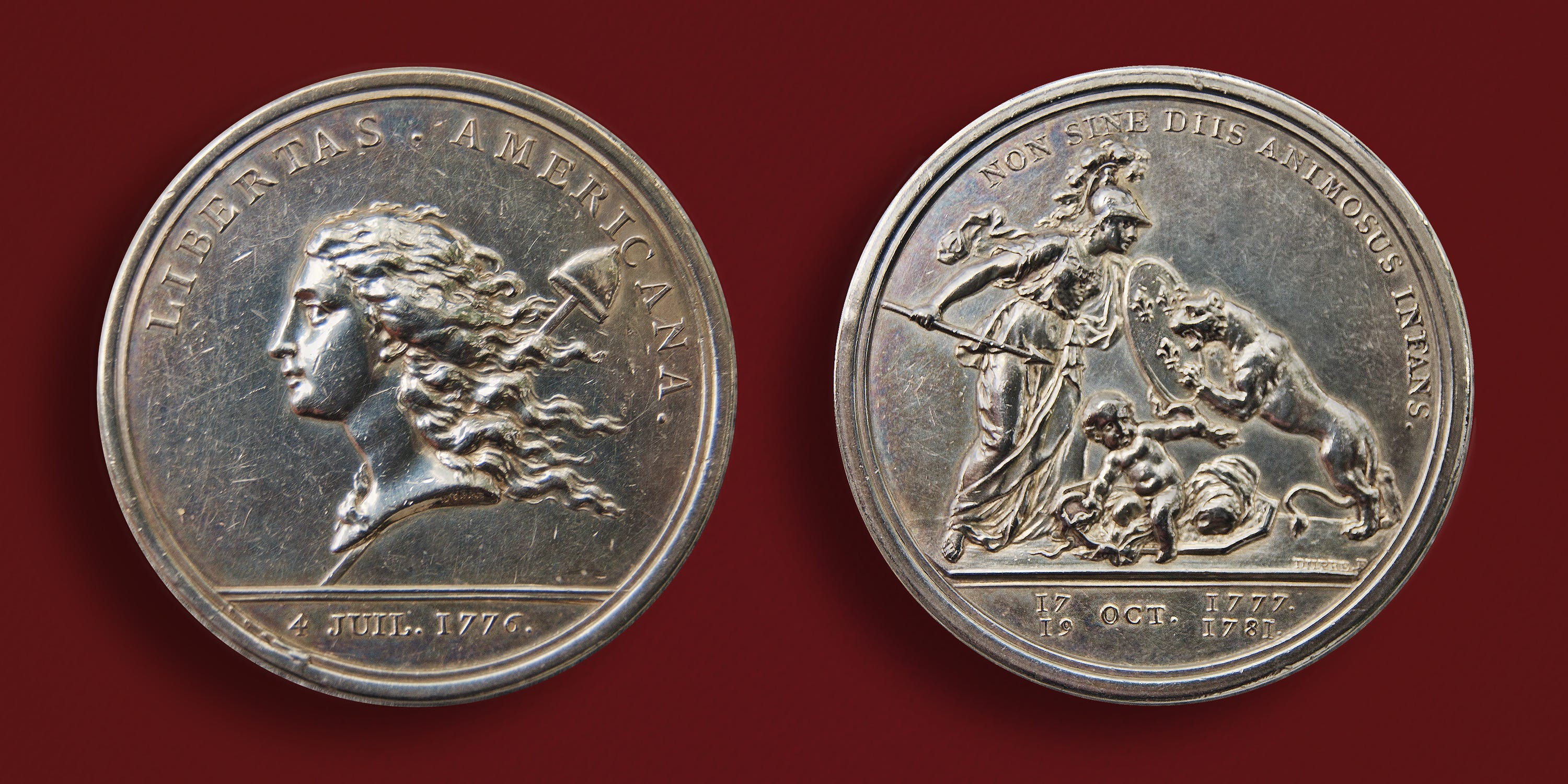
(Silver medallion commissioned by Benjamin Franklin while resident in Paris in 1783, depicting American Liberty and commemorating the Declaration of Independence.)
As America marks the two hundred and fiftieth anniversary of its democratic experiment, its remaining friends overseas—someone like me, for example—wonder what to make of the moment. The shared euphoria of the bicentennial celebration that I remember in 1976 is gone. If an outsider like me were to attend a Fourth of July party today, I’m sure I’d be welcomed with the usual American friendliness, but I suspect that the barbecues, block parties and fireworks displays will stay civil only if everyone agrees not to talk politics. American divisions and disagreements have widened into a dangerous silence. A diminishing third of the people, according to opinion polls, believe that the President can still make their country great again, while a majority, slowly increasing in size, believe he has accelerated their country’s decline. The pessimists worry, to paraphrase a famous remark by Benjamin Franklin, whether they can keep their republic at all.
Franklin was echoing the ancient Greek and Roman historians, who had taught the founders to fear that republics were fated to decline. Two hundred and fifty years later, the signs of decline in Washington are on shameless display: lawless exercises of executive power, gratuitous cruelty towards the defenseless, brazen erection of self-glorifying monuments, systematic corruption at the very top and open disdain for what America’s erstwhile allies think of the whole indecent spectacle.
The America I used to love once cared deeply about what the rest of the world thought. The Declaration of Independence proclaimed that the new American republic owed “a decent respect to the opinions of mankind.” Over the centuries, American respect for the opinions of friends became the essence of what the political scientist, Joseph Nye, my former dean at the Kennedy School once called American ‘soft power’. Two hundred and fifty years later, what decent respect remains, on either side? No President in anyone’s memory has done more damage to America’s power of persuasion and good example than the current incumbent.
America’s friends abroad have been shocked to see their friendships turned into a pretext for extortion. An innocuous and friendly ally, like Canada, discovers its dependence on the American market has been turned into a weapon. Canadians thought they mattered and have had to learn, in the President’s words, ‘we need nothing from you.’ Ukraine fights for its life only to learn that America’s leadership doesn’t seem to care whether its democracy survives. They hold no cards. Ukraine’s dependance on American weapons gives the President the leverage to insist on payment in full, backed up by the threat of cutting off intelligence support if they don’t. Europe, believing itself to be a regulatory superpower, is told that trying to regulate AI exposes it to the threat of 100 percent tariffs. The alliances which once gave America the power to encircle its real adversaries—China and Russia—turn into protection rackets. Once this happens, spurned friends quickly learn to fend for themselves. Former allies disengage, hedge against a predatory America and combine together to resist its power. When the US administration bans the use of AI models to non-Americans, the non-Americans buy cheaper models from China that they adapt to their own uses. When the Americans turn their back on clean energy and seek to leverage European dependency on American oil and gas, Europeans simply buy more Chinese produced solar panels and speed up their green energy conversion. America is having to re-learn the oldest lesson in the physics of power: for every action, there is an equal and opposite reaction.
America is also having to reckon with their own false confidence in their military might. They’ve learned that the weak can prevail against the strong by being early adopters of technologies that the strong foolishly ignore. The Ukrainians were first to understand the devastating capabilities of drones, and they used them to humble a vastly superior Russian army. The Iranians used the same weapons to strike at America’s Gulf State allies and force the superpower to accept a humiliating cease-fire. A radically destabilizing revolution in military affairs is hardly the moment for America to celebrate the unassailable superiority of its military strength.
If all this is true, it becomes especially tempting for discarded friends to start believing that a once great country is now locked into irreversible decline. The ancient narrative of republics falling prey to hubris and corruption has haunted the historical imagination for millennia, but America’s former friends should beware of its seductive allure. For the America we once loved is still there. The America whose democracy displays so many of the pathologies the ancients took as portents of decline is also the America whose federal judges have been striking down the most lawless of the administration’s reckless gambits. The America whose digital public space is ‘enshittified’ with AI slop, is also a nation with a free media relentless in its uncovering of the Administration’s incompetence and skullduggery. The America that worries whether the Madisonian machinery of checks and balances can survive is also the country with lawyers and civil society activists determined to use every legal avenue to ensure the mid-term elections in November remain free and fair. The institutions of America are being degraded from the top but courageously defended from the bottom.
Besides neglecting the resilient republican virtue of ordinary Americans, narratives of American decline also neglect the ruthless dynamism of the American economy. Canadians living next door have as much to fear from the American standard of living outpacing their own and draining their young people southward, as they have reason to fear American authoritarianism. Europeans who’ve long decried the savage inequalities of American capitalism the better to congratulate themselves on the tender mercies of European social democracy, now fear that they will be left in the dust by a resurgent American capitalism with a chokehold on the technologies of tomorrow.
American and European liberals once made common cause believing that the very purpose of a liberal state was to prevent capitalism from destroying democracy. Now we must ask whether it is American capitalism’s rude health that might just save its democracy. A country whose per capita wealth is growing, however unequally, may stand a better chance of mastering its democratic discontents than economies like France, Britain, or Canada where growth is stalled and structural budget deficits make it ever harder to meet public expectations.
The rude health of the American economy, at least its high growth, high tech sector gives American democratic institutions the resources to heal the nation’s divisions. Whether it uses these resources now to bind up the wounds of inequality depends on whether these institutions can control the political power of the new plutocrats. The staggering impact of new technology and the wealth that flow from it has inverted the old relation between the state and the private sector. As late as the 1960’s, it was the American state, in the form of NASA, that took mankind to the moon. Now it is a single private company, Elon Musk’s Space X, that promises to take humankind to Mars. A state that depends on one man to realize its national dreams is no longer in sovereign control of its future. The question facing American democracy in its 250th year is whether its institutions can compel its trillion-dollar men to obey the law and will of its people. The scale of the new wealth may be new, but great wealth has been feared as a nemesis of public freedom since the Greek and Roman historians. The American founders’ constitutional solution to the problem of inequality was to set power against power in order to keep the people free. America’s friends are right to admire its democracy, but we call it an experiment because none of us can be sure whether, or for how long, its institutions will guarantee public freedom. The unimaginable wealth accumulating in a few hands now presents American democracy with its greatest test. America’s friends overseas should hope that it proves equal to the challenge.
No posts
Comments
Nothing yet. Say the first thing.
Sign in to join the conversation.