
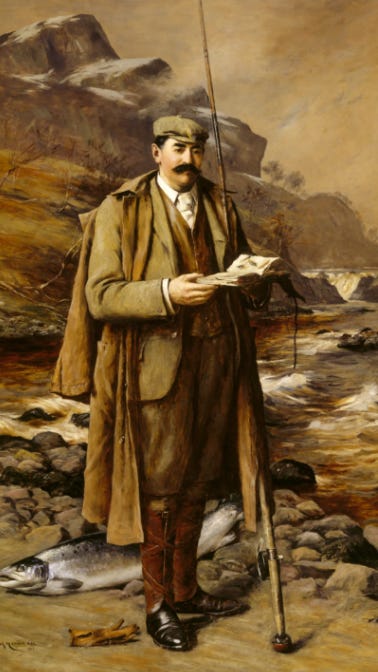
Take a look at this painting. Here you see a man of distinction.
Weighed down with layers of the finest tweed, wearing best brogues, he is a country gentleman depicted at ease in the land.
Was the salmon at his feet really that big or was the portraitist being paid handsomely to record for posterity an exaggerated angling prowess, a tall fish tale in oils?
Meanwhile, and somewhat incongruously, as the fish breathes its last our generously moustachioed figure has opened a book of British birds, representing his love for, and knowledge of, nature.
It will come in handy later to identify some of the species he will blast to kingdom come, for he was also an enthusiastic hunter striding across moors and heathland taking pot shots at unfortunate creatures who happened to be flying across the scene.
The location for the painting is the River Tummel in Perthshire, Scotland but could easily have been the man’s country pile in the heart of Dartmoor in the county of Devon, England where it now hangs.
But take a closer look. Have I imagined it or is there a trace of doubt, even melancholy, in the man’s eyes.
Is all as it seems?
You see this figure undoubtedly possesses unimaginable riches yet in the early 20th Century sometimes that wasn’t always enough.
For Julius Drewe was a parvenu. He was, whisper it, a grocer.
A hugely successful one at that but he was, nevertheless, ‘trade’.
In the ossified class system of Britain at the time (and still now?) the landed aristocracy, their wealth passed down since Norman times, came out in hives should Julius and other arrivistes start coming on with the airs and graces that were their own birthright.
Today we might laugh off the sniffiness of this bunch of weak-chinned inbreds but back then this was not an option if you wanted to get into the best clubs, enter London high society, attend the grandest balls in the hope of marrying off your offspring to a blue blood, stay in the money.
So Julius went at it with gusto, spent millions trying to buy his way in, as did many of the new industrialists and merchants emerging at the time.
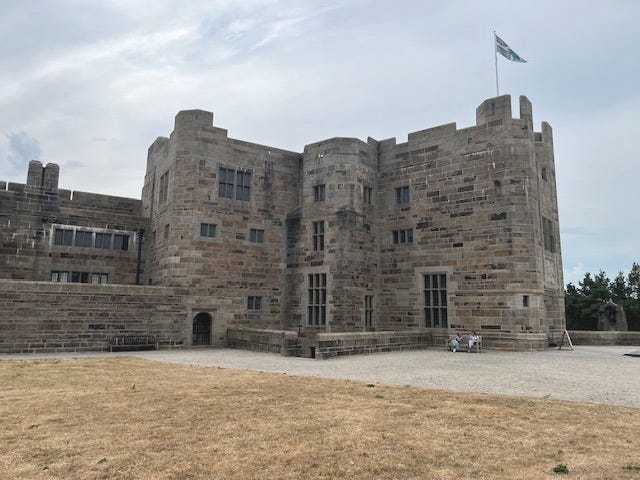
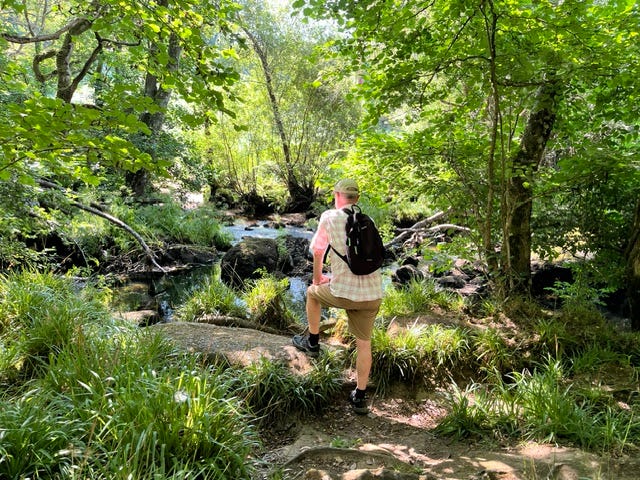
And what he left us was the last ever castle built in England, a stunning garden and the preservation of beautiful woodland weaving through a river gorge that, if you plunge into its waters, literally takes the breath away.
I visited Castle Drogo in Dartmoor last week while on holiday and was transfixed by the Julius story as much as the building by Edwin Lutyens and the gardens by the unfairly forgotten landscape architect George Dillistone.
Son of a wealthy vicar, Julius started working life as a tea merchant in India with his uncle Francis Peek (of later Peek-Frean baking fame) and made a sizable amount of money.
After setting up a tea shop in Liverpool he co-founder in 1883 Britain’s first-ever department store, Home and Colonial, on the Edgware Road, in London, which rapidly expanded to 500 outlets across the country by 1903.
In 1919, at the age of just 33, Julius sold his shares in the company for the modern equivalent of almost £200m.
From then on he was free to pursue his dreams, to be a man of leisure, travel and appreciation of the finer things.
There was just the small problem of gaining acceptance from those he wished to rub shoulders with.
Money helps find a way. Julius hired a genealogist to prove that he was actually descended from the aristocracy.
Well funded, it was no surprise that this expert did indeed posit a link between Julius and the landed gentry Drewe family of Devon, who he added, pushing his luck, were descended from the Anglo Norman family of Dro (latinised to Drogo) lords of the manor all over the county and friends of Royalty. Bingo.
Julius added the ‘e’ to his Drew surname and thought he was on his way.
He wanted to build a castle on his ‘ancestral lands’ and, through dubious means that are too complicated to go into here, bought 450 acres straddling the stunning River Teign gorge in 1910.
Now, aged 54, nothing would stop him. Befitting his new found status he chose the highest ground possible to build Castle Drogo.
Lutyens designed the granite pile both outside and in.
Don’t tell the National Trust, which now owes the place, but the castle itself appears to me a bit, well, cheesy.
I think I hear Julius turning in his lavishly appointed grave as I write that it feels the castellated equivalent of a pebble-dashed bungalow.
And before you dismiss me as an aristocratic snob I was brought up in one of the latter.
Inside though all is magnificent. Simple, cool, wide open, exuding style. It is an impressive family home (albeit one complete with 30 servants).
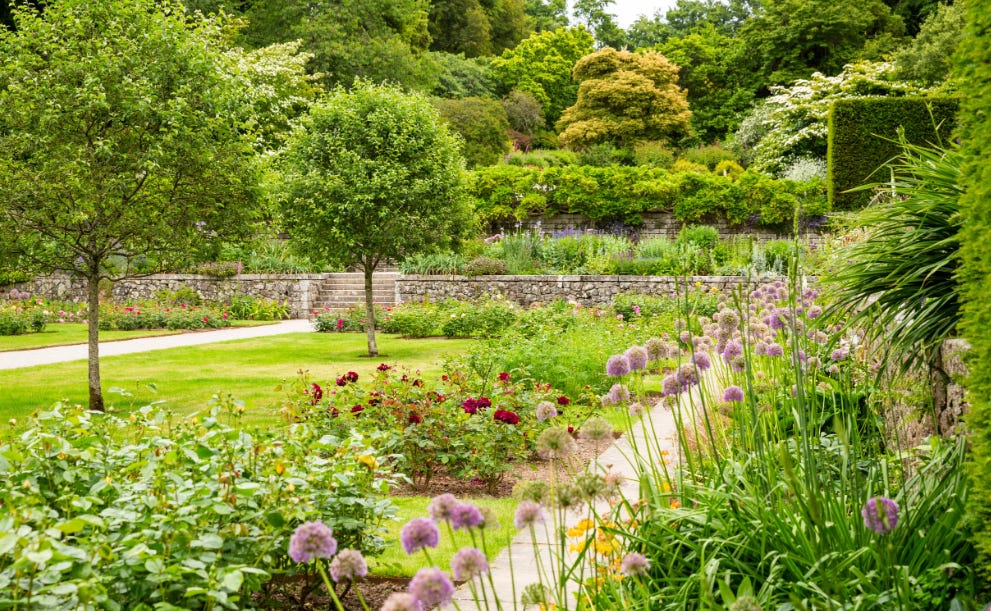
Dillistone’s garden, now beautifully looked after by the NT, is a triumph. To the left of the castle it climbs the steep slope in a series of terraces.
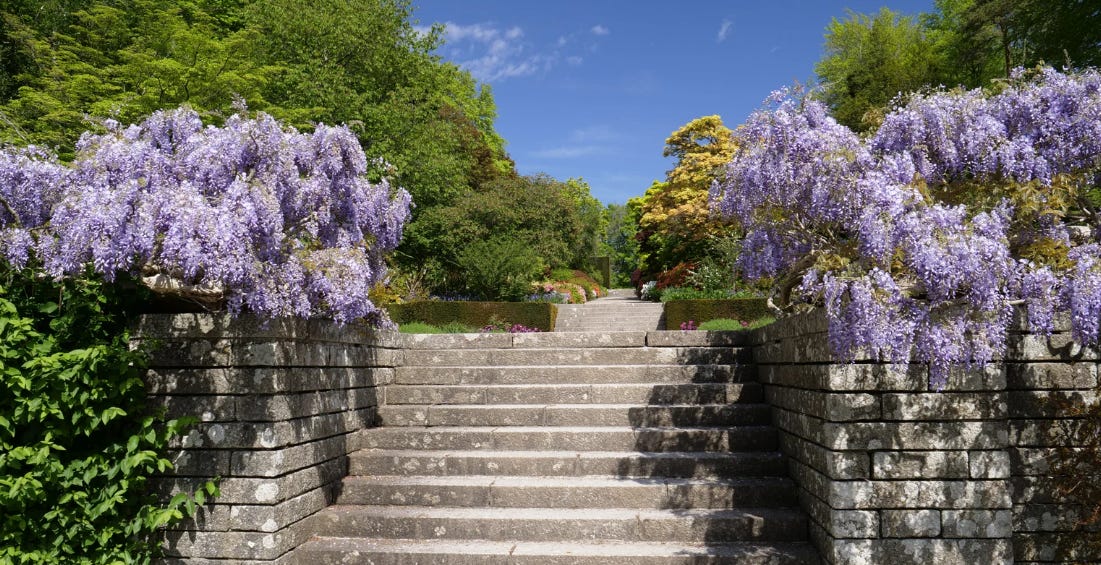
Formal rose gardens and wild rhododendron fields entice. High-hedge surrounded circular lawns are for hide and seek and other play and vine covered arbours protect from the beating sun.
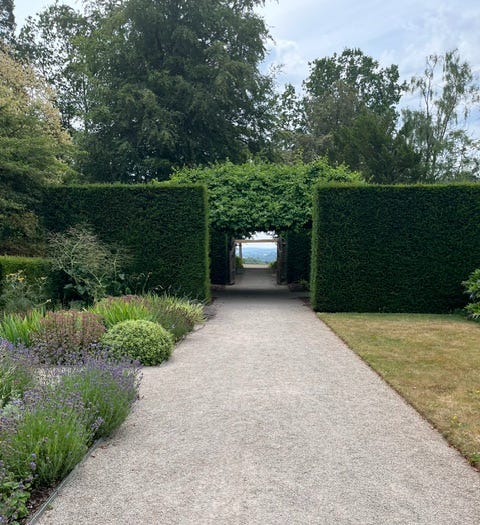
The views through arches in the yew, taking the eye from formal garden to woodland gorge in the distance, are a masterclass in horticultural perspective.
Julius did well to choose Dillistone over Lutyen’s normal garden partner Gertrude Jekyll.
And yet a project on such a grand scale was never going to be easy to complete.
The intervention of World War One, in which eldest son Adrian was killed at Ypres, and the post war economic depression meant this Devonian Xanadu was not completed until 1930.
Julius suffered a debilitating stroke in 1925 just before he and his family moved in.
A year after Drogo was finally finished he died at the age of 75.
He had plenty of time in between, as the Dartmoor-driven rain leaked from flat roofs and even through thick granite walls, to ponder whether his ascension project had really been worth it.
Apart from the Drewe family, Sir Edwin, Dillistone, servants and a steady procession of workmen no aristocratic visitors came, no laughter from balls was heard nor admiring approvals from gentry in the rose garden.
Castle Drogo endures as a magnificent symbol of a forlorn desire to earn respectability from a dying breed, the aristocracy, who were never going to bestow it.
From this place high on the moor Julius had one of the most dramatic vistas to gaze out on in England.
What he couldn’t see was the folly of his creation.
Comments
Nothing yet. Say the first thing.
Sign in to join the conversation.