
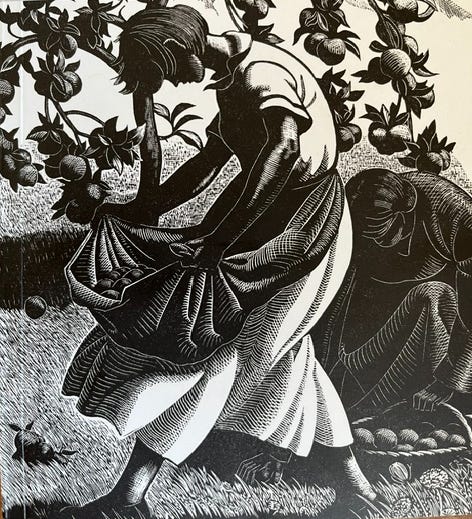
Ours is an ordinary garden. It is perched on a slope of the Chiltern Hills, exposed to every wind that blows. Its soil is chalk; its flower beds are pale grey. Dig into it just one spit, and you reach, as it were, a solid cement foundation. One might be hacking at the white cliffs of Dover.
For a decade the garden described above, unprotected from sweeping winds and creeping frosts, was a haven, a paradise for two lovers.
The couple stumbled across the meadowland on a walk on a ‘shining day in May’ and were entranced immediately by its wild, untamed sloping contours.
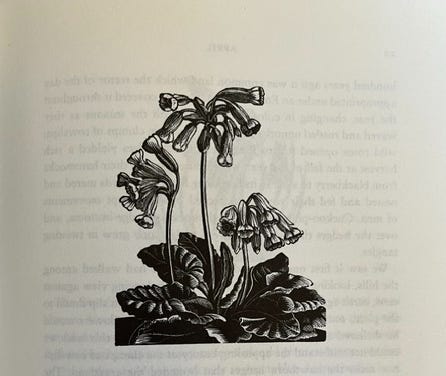
Proving these were people of unconventional thought and tastes, it was the profusion of clumps of Cowslip and border hedges of prickly hawthorn that first entranced them.
Larks soared and field mice busied themselves unbothered.
This was the place that would be their sanctuary, a removal of themselves.
He, briefly, from a front seat at the tumultuous political events of the day, she to draw further inspiration for her astonishing art.
And both to avoid, temporarily, a truth that would eventually consume them.
The land was quickly purchased and a cottage and studio constructed.
But it was the creation of a garden that would take all their energies, bring them joy and occasionally frustration.
A horticultural menage a trois, artist, writer and nature, was to be consummated.
A lawn, flower beds, a kitchen garden and small orchard would have to be created but the wildness, the former meadowland, at the edges, a reminder of first love, would remain.
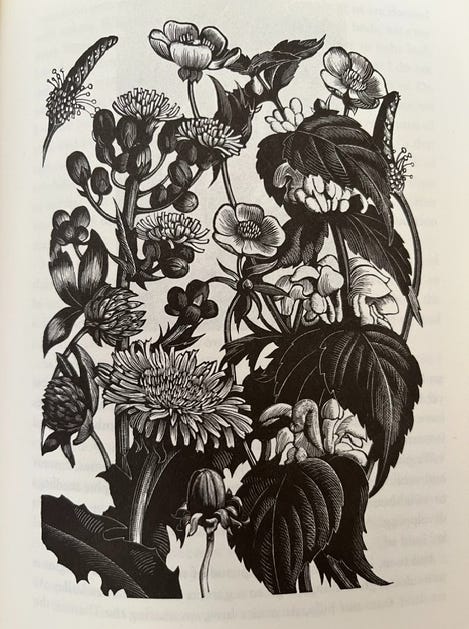
Wildflowers and plants, sorrel, ragwort, coltsfoot and bellflower among them, would have their place too.
A crude pencil drawing was the basis for the half acre formal garden plan from which the couple’s vision would be brought to life. Bliss on a page.
In 1935 Clare Leighton’s Four Hedges: A Gardener’s Chronicle was published. Starting in April it is a diary set over 12 months telling the story of this garden creation.
She is three or four years into a nine-year project, the land purchased around 1930.
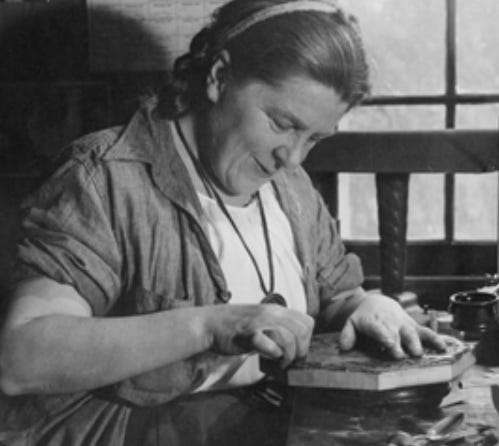
Leighton, an artist, writer and illustrator, was the foremost wood engraver of her day, leading the revival of an ancient craft.
Her work is breathtaking, bursting with black and white life, the hard manual labour required for creation metamorphosing into a delicate beauty.
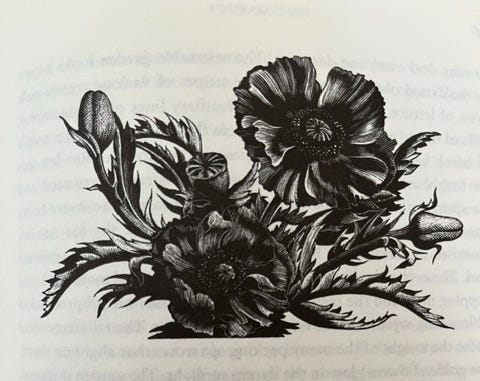
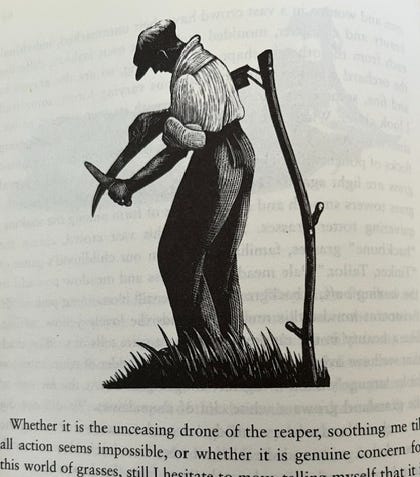
Many examples of this art illustrate the book, simple but soulful depictions of the flowers, vegetables and people she encounters on the journey.
The engravings don’t simply illustrate the text, they dramatically improve the story.
Four Hedges was Leighton’s home until 1939. She shared it with her lover, the left wing writer and journalist Noel Brailsford.
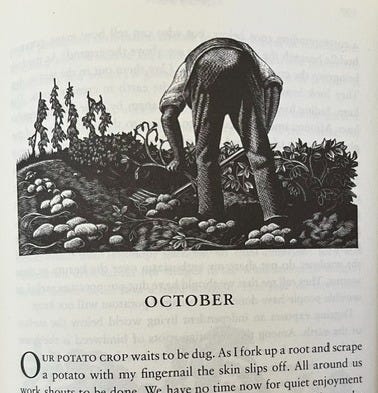
A radical metropolitan elite couple they took to rural life with gusto
Brailsford, a staunch supporter of the suffragette cause and leading socialist intellectual, was quite the converted gardener, tackling Four Hedges with ferocious intensity and, as Leighton writes, often turning up at posh dinner parties in his garden jacket, pockets still full of pruned foliage.
Yet the couple are pretty far down on the Four Hedges bill. Like a 20th Century Gilbert White, Leighton keeps her focus on the emerging garden and the flora and fauna within.
‘Noel’s’ horticultural enthusiasm gets the occasional mention and there’s Leighton’s unbridled joy at the appearance of a new flower, say iris stylosa surprising her in late winter.
Plenty of Cider With Rosie-style locals pop up - gardeners, housekeepers - burring common sense advice to the blow-ins.
They fight a losing battle against local know-it-all Darville’s obsession with populating the couple’s cold frame with cucumbers.
House maid Mary’s reminiscences about how rural folk used to celebrate May Day is a poignant reminder of a fast fading link to the land.
Leighton is at her best when her artist sensitivity comes to the fore.
She hates using gardening gloves, preferring to feel the plants, flowers and produce she is nurturing through her finger tips
Colour is not all, she writes, look at the shapes, the way shade adds texture and depth to the garden picture. Just like her exquisite engravings.
And oh simple pleasure of mowing the lawn, hours spent pushing the little mechanical machine hither and yon.
Feet should be bare; grass should be slightly damp. The cold, moist clover strikes up from the mower upon my bare feet, and blades of cut grass and bits of slashed weeds stick between my toes
Gardening at Four Hedges becomes an obsession.
The couple sneak into nearby woodland to steal top soil for their chalk.
As all of us, they suffer horticultural inferiority on espying the fecundity of a neighbour’s plot compared to the sparsity of their own.
Discovering she has employed a landscape gardener to obtain the result has them renewing their faith in their organic trial-and-error approach..
And they become bolder, looking excitedly in books for more unknown blooms.
They buy seeds of the poppy-like Chelidonium Japonicum to populate a new bed and wonder excitedly what it will look like next year. Vibrant or dull?
The Four Hedges year is coming to an end so we will never know.
It might be that they never knew either. For in a few short years this idyll will be shattered.
Not even the intense work of creating a garden, which they must have hoped would give them comfort for the rest of their lives, could shelter them from other fates.
For Brailsford was already married, unhappily, to a suffragette campaigner who refused to have children or grant him a divorce.
When his wife died of alcoholism in 1937 Brailsford, consumed by remorse, tailspinned into depression effectively bringing an end to his love affair with Leighton. A year later it was over.
The garden, the creation of an alternative universe, was no longer a sanctuary.
The growing of flowers, vegetables, fruit trees was no longer proof of permanence.
Brailsford went back to his intellectual life in London and never took up a spade or hoe again.
Leighton moved to America where her art found many new admirers. She naturalised in 1945.
Those of us lucky to have a garden will have experienced the same calm of long summer nights after a day of toil, the joy felt at the first daffodil of Spring arriving, the contemplation of the beauty of it just as they did.
Yet Hortus Conclusus can only shelter us from the real world for so long. Our gardens of Eden turn into gardens of memory.
It is not known whether Brailsford or Leighton ever talked about that decade in the garden at Four Hedges.
The book, however, reads as a perfect moment in time, a forever garden for every new reader.
Today there is a larger house called Four Hedges where the cottage on the edge of the village used to be.
It is not clear what, if anything, survives of the garden or whether Chelidonium Japonicum thrives.
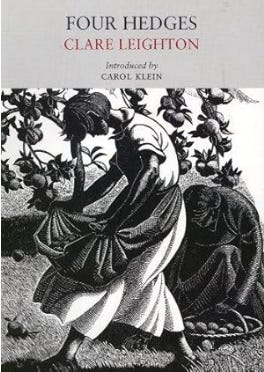
Four Hedges: A Gardener’s Chronicle, written and illustrated by Clare Leighton is published by Little Toller Books and can be bought here
Comments
Nothing yet. Say the first thing.
Sign in to join the conversation.