
The setting, the dates and the combinations of biological differentiations among protagonists varied, but the recurring story of the creation of society — as modern social science may now tell it — runs along these lines. Twenty thousand years ago, within a sizeable Dominator group in the Zagros mountains (present day Iran), there lived some intelligent, sagacious and adventurous male-female couples. They were competent in language, and between them they possessed all of the skills for hunting, gathering, tool making, sheltering, and warfare. These unusually dynamic couples discussed their futures in private. Sometimes they joined as a subgroup with other individuals and couples with whom they were on friendly terms. On these occasions they complained to each other about the violence, unpredictability and inefficiency of life in the Dominator group, which they compared to the lives of the dumb animal prey they hunted. They philosophised and debated heatedly about the possibility of lives led independently of any Dominators. Some of them competed with each other to devise the best arguments, or to display their superior knowledge of the world. Some were outstandingly impressive, vociferous and persuasive in deploying their expertise and creativity. It finally became apparent to all these pioneers that if they could join together boisterously yet amicably to debate the wrongs of Dominator life, they might as well also discuss together the types of decisions about subsistence and maintenance of public order that were currently the sole preserve of their Dominator.
At some point, perhaps in the wake of a severe episode of Dominator violence, these couples and assorted unattached individuals determined jointly in discussion to leave the Dominator group. They agreed on the simplest most logical common decision that could bind them together and justify their new way of life. The root of evil as they saw it lay in domination. They promised themselves always to dispute but never to dominate.
This promise set the Sociational group apart from the Leveller group. Both despised domination in equal measure. Only the former encouraged expression of superiorities that were rooted in individual sex, personality, age, experience, knowledge, cleverness or physique. Instead of suppressing all signs of superiority — as in Leveller groups — the pioneers chose meritocracy. The method of demonstrating merit is competition, i.e. setting one action or idea against another in terms of their relative values. Once the need for competition was recognised the requirement for disagreement followed.
Though it carried risks of uncertainty and indeterminacy, this was not a complex or original philosophy to formulate ‘on the hoof’. It was available intuitively for every human group that ever formed voluntarily. It was simple enough to be reinvented and re-expressed in any group that possessed the rudiments of language but was not yet sufficiently large to justify dividing the labour of governance by ‘representation’.
A notion basic to all elemental group life was that in the absence of any Dominator everyone was necessarily ‘equal’ in principle. In the original sociational context this implied an equal right to compete in order to demonstrate the merit of a cause or an idea, or to approve or disapprove decisions arrived at by these means. The individuals were equal in their rights to ‘exit, voice and loyalty’. Everyone was free to leave. They could remain only if their behaviour contributed to group cohesion and welfare.
The constraints on equality were structural — time budgets were limited, and not all ideas and causes were equal in value. The competitive process weeded out irrelevant and unhelpful discussion. A person would be ‘heard out’ if they had something useful to say. The vital word is ‘useful’. In practise, each group decided for itself what was ‘useful’ in the utilitarian order of requisites for survival. Food first and rules second, and all else followed logically in whatever time remained available for discussion.
The observations above are only an introduction to broader arguments that will necessarily follow about various manifestations of division of ‘labour’ characterising all the ‘first’ societies. But in this section I will let them stand on their own in relation to an idea I think was erroneously put forward by Francis Fukuyama two days ago.
Frank has been an extremely loyal subscriber to Social Science Files since 2022. He reads almost everything I write here, and I am very grateful for that. However, I must take issue with one particular train of argument, which seems to run as follows —
It will not have escaped Frank’s notice that I frame my present arguments in non-religious terms. The two Enlightenment theorists I refer to in support of this secular approach (Kant and Hume) disavowed literal and historical teachings of Christianity.
When it was convenient to do so all religions exploited ideas about the equality of humans, and recognised previously-existing ‘though shalt not’ rules for maintaining those equalities ever since the appearance of the first societies. As I suggested in the paragraphs above “liberal belief in universal human equality” (as referred to by Frank) was primordial. It was afterwards hijacked by religion and most of the secular societies.
We have, of course, to make clear distinctions between types of equality. ‘Equality of opportunity’ is basic to capitalism. But capitalism would fail miserably if it adopted the credo that all economic inequality is ‘wrong’. Attainments of profits, savings and income disparities are among the necessary incentives for rich societies. One of the stupidest sentences I have heard in recent times was uttered by The Economist:
“Pretty much everybody agrees that income inequality is bad, and nobody is a particularly big fan of paying taxes. Governments have to do a lesser of the evils balancing act here with progressive tax systems, taking a bit more from the rich than from the poor, or a lot more from the rich. You might call that wealth redistribution, or chalk it up to means-tested entitlements, or you could just call it the welfare state..” The Robin Hood state: taxes are getting more progressive, 18 Feb 2026
True, “openness, tolerance, and skepticism” were only fully institutionalised in modern capitalist and democratic societies. But openness, tolerance, and skepticism had also existed in the rational secular beliefs that drove human progress 20k or 100k years ago.
The point: the ‘universal equality of all human beings’ was a political invention of all first societies in assemblies they organised around the glowing embers of campfires.
My Theory & History of Society began chronologically on Substack in Sept 2025 with The Politics of Becoming Human. Research began in 2020. Extensive filings of all bibliographic academic material, draft proposals and new theoretical concepts are archived from 2022.
Reply to the email or HellerFiles@gmail.com. This publication is recorded for referencing and copyright under the ORCID publications ID https://orcid.org/0009-0006-0935-0826
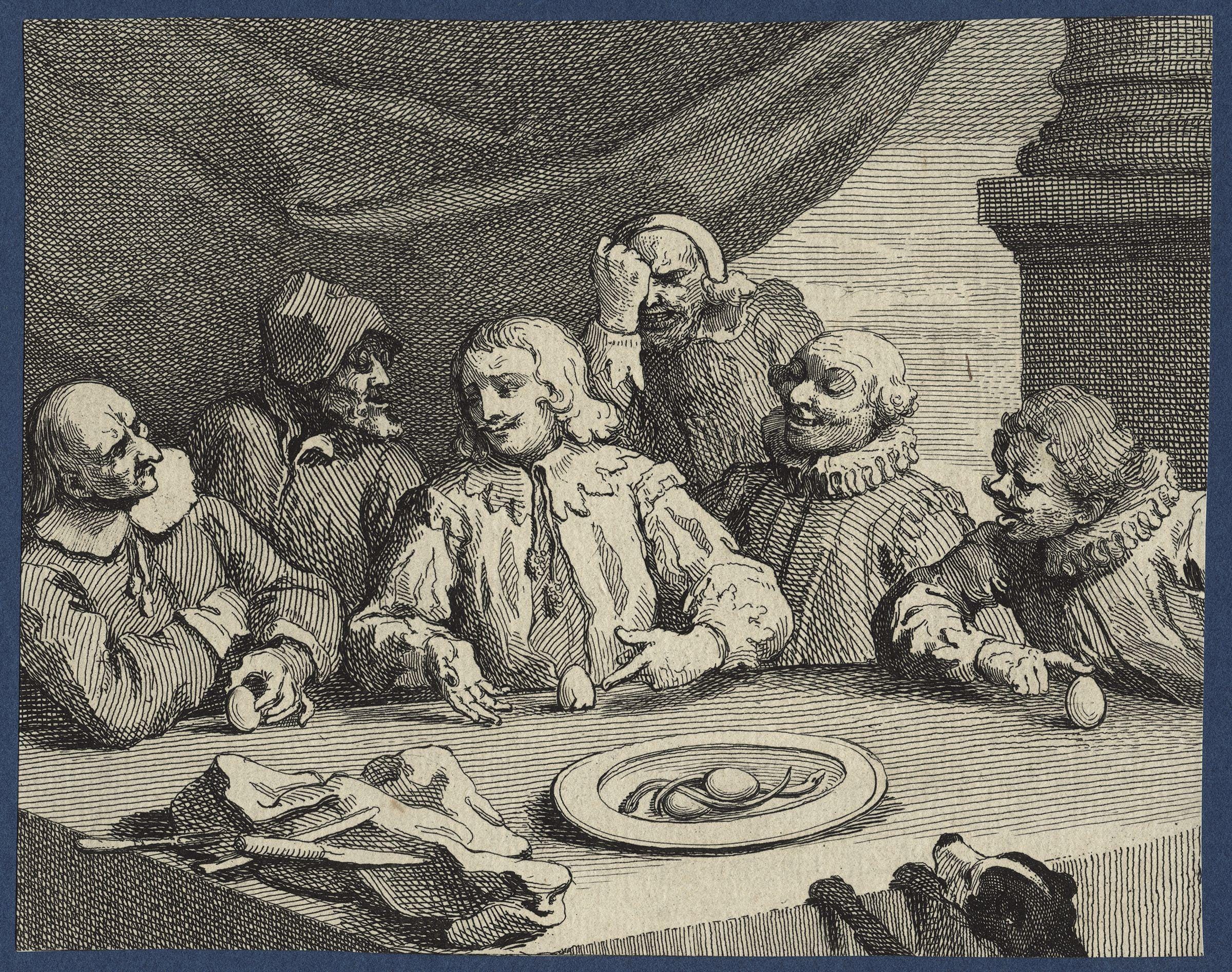
Columbus Breaking the Egg is a 1752 engraving by English artist William Hogarth
Comments
Nothing yet. Say the first thing.
Sign in to join the conversation.