
To what expedient, then, shall we finally resort, for maintaining in practice the necessary partition of power among the several departments as laid down by the Constitution? The only answer that can be given is that as all these exterior provisions are found to be inadequate the defect must be supplied by so contriving the interior structure of the government as that its several constituent parts may, by their mutual relations, be the means of keeping each other in their proper places. (James Madison, The Federalist No. 51)1
Writ large, the partitioning of labour in the first society manifested simultaneously on three interlinked levels —
The actions conditioned by natural biological differentiation between persons.
The survival functions of human activities, and their criteria for thriving.
The artificial method for deciding on distinctions and functions, and for selecting the corresponding information.
The ‘methods’ at their crudest could be any two adults paired as a whole unit in a functional activity. Typically in the prehistoric context we would then refer either to male-female breeding units or a unit of two male hunters, their respective functions being either to breed or to hunt in conditions that required isolation as a unit.
These are proto-sociational units. The intimate methods employed for coordination, collaboration and compromise (relevant to some forms of hunting and all forms of male-female coupling) mirror the public procedures employed in whole assemblies.
More complex ‘methods’ (those characterising true ‘societies’) first came into view when all adults grouped together in assemblies. These contrast with non-sociational methods of human grouping in prehistory, such as the informal ‘clique polities’ of the Leveller groups. Cliques are not ‘functionally’ relevant in a true sociational context because they operate within the group unit without themselves constituting units.
The reason for quoting the Federalist Papers (above) is that the methods employed by emergent fully ‘functionalist’ societies in the seventeenth and eighteenth centuries rested on an equivalent formal partitioning of ‘powers’ between institutional units (executive, legal, and administrative). The direct equivalent in prehistoric societies was the informal partitioning of ‘influence’ among simply biologically differentiated individuals, also acting functionally in their roles as units. Equivalent methods can be found in the coupling and hunting scenarios. Thus an essential distinguishing feature of the first societies is active partitioning of individual initiative and influence. In this phase of evolution the operative word is ‘influence’ rather than ‘power’. Note also that each of these ‘methods’ refers in operational terms to instrumental decision making.
At a minimum, the sum of prehistoric survival ‘functions’ needed to include subsistence (food), safety (risk), shelter (protection), support (welfare) and stability (social order). In the prehistoric context the ‘methods’ outlined above produced the decisions for pursuing these 5-F functional activities either in proto-sociational pairings or in sociational group-level discussion. Any given decision making process on any given day in the life of a prehistoric community might well be focused on the discussion of one, some, or all of these survive-and-thrive functions. The numbers of people directly responsible for ‘decisions’ was limited only by the size of the unit.
The total of biological ‘differentiation’ in this context consists of five universal and innate human variables — age, sex, physique, personality, and intelligence. At a given moment in their life each person is composed biologically of their own uniquely combined quantum of these 5-B strengths and weaknesses. Sex stays constant. Age varies with time. Physique, personality, and intelligence vary with age, experience, learning and degrees of effort expended in optimising a given endowment. Etc.
These three variables — method, function, differentiation — combine as labours:
Political labours of governance, including the group-level processing and dissemination of bodies of knowledge.
Material labours, such as for foraging, food processing, tool-making, construction, welfare, war and all else required for reproduction of the species or society.
Psychological and cognitive labours for rationally optimising everyone’s biological selves and efficiently adapting to the given and usually adverse circumstances, including self-improvement and the active recognition and cultivation of unique abilities in other people, so that the whole group may benefit.
The items mentioned are not necessarily a comprehensive list of ‘labours’. But in the contexts outlined in the following sections they come first to mind. For descriptive purposes it is easiest to begin with the sexual (micro) division of labour, which scales up neatly to the group (macro) level. There was a lot to talk about in a coupling process.
As in the wider sociational process, food was probably the most time-consuming topic under discussion. More generally, all information needed to be processed, and choices made about subsistence, safety, shelter, support, and stability. The survival of the unit depended on some essential activities of ‘closure’ in order to border, bond, and bind, thereby expressing various degrees of separation from other ‘units’ of a similar type.
My Theory & History of Society began chronologically on Substack in Sept 2025 with The Politics of Becoming Human. Research began in 2020. Extensive filings of all bibliographic academic material, draft proposals and new theoretical concepts are archived from 2022.
Reply to the email or HellerFiles@gmail.com. This publication is recorded for referencing and copyright under the ORCID publications ID https://orcid.org/0009-0006-0935-0826
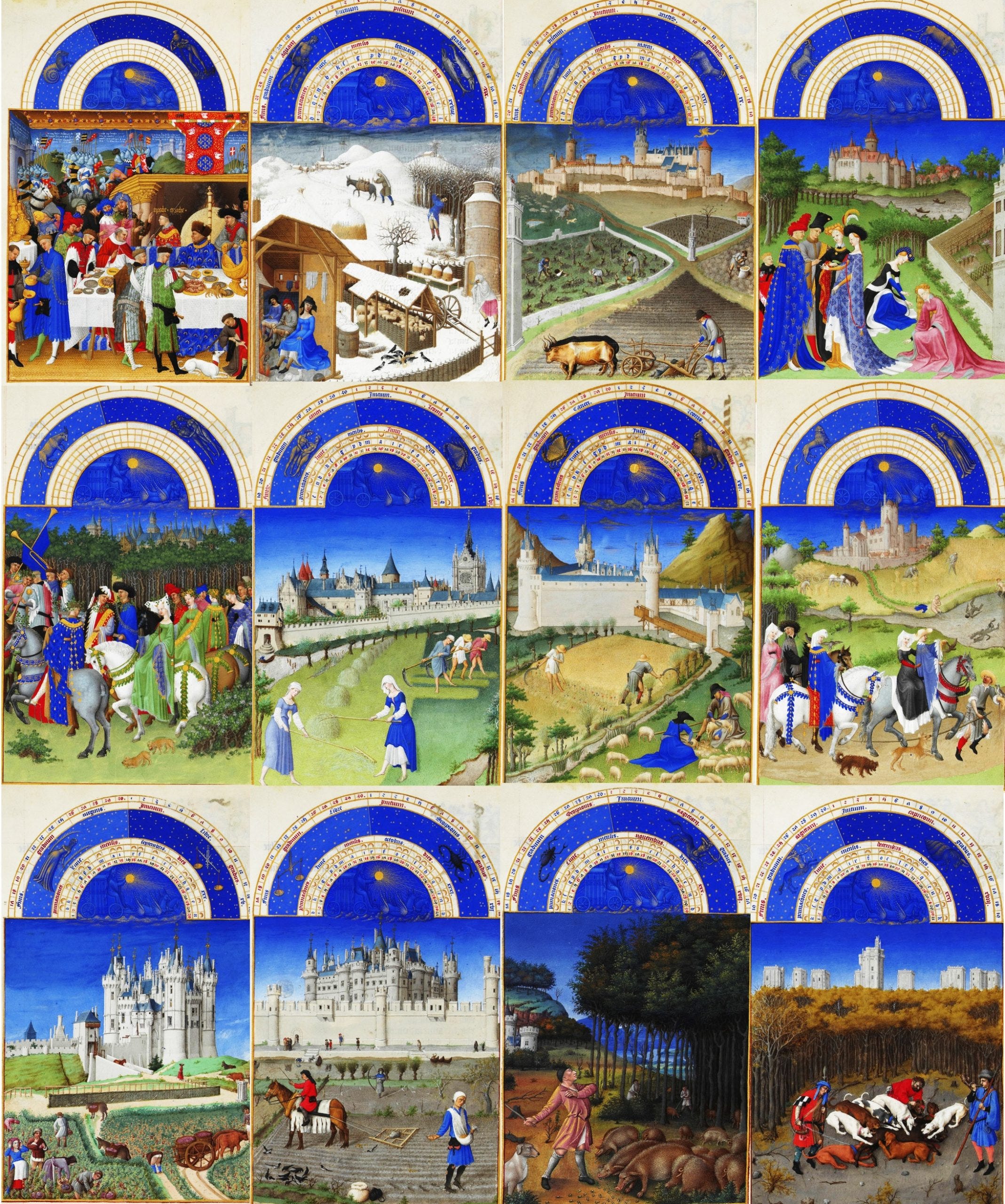
Calendar: Labours of the Months by the Limbourg Brothers, 1416 France/Holland
James Madison, The Federalist No. 51, The Structure of the Government Must Furnish the Proper Checks and Balances Between the Different Departments, Friday, February 8, 1788.
Comments
Nothing yet. Say the first thing.
Sign in to join the conversation.