
During the commission era, when agencies were paid via 15% media commissions, no one needed to document or measure the “size” of scopes of work. Fees were automatically calculated from a client’s media spend (along with a 17.5% commission on production costs).
SOWs were very modest in size during the commission era. David Ogilvy complained in 1983 that creatives did too little work, completing only 3 ads per year. Our own consulting experience in 1992 showed that creatives were completing 7 ads per year, having about 7 weeks to complete each TV, radio and print ad.
By 2004, though, digital deliverables began to grow, making SOW documentation and measurement more complicated.
2004 should have been the year for agencies and their clients to learn how to quantify the size of SOWs for fee purposes.
Unfortunately, this did not happen.
After 2007, social deliverables entered the picture, followed by programmatic advertising after 2009, and SOW size simply exploded.
Ignorance is not bliss. Marketing never knows the size of the SOWs it plans for its agencies. Neither do their creative agencies, who accept unknown workloads for fixed fees. Procurement has KPIs to cut fees, and they do so vigorously, oblivious to the growing workloads generated by Marketing.
Fees go down while the unmeasured workloads go up.
In the face of fee cuts, agencies downsize under holding company pressures, and the downsizing cuts into creative muscle rather than fat.
The growth in SOWs is extraordinary, and so is growing gap between fees and SOW workloads.
Outputs per creative have increased enormously. Creative departments that completed 7 ads per creative per year in 1992 now deliver hundreds of ads per creative per year, given the huge increase in digital and social ads.
AI will only increase this output considerably — probably without any increase in quality or value.
Farmer & Company has worked on the measurement of SOWs for over 30 years, and Farmer’s ScopeMetric® system has been used by many Procurement and agency executives to evaluate SOW size, agency fees and agency staffing.
Unfortunately, our old ScopeMetric® system was clunky and not easy to use. We’ve fixed this problem.
The ScopeMetric® Unit (SMU) is the measure of size of a SOW.
A typical TV:30 origination is about 2/3rds the size of an SMU. Other deliverables — originations and adaptations — have unique SMU values.
The ScopeMetric® system focuses on calculating the size of a SOW, the typical agency resources required to carry out it out, and a fair and appropriate fee.
When agencies and Procurement look transparently at the same SOW data, they can conduct their negotiations in a logical way, and fees can be determined by the size and characteristics of the SOW:
The number and type of deliverables.
Their combined ‘weight’ in SMUs
Price per SMU (fees divided by SMUs)
FTEs per SMU (ScopeMetrics® uses typical values that can be customized by users)
SMUs per Creative (usually 5.0 SMUs per creative)
Client Service + Strategic Planner (CS&P) FTEs per Creative
Production FTEs per Creative
Fee per deliverable — calculated by ScopeMetrics® to permit “output-based pricing.”
The actual metrics can vary, based on the way an agency chooses to staff a given SOW, especially in special cases that require higher staffing (pharma; global SOWs; highly strategic and complicated SOWs, etc.).
In all cases, though, ScopeMetrics® provides “typical values” to serve as a comparison. The typical values come from our diagnoses of over 1,500 SOWs during the 30 years of SOW consulting.
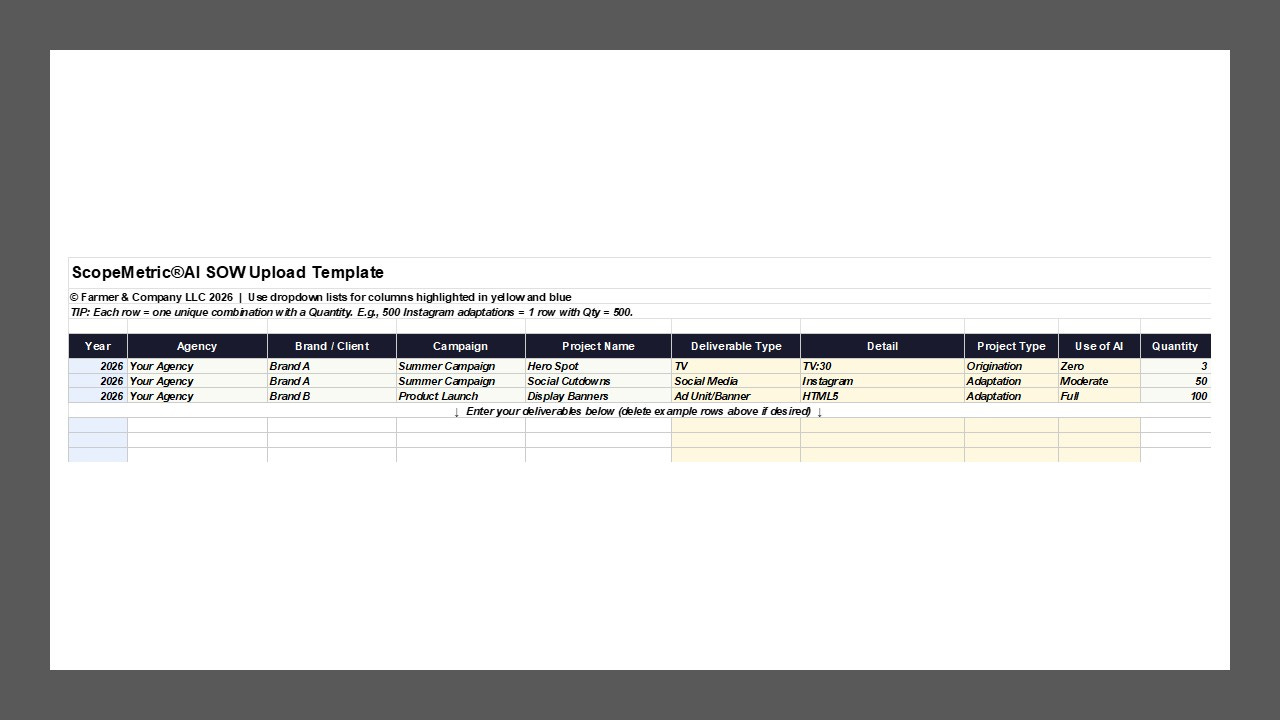
With our upgraded AI system, SOW deliverables can be documented online in two ways:
Either directly by entering deliverables manually in the ScopeMetrics®AI online platform, or
Bulk uploaded via our offline Excel template.
ScopeMetrics®AI will calculate typical agency staffing and fees for the deliverables. Agencies can then adjust the staffing upwards or downwards, based on circumstances, and ScopeMetrics® will recalculate the fee and metrics.
The outputs can then be used during discussions with Procurement.
Alternatively, Marketing or Procurement can use the platform to evaluate the size of a SOW and typical agency staffing and fees. The outputs can then be used to evaluate fee proposals from agencies during annual fee negotiations or new business situations.
Staffing and fees can be diagnosed when AI is used for the creation of some of the deliverables. ScopeMetric® adjusts SMU values when AI is used for certain deliverables (usually adaptations).
Users can interrogate and change the outputs of the model, using plain English prompts, like “change the composition of the SOW” to <maintain fee levels> or <reduce fee levels> or <change fee levels in a certain way>. Examples:
“How many programmatic deliverables do I have to eliminate in order to increase the number of TV originations by 15% and keep fee levels unchanged?”
“What is the fee effect of increasing my creative staffing by 10%? How much do I need to reduce the SOW size to keep fees constant?”
“I need more Client Service & Strategic Planning for this global SOW. If I increase it by 50%, what is the effect on the fee? How much do I need to reduce the SOW size to keep fees constant?”
The model can be interrogated in unlimited and unstructured ways to evaluate various SOW and fee scenarios.
The use of the interactive ScopeMetrics®AI model can create a healthy dialogue between agencies and Procurement — something that has not been possible for the past 25 years.
The model lends itself to “on-demand” use — for example, when a brand’s SOW has been changed substantially, or when a new agency is being evaluated to handle a brand’s SOW, or whenever there is a need for an agency and Procurement to engage in a dialogue about SOWs and fees.
Flexible arrangements for unlimited or on-demand use of ScopeMetrics® are available.
Give it a try! Send us a message, describing your situation, using the button below, and we’ll respond to your needs and organize a trial diagnostic.
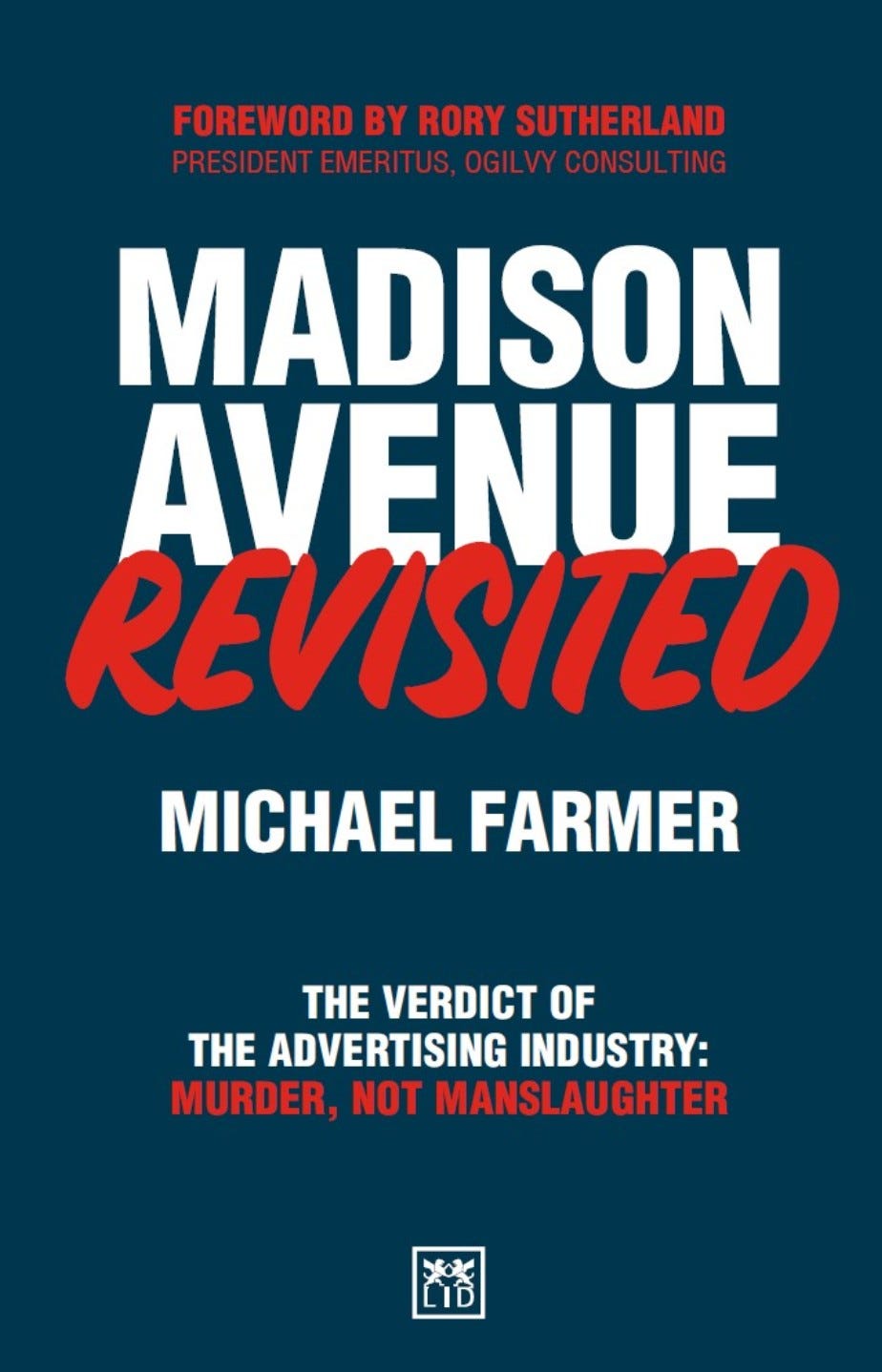
My third book about the advertising industry, Madison Avenue Revisited, is now available for pre-order on Amazon. The book, which focuses on the evolution of media and creative operations, the effect of holding company ownership and the brand performance challenges faced by clients will be launched at Cannes in June 2026.
No posts
Comments
Nothing yet. Say the first thing.
Sign in to join the conversation.