
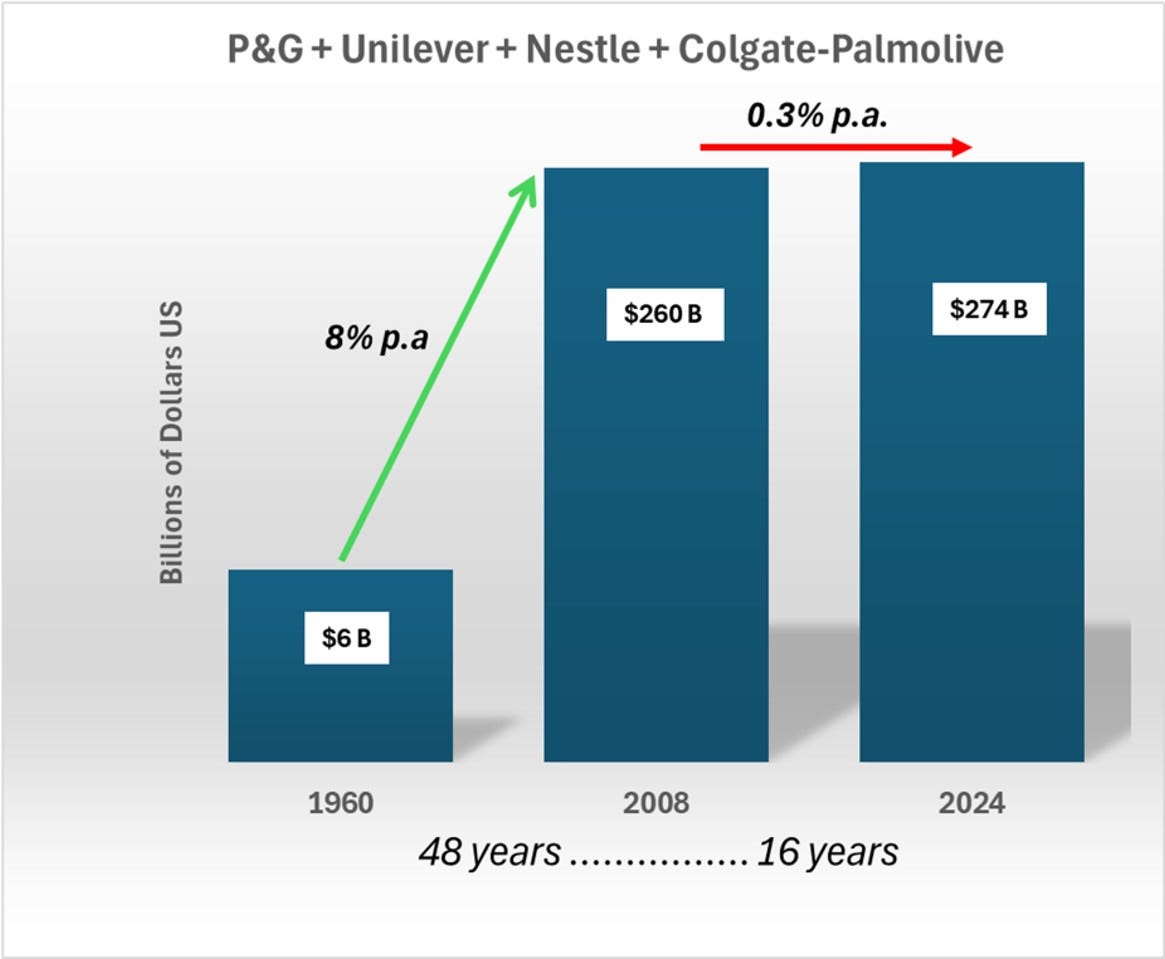
The brand growth problem is best illustrated by the sales performance of four major CPG companies, P&G, Unilever, Nestle and Colgate-Palmolive.
From 1960 to 2008, they collectively grew sales at 8% per year, seeing their sales grow from $6 billion to $260 billion over 48 years.
This growth was fueled by brand equity advertising (principally TV), new product development, product acquisitions and the dominance of Baby Boomer consumers who bought trusted national brands.
Between 2008 and 2024, though, collective sales growth collapsed to 0.3% per year, growing only by $74 billion over 16 years. Advertising shifted to programmatic, fewer new products were launched or acquired, more competition was created by major retailers and their private label brands, and Baby Boomers were largely displaced by Millennials and Gen Z consumers, who bought and consumed in a different way.
The same pattern can be observed for a broader sample of advertisers. 40 out of 60 advertisers grew at only half of nominal GDP growth rates during the past 15 years.
The past 15 years have been tough, but the legacy brands of these advertisers have not reached their peak, I believe. There is plenty of unrealized growth if new marketing and product development strategies are developed.
However, relationships with the advertisers’ ad agencies have deteriorated over this same period of time.
Marketing has imposed growing SOWs on their agencies, while Procurement, ignoring this growth, has routinely cut their fees.
This “I’ll grow and you cut” strategy is hardly an appropriate strategic response for slow-growth brands, unless it is based on “well, we’re not growing; let’s accept it and focus on cost reductions.”
Cost-cutting is “custodial leadership” — hardly what the advertising industry needs today.
Agencies, facing the fee cuts, have downsized and liquidated many of their mid-level and upper level executives, leaving media planning / buying and creativity in the hands of relatively inexpensive and junior employees — most of whom could be replaced by AI.
Agencies, too, are routinely changed in an effort to lower costs even further.
What if, instead, advertisers and agencies mobilized to solve the brand growth problem, working hand in glove:
Identify the reasons for brand stagnation over the past 15 years?
Use AI to assist in the strategic research. I have personally prompted Claude and ChatGPT to explore and explain the historical reasons for certain brands’ underperformance during the past 5 years or so, and the results are gratifying. AI can help media and creative agencies to become more consultative, much like Bain, BCG and McKinsey, using AI as powerful research tools.
Jointly develop action plans and SOWs that are likely to do a better job stimulating brand growth? Agencies and their clients, in the distant past, created TV programs (i.e., soap operas), new products and even menu items for restaurants. Why can’t the notion of “creativity” be expanded to include those actions required to stimulate brand growth?
Use Procurement to eliminate the sources of relationship inefficiency (poor briefing and ad approval processes) instead of fee reductions?
Pay agencies for their outputs rather than a guess at man-hours? Agencies and clients could use ScopeMetrics®AI for this purpose — the platform already exists.
All of this is well within reach of visionary CMOs if they work in partnership with their Procurement colleagues and with their agencies…rather than seeing all three parties work at cross purposes in conflict-ridden relationships.
AI can facilitate this change, if it is so directed.
Alternatively, AI can make relationships worse, particularly if Procurement sees “lower agency costs” from AI efficiencies as the next goal to be pursued and realized.
Many advertisers will go down this route, to be sure, but they will inevitably pay a price for the further deterioration of the quality of their marketing.
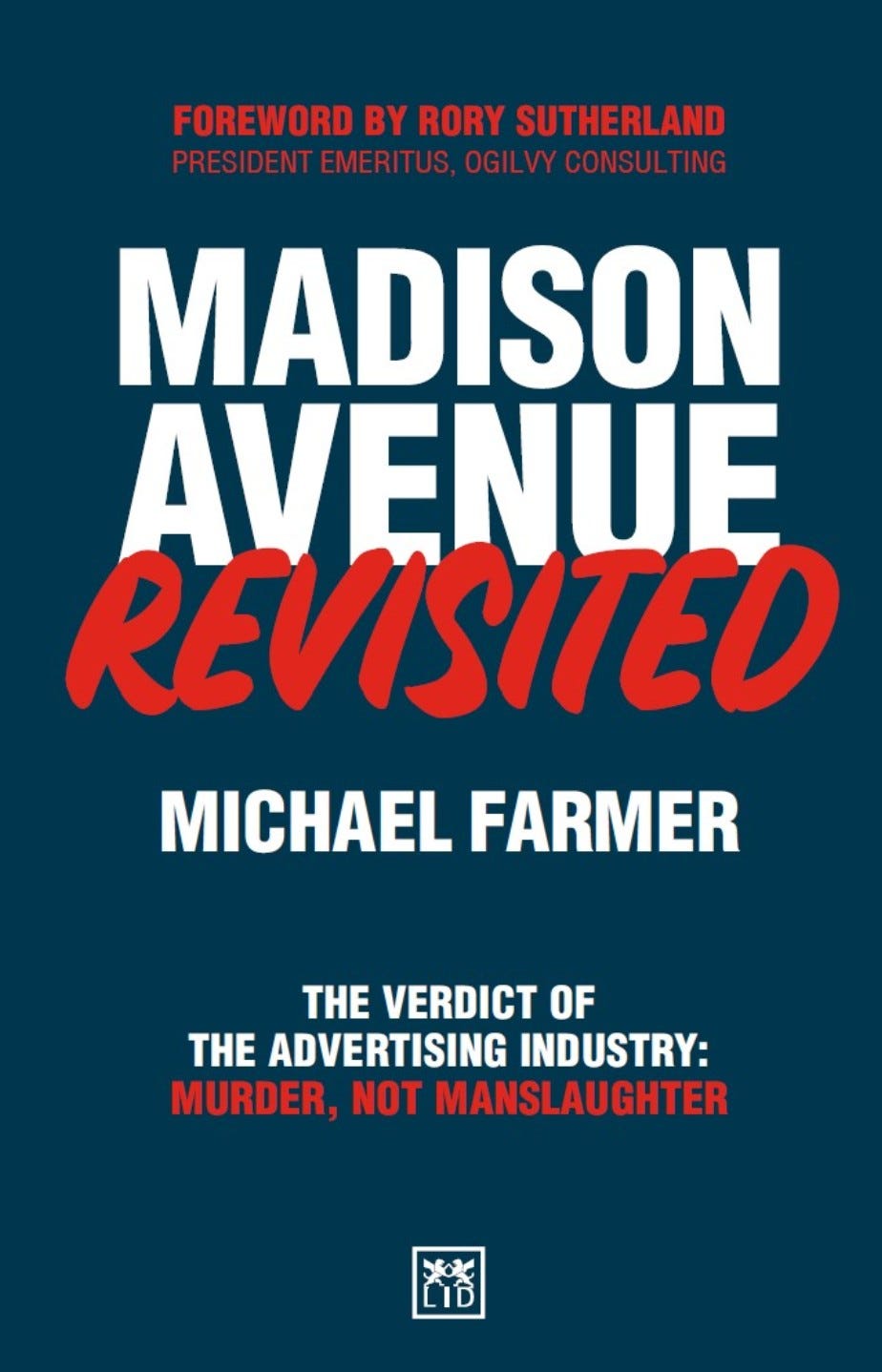
My third book about the advertising industry, Madison Avenue Revisited, is now available for pre-order on Amazon. The book, which focuses on the evolution of media and creative operations, the effect of holding company ownership and the brand performance challenges faced by clients will be launched at Cannes in June 2026.
No posts
Comments
Nothing yet. Say the first thing.
Sign in to join the conversation.