
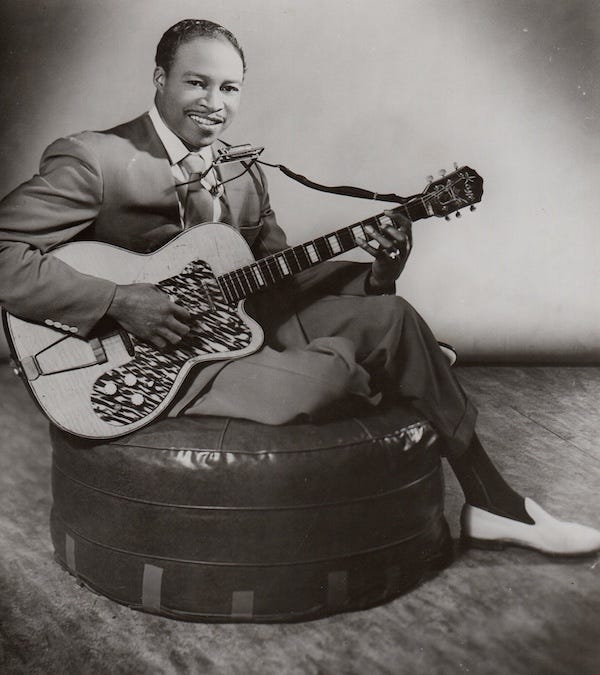
Jimmy Reed was a pop star. No doubt about it in my mind. He wrote two and a half minute gems filled with catchy melodies and infectious grooves. From 1955 to 1961 – part of his tenure at Vee-Jay Records in Chicago, Illinois – he had ten records in the top ten on the Rhythm & Blues charts. Those same songs also landed in Billboard’s Hot 100 chart. Hundreds of artists have given us their interpretations of Jimmy Reed’s songs. I believe that gives credence to my notion. Just that list would fill this essay. Aretha Franklin, Rod Stewart, Neil Young, Etta James, The Yardbirds, Betty Everett, Jerry Butler, Bryan Ferry, Steve Miller, The Doors, Charlie Rich, Elvis Presley, The Standells, Pat Boone, The Rolling Stones, Bobbie Gentry, Waylon Jennings, Willie Nelson, Van Morrison, and hundreds more. Jimmy Reed was a bluesman first and foremost even while he was landing songs on the Hot 100 and Rhythm & Blues charts.
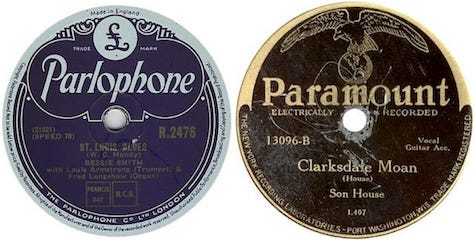
Son House to Bessie Smith to Memphis Minnie to Charles Brown to Willie Dixon to Jimmy Reed and many, many others brought the blues from the oral, folk tradition to the recorded medium with brilliant stories woven into roughly three minute masterpieces of life told in song. The story was the essence of the song and record. Whether a big band in the case of Bessie Smith and, say, Ma Rainey, or Son House with simply his guitar, the accompaniment was there to support, to serve the song. And, for sure, that accompaniment was killer – great arrangements, inventive piano playing, swinging horns or in the case of Muddy Waters changing to amplification, as I wrote last week: “(His) style and sound did (change) needing to be heard over the din of the Chicago bars and clubs – thus becoming the genesis of the guitar-powered rock’n’roll band.” When did blues stop being about the story? Because, for me, to me just about all of modern recorded blues is no longer about the story. Sure, they are lyrics but that writing is nowhere near the genius of Willie Dixon or Memphis Minnie or Chuck Berry. When I listen to most modern blues, those pesky lyrics (and songs) are there to help support the blood-thirsty, over-the-top, endless guitar soloing. It’s no wonder people say that they don’t like blues or find it extremely boring.
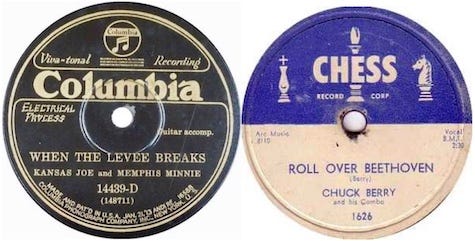
When did blues change? I don’t believe we can point to a definitive demarcation but quite possibly the evolution, the change started with Muddy plugging in Chicago during the ‘50s – giving us one of the greatest bands the world has ever heard or seen. I think it is right around the mid-60s, with the British Invasion and its guitar heroes, you can really see the change. All throughout B.B. King’s Live at the Regal – recorded in 1964 in Chicago and considered the gold standard of live blues albums by most – he’s still giving us short songs with intense bursts of his incredible and influential guitar playing. But, just three years later, on Blues is King, also a live album recorded in Chicago, he’s stretching out, taking longer and longer solos. There’s no doubt in my mind that was a direct influence of the guitar hero-worship that had begun with sayings like “Clapton is God” being spray-painted all over London. I do not begrudge or belittle the guitar hero-worship. It is as it is, and for what it’s worth it makes people extremely happy – drinking in all its excesses. I just wish it hadn’t almost completely overshadowed the music I so dearly love, and wish more people would hear the music in its older forms.
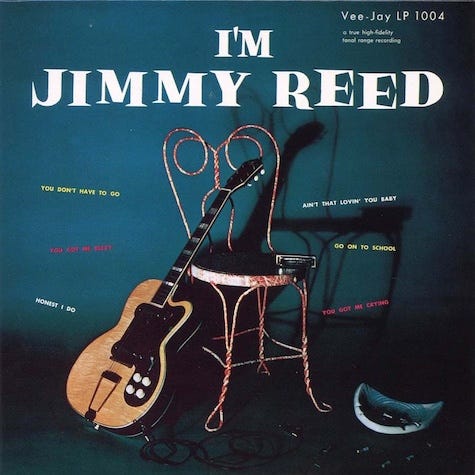
Songs were oral histories before recording. The recording process was simply a way to document those histories and stories – and, of course, sell them. Maybe the time limitations of the old recordings were a blessing in disguise. If you only had around three minutes to tell your story, you weren’t going to waste time with guitar playing when folks wanted to know what was gonna happen to “Frankie and Johnnie.” I find myself more drawn to the song’s story than anything else about it as I get older. And, here’s where I’ll get sideways with it all: one of my favorite pieces of music is Blind Willie Johnson’s “Dark was the Night (Cold was the Ground).” He tells us a story with no words, only his guttural moaning and other-worldly slide guitar. But, he’s still telling us a story, just like Jimmy Reed in “Big Boss Man” or “Honest I Do.”
I have no doubt that somewhere at sometime today in some city at some blues jam or open mic someone is gonna play a Jimmy Reed tune. He was, after all, a pop star.
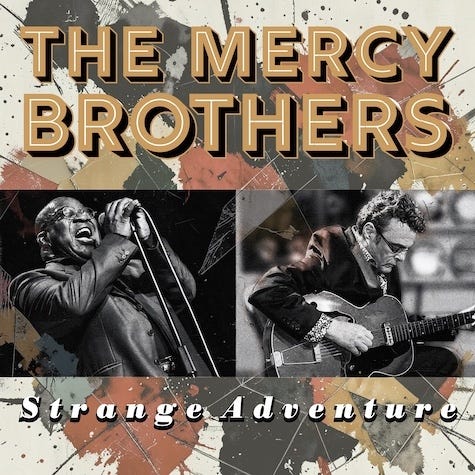
Find Strange Adventure at your preferred music delivery service here.
My playlist for Saturday, July 18, 2026 on WICN 90.5fm in Worcester, Massachusetts, and globally at wicn.org:
Frank Stokes “Downtown Blues”
Lightnin’ Slim “Rooster Blues”
Jimmy Reed “You Don’t Have to Go”
Jerry McCain “Steady”
Papa Lightfoot “Mean Old Train”
Lazy Lester “Sugar Coated Love”
Slim Harpo “I Got Love if You Want It”
Betty Everett “You’re No Good”
Linda Ronstadt “You’re No Good”
Buddy Holly “That’ll Be the Day”
Linda Ronstadt “That’ll Be the Day”
The Everly Brothers “When Will I Be Loved”
Linda Ronstadt “When Will I Be Loved”
Buddy Holly “It’s so Easy”
Linda Ronstadt “It’s so Easy”
Allen Toussaint “Pure Uncut Love”
Irma Thomas “The Same Love that Used to Make Me Laugh”
Johnny Adams “I Don’t Want to Do Wrong”
Snooks Eaglin “Sleepwalk”
No posts
Comments
Nothing yet. Say the first thing.
Sign in to join the conversation.