
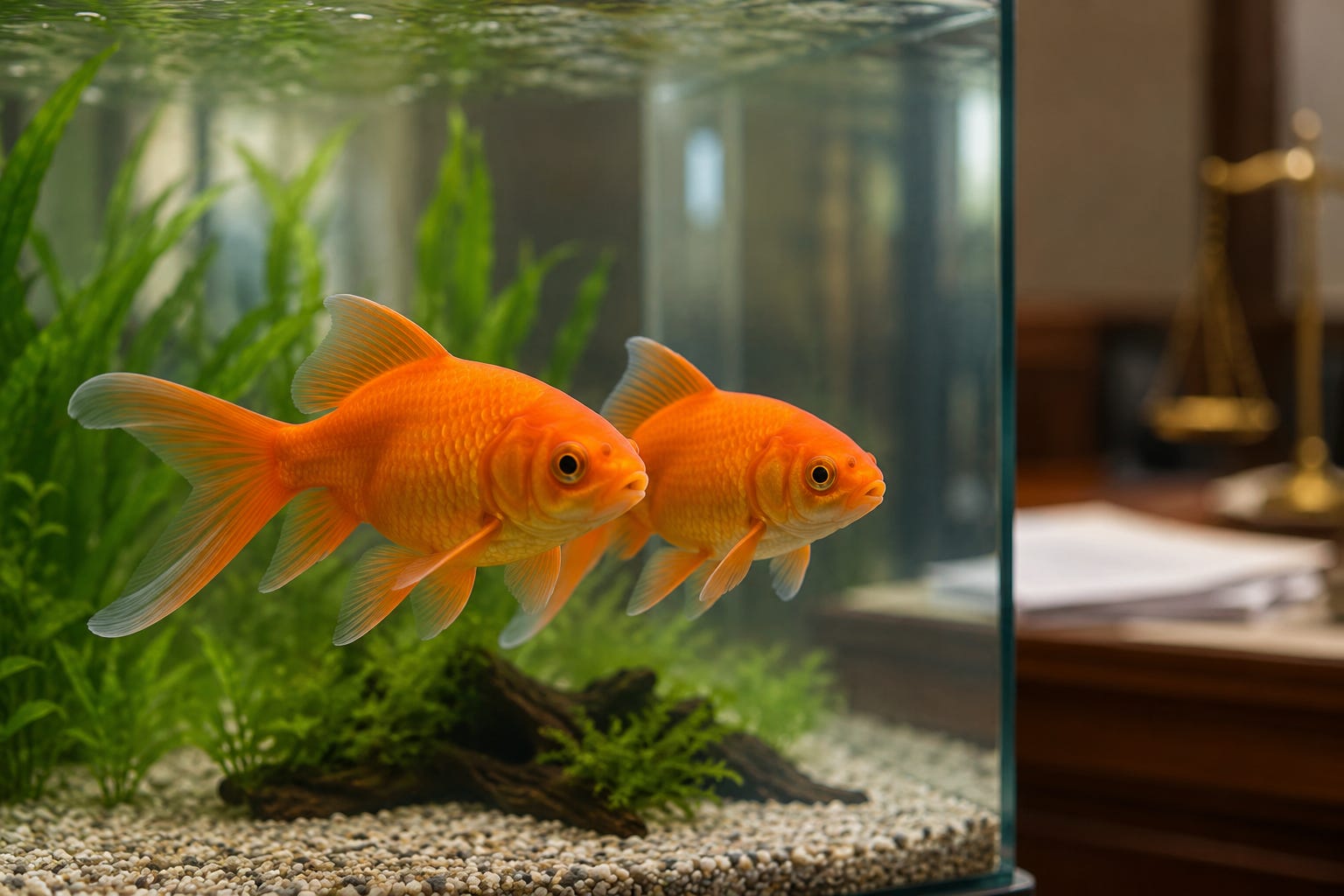
Two goldfish named Fede and Magui have done something rather extraordinary without knowing anything about courts, lawyers, or animal-rights law.
They helped move the legal line between something and someone.
The fish had been kept in a small vertical tank outside a sushi restaurant in Buenos Aires. According to investigators, the aquarium restricted their natural horizontal swimming, exposed them to changing temperatures from sunlight, subjected them to vibration and street activity, and caused them stress. Animal advocates intervened, authorities investigated, and the fish were removed.
But what happened next makes this far more than another animal-cruelty case.
A Buenos Aires court recognized the two goldfish as sentient beings and legal subjects rather than simply objects belonging to someone. Advocates involved in the case say it is the first time fish have received this kind of legal recognition in Argentina.
That distinction matters.
We have an odd habit of allowing appearance and familiarity to determine how seriously we take another animal’s suffering.
Hurt a dog and people are outraged. Confine a horse in terrible conditions and most people immediately recognize something is wrong.
Fish have traditionally received far less consideration.
Perhaps it is because they live underwater. They do not cry out in ways we understand. We cannot read their faces as easily as we read those of dogs or chimpanzees. They are sold as decorations, prizes, pets, bait, and food.
But our inability to easily recognize another being’s experience does not mean that experience does not exist.
Research on fish cognition and welfare has produced substantial evidence that fish can experience pain and other negative states. Scientists continue to debate exactly how those experiences should be described, but the case for treating fish as sentient animals has become increasingly difficult to dismiss.
The Buenos Aires case takes that understanding somewhere science alone cannot take it: into the law.
Want to put compassion into practice? Download The 7-Day Compassion Challenge, a practical 17-page workbook from The Vegan’s Voice designed to help you make kinder, more consistent choices for animals. It’s free, or pay what you want. Get your copy here.
Giving an animal legal rights does not mean giving a goldfish the right to vote, own property, or open a checking account. That sort of ridicule often appears whenever animal rights advance.
It means recognizing that an animal has interests that matter independently of the interests of the human who owns or uses them.
Fede and Magui had interests of their own: enough room to swim, appropriate water conditions, and freedom from unnecessary stress and suffering.
Those interests existed whether the restaurant owner recognized them or not.
The court’s decision acknowledged that.
The owner was required to relinquish rights over the fish, refrain from keeping animals at the restaurant, and participate in environmental and animal-law education as part of an eight-month probation agreement. Fede and Magui were ultimately moved to a much larger aquarium.
And this is where the ruling creates a problem for the rest of us.
If fish are sentient when they are swimming inside a restaurant aquarium, they do not somehow become insentient when they appear on the restaurant menu.
Sentience does not disappear because an animal is profitable.
That is the contradiction animal-rights law will eventually have to confront.
We increasingly recognize that animals can suffer, experience fear, form preferences, respond to their surroundings, and have lives that matter to them. Yet our food system continues to kill enormous numbers of animals because we have placed them in a separate moral category called food.
Nothing about the animal has changed. The only thing that changed is the label we put on them.
This is why the recognition of two goldfish matters far beyond one aquarium in Buenos Aires. Once the law begins acknowledging that animals are not merely objects, it becomes increasingly difficult to justify treating them entirely as commodities.
There will not be one court decision that suddenly gives every sentient animal meaningful legal protection. Social change rarely works that way.
The law tends to move through individual cases, one animal and one ruling at a time. Dogs, elephants, primates, and now two goldfish outside a restaurant have all helped push the same question further into public consciousness.
If an animal can suffer, and if that suffering matters, what exactly gives us the right to cause it when we do not need to?
Fede and Magui cannot answer that question.
But simply by being recognized as individuals whose welfare mattered, they have helped force the rest of us to answer it.
And sooner or later, “because they are animals” is going to stop being good enough.
I know some may not want to commit to a paid subscription, but if you’d like to support my work, you can always buy me a coffee on Ko-fi. Your contribution helps sustain independent writing rooted in consciousness, compassion, and social renewal. Every bit of support truly makes a difference. Thank you!
Comments
Nothing yet. Say the first thing.
Sign in to join the conversation.