
‘‘The strongest argument against animal experimentation may ultimately come not only from ethics, but from better science.’’
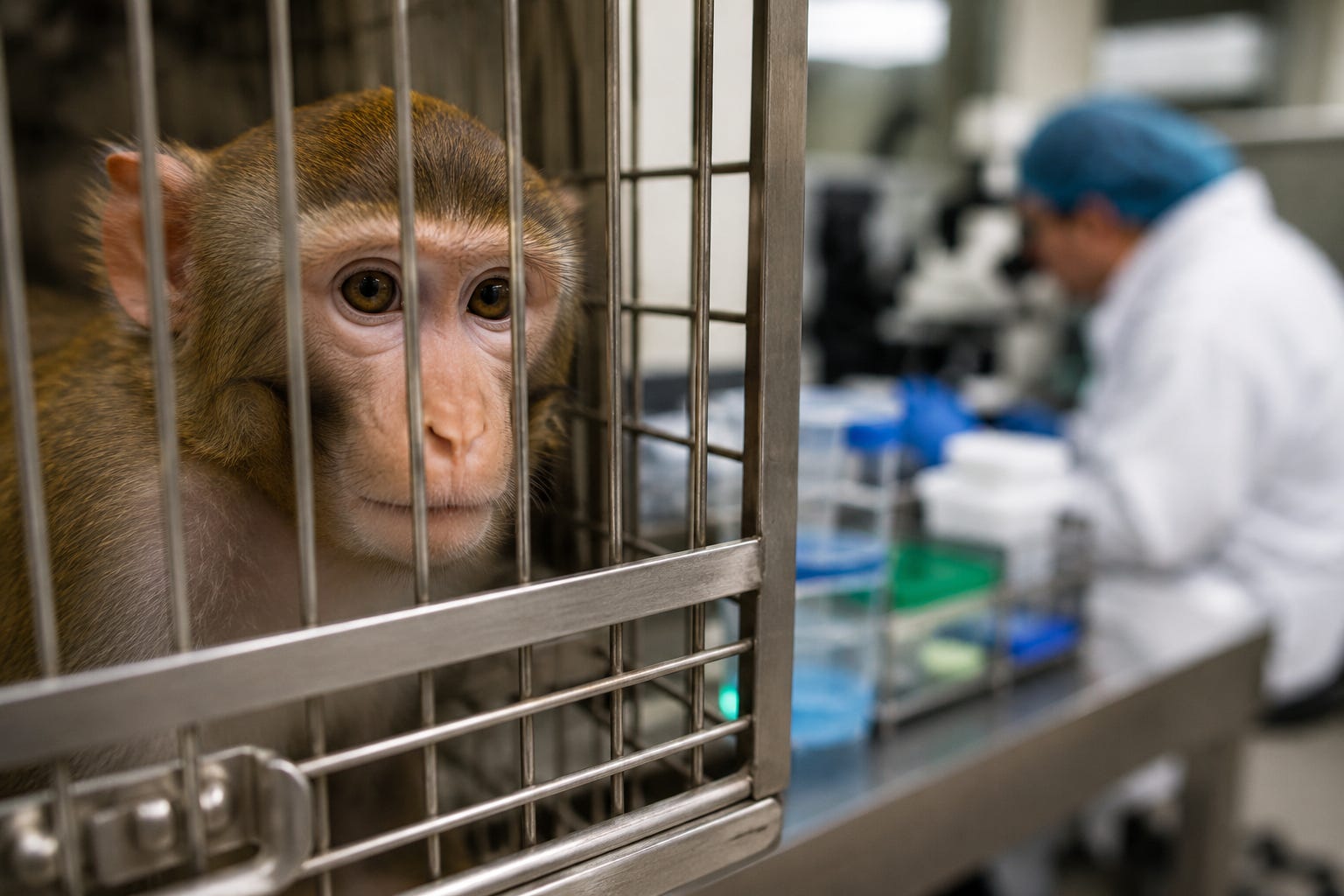
For more than six decades, thousands of monkeys at the Oregon National Primate Research Center have been used in experiments involving infectious disease, neuroscience, reproduction, metabolism, vaccines, gene therapy and other areas of biomedical research.
Now Oregon Health & Science University, which operates the center, has decided that its future should look very different.
On July 27, OHSU’s Board of Directors approved a plan to substantially reduce the center’s primate colony and transform it into a national leader in New Approach Methodologies, or NAMs. These include human-based experimental models, organ-on-a-chip technology, computational biology, artificial intelligence, advanced imaging and biofabrication.
The center currently houses about 5,000 nonhuman primates, mostly rhesus macaques, making it one of the largest facilities of its kind in the country.
The OHSU resolution calls for a substantial reduction in the monkey population, limits on breeding and an end to the center’s role as a national supplier of primates for research. It also raises the possibility of transferring some animals to sanctuaries.
OHSU also expects eventually to give up the facility’s federal designation as a National Primate Research Center, although that transition depends on funding and approval from the National Institutes of Health.
Some primate research will continue. OHSU says certain experiments still lack scientifically validated alternatives and that a smaller colony will remain for specialized research and for developing and validating new non-animal methods.
This is not the abolition of animal testing. But it is a major research institution acknowledging that the scientific future may not depend as heavily on animals as its past did.
The Vegan Handbook by Michael Corthell is a practical, compassionate guide for anyone who wants to move toward a vegan way of life and understand the ethical reasons behind that choice.
Get your Vegan Handbook today!
The ethical argument against experimenting on sentient animals is familiar. Monkeys are intelligent, highly social beings capable of fear, stress, pain and complex relationships. For animal advocates, deliberately subjecting them to invasive experimentation presents an obvious moral problem.
But another challenge to animal research has been gaining ground: animals are not miniature humans.
A treatment that appears safe or effective in another species may behave differently in the human body. Differences in genetics, metabolism, immune responses and physiology can make translating animal findings to people difficult.
Modern alternatives are designed to address that problem more directly.
Organoids can recreate aspects of human organs using human cells. Organ-on-a-chip systems can mimic biological processes in tissues such as the liver, lung or heart. Computer models can predict toxicity and drug interactions. Artificial intelligence can analyze vast amounts of biological and clinical data.
The point is not simply to replace a monkey with a computer. It is to develop research methods that more closely reflect human biology in the first place.
Oregon is not acting alone.
The FDA announced in 2025 that it would begin reducing or replacing animal testing requirements for monoclonal antibodies and certain other drugs. In March 2026, it released draft guidance describing how drug developers can validate and use new approaches instead of traditional animal tests.
The agency now points to human organoids, organs-on-chips, computer simulations and other human-relevant systems as part of a broader shift in drug safety testing.
Validated alternatives do not yet exist for every kind of medical research, and replacing animal models will take time. But the scientific infrastructure needed to move away from them is advancing quickly.
For generations, the debate over animal experimentation has often been framed as a choice between compassion for animals and lifesaving medical research.
New technology is beginning to make that argument look outdated.
If researchers can develop methods that cause less suffering while producing information more directly relevant to human beings, the old ethical compromise becomes harder to justify.
OHSU’s decision will not empty America’s laboratories of animals. Thousands of monkeys will remain in research, both in Oregon and elsewhere, and some experiments will continue for years.
But institutions matter. When one of America’s largest primate research centers begins shrinking its colony, reducing breeding, considering sanctuary placement and investing heavily in human-based science, researchers elsewhere will be watching.
Animal testing was once treated as an unavoidable cost of medical progress.
Now a more interesting possibility is coming into view:
What if medical progress is what finally makes animal testing unnecessary?
Sources:
OHSU board greenlights plan for fewer monkeys in research, investments in alternatives
Oregon Public Broadcasting’s report provides the details of the OHSU board decision, including plans to reduce the primate colony, limit breeding, explore sanctuary placement and invest in human-based research methods.
OHSU Oregon National Primate Research Center
The official OHSU source provides background on the center’s research programs, mission and role in biomedical research, including its work with nonhuman primates and emerging alternatives.
I know some may not want to commit to a paid subscription, but if you’d like to support my work, you can always buy me a coffee on Ko-fi. Your contribution helps sustain independent writing rooted in consciousness, compassion, and social renewal. Every bit of support truly makes a difference. Thank you!
Comments
Nothing yet. Say the first thing.
Sign in to join the conversation.