
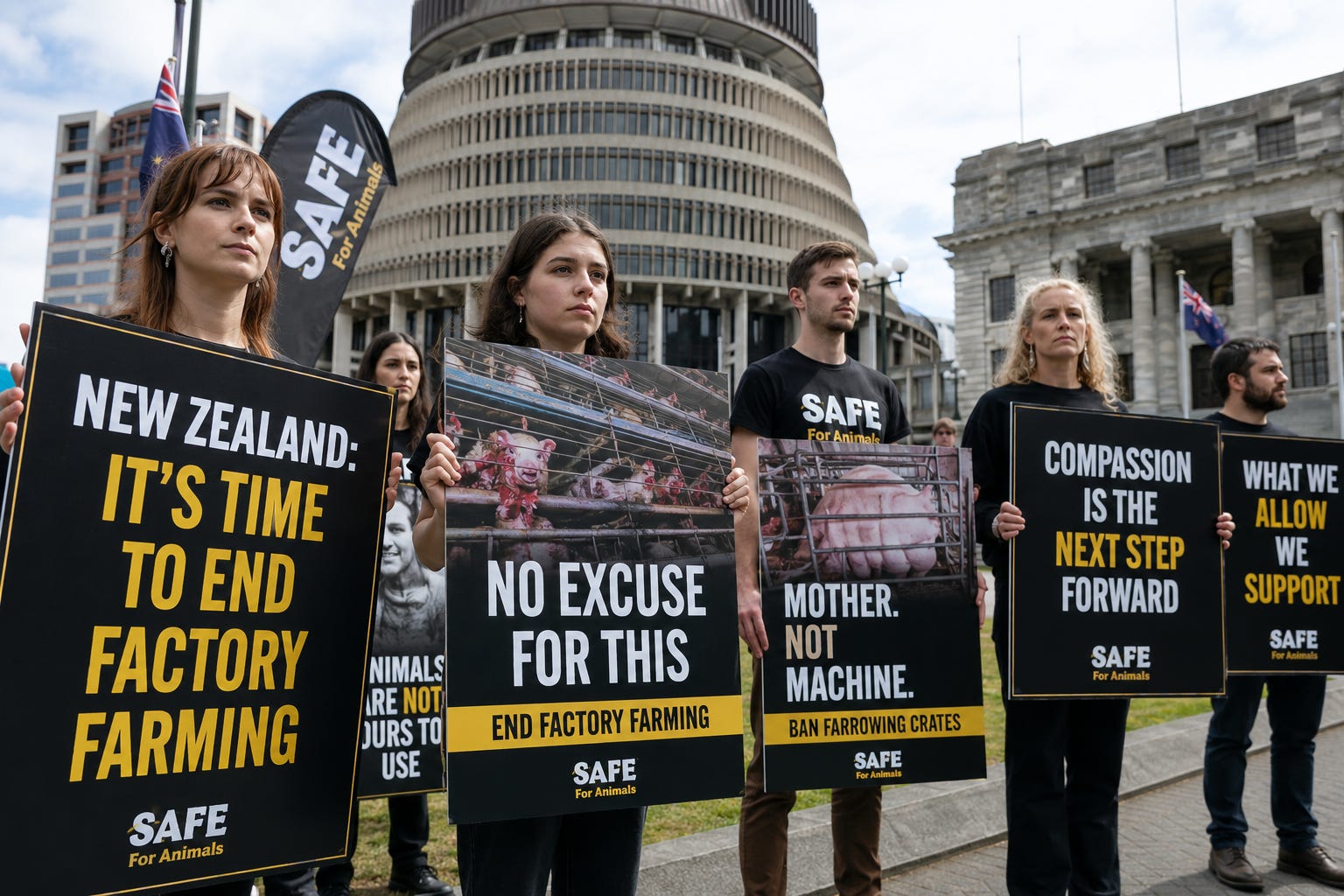
New Zealand is often pictured as a country of rolling green pastures, grazing sheep, dairy cows, and farms closely tied to the land.
That image is not entirely false. But it is incomplete.
Behind it sits another agricultural reality, one that is far less visible to the public.
Animal advocacy organization SAFE has launched what it calls its biggest campaign yet to end factory farming in Aotearoa New Zealand, drawing attention to intensive farming systems affecting at least 123 million animals.
That is an extraordinary number of living, feeling beings caught inside an industrial system built primarily around production.
These animals are not machines. Chickens, pigs, cows, and other farmed animals can experience fear, stress, pain, comfort, pleasure, and social attachment. Yet in factory farming, their individual interests are routinely subordinated to efficiency and profit.
Increasingly, New Zealanders appear uncomfortable with that arrangement.
A 2025 national poll commissioned by SAFE found that 78 percent of respondents were concerned about the welfare of animals on New Zealand factory farms, while 72 percent opposed confining animals in factory farming systems.
That level of concern is difficult to dismiss as some fringe animal-rights position. It suggests that many people are beginning to question not only how animals are treated, but whether some farming systems should continue at all.
Want to put compassion into practice? Download The 7-Day Compassion Challenge, a practical 17-page workbook from The Vegan’s Voice designed to help you make kinder, more consistent choices for animals. It’s free, or pay what you want. Get your copy here. 👈🏿
Governments and animal industries usually respond to public criticism by promising better welfare standards.
Animals may receive slightly more space. Cage requirements are adjusted. Stocking densities change. Rules governing confinement are revised.
Those reforms can reduce suffering, and reducing suffering matters.
But there comes a point when we should ask whether improving a bad system is enough.
New Zealand has been reviewing welfare standards for laying hens, including stocking densities and housing requirements. Pig welfare rules, including the use of farrowing crates that restrict the movement of mother pigs, have also faced scrutiny.
Those debates matter, but they expose a deeper disagreement between animal welfare and animal rights.
Animal welfare asks how animals should be treated while humans continue using them.
Animal rights asks whether we should be using them in these ways at all.
That distinction matters because there is a limit to how humane confinement can become when confinement itself exists primarily for our convenience.
A slightly larger cage is still a cage.
Most people never see where their meat, eggs, or dairy products actually come from.
They see packages in supermarkets, meals in restaurants, advertisements filled with green fields, and carefully selected images of contented farm animals.
The animal disappears from the story.
That distance is one of industrial agriculture’s greatest advantages.
If consumers had to regularly watch animals being confined, handled, transported, separated from their young, and eventually killed, our relationship with animal agriculture might look very different.
Instead, the difficult parts happen elsewhere, usually behind closed doors.
That is why campaigns like SAFE’s matter.
They reconnect the product with the animal who produced it or became it.
Once that connection is restored, the ethical question becomes harder to avoid.
If an animal can suffer, wants to avoid pain, and has an interest in continuing her own life, what morally relevant reason allows us to disregard those interests when we have alternatives?
Tradition explains why we do many things. It does not automatically justify them.
Convenience may explain our choices. It does not settle their morality.
And profit should never be allowed to define the ethical value of another sentient being’s life.
Americans should be paying attention.
Factory farming is not a uniquely New Zealand problem. It is an industrial model used throughout much of the world.
The details differ from country to country, but the basic formula remains remarkably similar: produce the greatest possible quantity of animal products at the lowest possible cost.
Some of those costs never appear on the supermarket receipt.
The animals absorb them.
SAFE’s campaign is important because it pushes the conversation beyond whether factory farming can be made slightly less cruel.
It asks whether mass confinement belongs in a society that increasingly understands animals as sentient individuals rather than agricultural equipment.
That is a conversation worth having everywhere.
Perhaps the question we should be asking is no longer, “How can we make factory farming better?”
Perhaps it is:
“Why are we still factory farming animals at all?”
Sources: SAFE For Animals | New Zealand Ministry for Primary Industries
I know some may not want to commit to a paid subscription, but if you’d like to support my work, you can always buy me a coffee on Ko-fi. Your contribution helps sustain independent writing rooted in consciousness, compassion, and social renewal. Every bit of support truly makes a difference. Thank you!
Comments
Nothing yet. Say the first thing.
Sign in to join the conversation.