
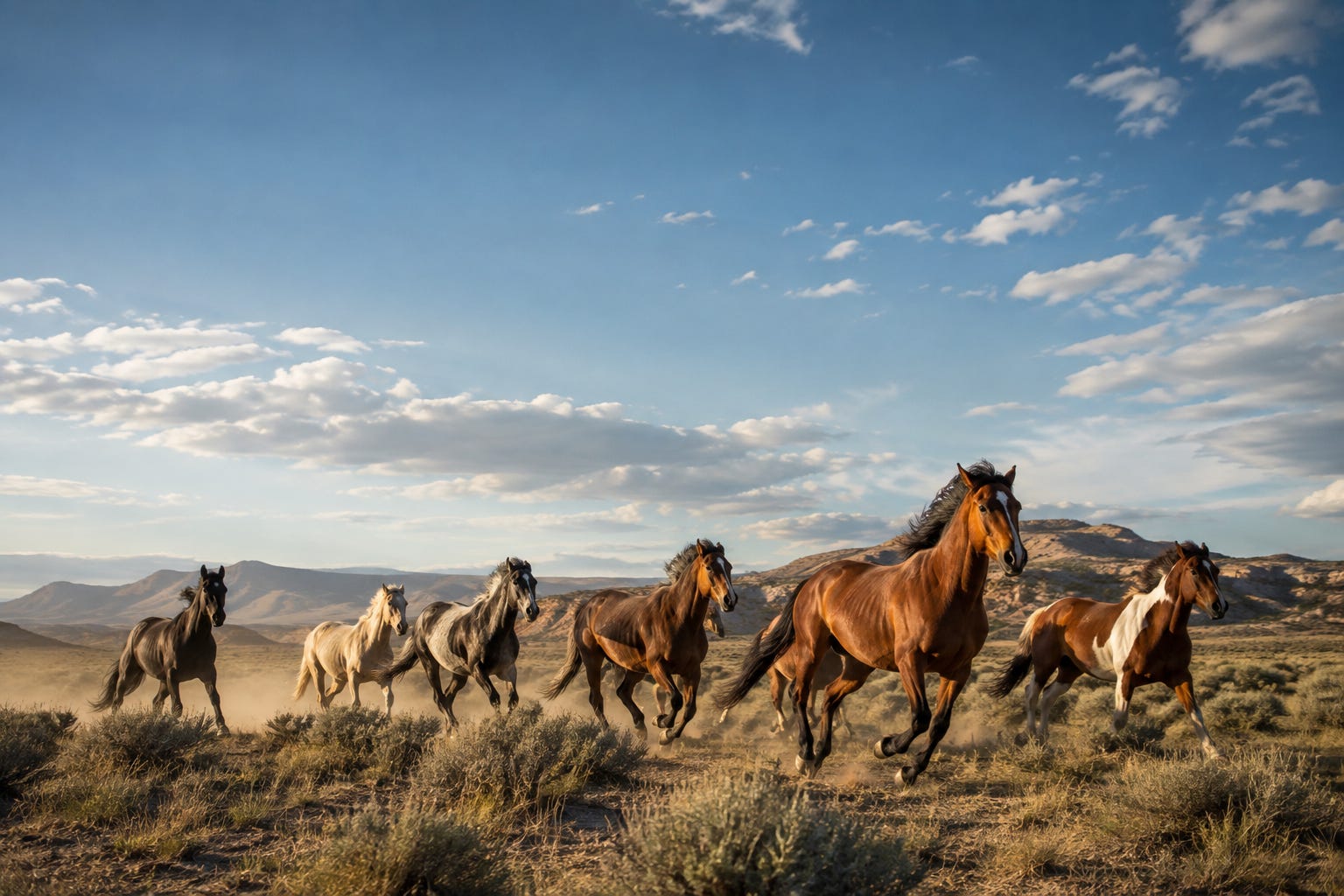
“A loophole big enough for a livestock truck is not much of a safeguard.”
For more than half a century, America’s wild horses have been protected under federal law. They remain one of the enduring symbols of the American West, animals whose survival on public lands has become part of the national story.
That makes what is happening now especially disturbing.
A recent investigation into the Bureau of Land Management’s wild-horse sales program found that federally protected mustangs have moved through private buyers and livestock dealers into channels associated with slaughter, including operations supplying Canadian slaughterhouses.
Some of those horses were sold by the government for as little as $25.
The problem is not simply that the horses are being removed from public land. It is what can happen after the federal government sells them.
The Bureau of Land Management, or BLM, removes thousands of wild horses and burros from Western public lands each year. The agency says these roundups are necessary to prevent overpopulation, protect forage and water, and reduce damage to fragile rangelands.
There is a legitimate debate over how wild-horse populations should be managed. But management and disposal are not the same thing.
Under a 2004 amendment to the Wild Free-Roaming Horses and Burros Act, certain animals may be sold once they are more than 10 years old or have been unsuccessfully offered for adoption at least three times. Once a sale is completed, legal title passes to the buyer.
And sales have increased sharply.
According to BLM data, the agency sold 1,509 horses and burros in fiscal year 2024. In 2025, that number jumped to 3,718, including 2,387 horses and 1,331 burros.
That means thousands of formerly protected animals moved into private hands in a single year.
One livestock trader in Ohio reportedly obtained hundreds of mustangs. Some horses were sold for $25 each, while animals entering the commercial slaughter trade can be worth considerably more.
That kind of price difference creates an obvious incentive.
The buyer reportedly denied sending horses to slaughter, but did not fully account for where many of the animals ultimately went.
And there lies the larger problem. The federal government may know where a horse was rounded up, which holding facility it entered, and who bought it. After the sale, meaningful oversight can become far more difficult.
BLM policy states that wild horses and burros are not to be sold for slaughter. Buyers are required to certify that they will provide humane care and will not knowingly transfer the animals for commercial processing.
Congress has also restricted federal funding from being used to facilitate the commercial destruction of wild horses and burros.
That sounds reassuring until you look at how the process works.
Once legal ownership passes to a private buyer, federal protection weakens dramatically. Horses can change hands again. They can move through livestock auctions, dealers, transport networks, and holding facilities.
At that point, the government may no longer have a clear picture of where they are.
Reporting on one group of 68 mustangs illustrates just how easily that can happen. The horses had once roamed freely in the West. They were transported roughly 1,800 miles to an Ohio buyer who reportedly paid $25 apiece. Soon afterward, cattle trucks arrived and carried them away.
Where they ultimately went was not publicly accounted for.
That should be unacceptable.
The issue is not whether the BLM personally drives horses to a slaughterhouse. Of course it does not. The issue is whether the government has created a disposal system that makes it possible for protected animals to enter the slaughter trade once they pass through private hands.
If that can happen, the safeguards are not doing their job.
Managing wild-horse populations is difficult. Drought is real. Grazing pressure is real. Long-term holding costs are real.
None of that requires us to shrug at the possibility that federally protected horses could disappear into a commercial slaughter system.
Better management would mean stronger fertility-control programs, tighter screening of bulk buyers, improved adoption oversight, permanent traceability for sold animals, and real penalties for anyone who knowingly sends federally protected horses into slaughter channels.
It should also force a broader discussion about a system that repeatedly rounds up wild horses and then struggles to decide what to do with them afterward.
Americans have spent generations turning the mustang into a national symbol. We put wild horses on calendars, tourism brochures, paintings, documentaries, and Western memorabilia. We admire them because they represent independence, endurance, and freedom.
Yet some can apparently move from federal protection to a $25 sales receipt and then vanish into a system the government can no longer reliably track.
That is not protection.
If the law is supposed to protect America’s wild horses, then that responsibility should not end the moment somebody signs a bill of sale.
Sources: Bureau of Land Management Wild Horse and Burro Program data and sales policy; federal wild-horse protections; recent national reporting on BLM horse sales and the slaughter pipeline. The New York Times: “Under Trump, Protected Wild Horses Are Going to Slaughter,” by Dave Philipps and Erin Schaff, August 20, 2026.
Want to put compassion into practice? Download The 7-Day Compassion Challenge, a practical 17-page workbook from The Vegan’s Voice designed to help you make kinder, more consistent choices for animals. It’s free, or pay what you want. Get your copy here.
I know some may not want to commit to a paid subscription, but if you’d like to support my work, you can always buy me a coffee on Ko-fi. Your contribution helps sustain independent writing rooted in consciousness, compassion, and social renewal. Every bit of support truly makes a difference. Thank you!
Comments
Nothing yet. Say the first thing.
Sign in to join the conversation.