
How many worlds are there? Why do we talk of the Global North and the Global South? What happened to the terminology of First, Second and Third World? Why is it that what was known as the First World is now called the Global North, which is not geographically accurate, and the Third World is now the Global South? What happened to the Second World? And why are countries that used to be called underdeveloped now called developing or emerging?
Six questions in one, which follow on from my last post about the structure of the globalised food industry, where I wrote about differences between rich and poor countries on a single planet. But the truth is, to speak of rich and poor is a simplification. The planet is not only divided into continents but in socio-economic terms, comprises different worlds structured by the power dynamics and patterns of economic development known as geopolitics.
To see this in historical perspective, the old terms belong to the Cold War, when First World designated the heartlands of capitalism, Second World identified the Communist bloc, and Third World comprised the rest of the countries who declared themselves aligned to neither. The new terminology denotes the transformation that occurred at the start of the 1990s when the Soviet Union dissolved, the Soviet bloc collapsed, and the Second World disappeared. This explanation, however, is loaded with amnesia about the origins and rationale of the Three Worlds theory, which was first promulgated in the 1950s in response to the fractured geopolitics of the après-guerre.
WWII led to the demise of the imperialist system by which a small number of super-rich industrialised countries had dominated and exploited the rest of the world, carving it up between them (although notably, China was never absorbed by a single colonial power). The globe was transformed into political blocs, each governed by their own trading rules rather than naked power, but leaving most of the world in the same unequal terms of trade between the industrialised countries of ‘the West’ and the colonies, as one by one, by fair means or foul, the colonies acquired the status of independent states, and passed into the condition that Kwame Nkrumah, the first President of Ghana, called neocolonialism. Instead of Lenin’s Imperialism, The Highest Stage of Capitalism of 1917, in 1965 he proposed Neo-Colonialism: The Last Stage of Imperialism, where he argued that former colonial powers continued to exert economic and political control over newly independent nations through indirect means — such as debt, trade agreements, and multinational corporations — rather than direct political rule.
As for the concept of geopolitics, this is a term coined by one Rudolf Kjellén, a conservative Swedish political scientist, in 1899, which almost a century later, Gearóid Ó Tuathail, a critical geographer called ‘a convenient fiction’ to describe the global conditions of space, power, and technology created by the imperial expansionism of the great European powers that, as Lenin discerned, had reached a new pitch in the last thirty years of the nineteenth century.1 In short, the global distribution of economic power generated an imaginary geography, suitably coloured on distorted map projections of the globe, which did not survive the rise of fascism and the ensuing world war, events that rendered nineteenth century concepts of the balance of power obsolete.
When the League of Nations was created after the First World War, there were 42 founding members, and never more than 63, which then amounted to the majority of sovereign states. When the United Nations was set up to replace it after the Second, its 51 founding members steadily grew in waves as more and more countries claimed independence, sometimes through violent liberation struggles, to reach the current number of 193. However, the structure of the UN betrays the fragility of the post-war world order, which George Orwell, writing at war’s end about the ideological confrontation between the Soviet Union and the Western powers, was perhaps the first to call a ‘cold war’.2 Thus, a global conflict between two opposed and irreconcilable systems of universal values determined the balance of power within the UN, where authority lies not in the General Assembly, but the Security Council, whose decisions are binding on all member states. (This architecture was worked out in a series of meetings during the course of the war, initiated by Roosevelt and Churchill with the Soviet Union and China joining in at the Dumbarton Oaks conference in 1944 and finalised at the Yalta Conference in February 1945, before the Charter was agreed by 50 nations in San Francisco in June.) Of the 15 members of the Security Council, five are permanent members and the others elected by the General Assembly. The five permanent members – USA, Russia, China, UK and France – hold veto power, thus preserving the sense of a world dominated by a small number of major powers which control the space of everyone else, and allowing them to block resolutions any one of them considers against their geopolitical interests. The most egregious is the USA, which has used its veto 89 times in total, 51 of them to protect Israel.
But the new postcolonial states were not to be easily aligned with either the capitalist First World or the communist Second World. On the contrary, the growing wave of historically unprecedented decolonisation presented a field of rivalry between the two blocs and an obstacle to peaceful coexistence. The idea that these were not two worlds but three, and the third of them was a world of poverty, political instability, and lack of economic development, has various sources. Several scholars speak of a short article called ‘Three worlds, one planet’ by the French scholar Alfred Sauvy published in a French socialist weekly in 1952, which occasioned some debate. Almost ten years later, in his signal book The Wretched of the Earth, Frantz Fanon presented the ‘first world’ as the imperialists (who call themselves the ‘free world’); the ‘second world’ as the socialist countries – the U.S.S.R., the people’s democracies of Eastern Europe, China, North Korea, Cuba, Vietnam and Albania; and the ‘third world’ as the colonies and former colonies. This would become the generally accepted definition.
Another source is the Non-Aligned movement, itself a combination of currents. The term ‘Non-Alignment’ was used for the first time in 1950 at the UN by India and Yugoslavia, both of which refused to align themselves with either side in the Korean War. The Bandung Conference in 1955, bringing together 24 nations from Asia and Africa, including China, took a similar stance, then six years later Yugoslavia’s Josip Tito hosted the first conference of non-aligned nations. Yugoslavia stood outside the Soviet camp, the first postwar communist country to defy Soviet hegemony, when in 1948, the country’s communist leadership, in Eric Hobsbawm’s phrase, ‘pushed their resistance to Soviet directives to the point of an open breach’, and subsequently developed their own brand of communism. But by the time Tito played host in Belgrade, the Sino-Soviet split was destroying the unity of the communist world, and China’s response was to adopt a version of the Three Worlds in which they declared their allegiance to the Third. (Tito’s successor as leader of the non-aligned movement was Fidel Castro, a fierce third-worldist whose country nevertheless became strategically aligned with the Soviet Union.)
Over the same period a new generation of intellectuals, several of them in third world countries, developed the theoretical underpinning of underdevelopment, which they interpreted not as a state of existence but a process by which rich countries exploit poor ones, a historical process generated by the development of capitalism itself. The roots of this analysis go back to the Communist Manifesto, which speaks of how capitalism’s ‘need of a constantly expanding market for its products chases the bourgeoisie over the entire surface of the globe. It must nestle everywhere, settle everywhere, establish connexions everywhere,’ and in doing so, ‘industries no longer work up indigenous raw material, but employ raw material drawn from the remotest zones’. In underdevelopment theory, these remote zones are the periphery, and the centres of industry and capitalism are the metropolis; the latter is connected to the former through a network of local metropoles serving as satellites. The result is a lopsided structural dependence in which the exploited country is deprived of the benefits of its own natural resources, whose extraction goes to enrich the industrialised economies that consume them, leaving permanent damage behind, like degraded soil, depleted mines which are irreplaceable, and permanently impoverished populations deprived of just reward. Now we know that beginning with the industrial revolution, this process has also produced the climate change that threatens the whole planet, rich and poor countries alike.
Dependency theory teaches that the poverty of the countries in the periphery does not arise because they are not integrated into the world system, but because of how they are integrated into the system – which extends to finance and banking, political alliances, education, health care and more. The principle object of the system, nowadays known as extractivism, consists in fleecing natural resources in the same way capitalism has always treated nature as there for the taking, and sending them for export with minimal processing (and then sometimes sending them back in processed form whence they came). The process has not only intensified but also mutated, compounded by neoliberal deregulation and globalisation, a new geography of production in which productive forces are dispersed to the periphery in order to exploit the cheap and unprotected labour available there. This did nothing to alleviate the deep inequalities which continued to plague the rich countries, but globally, new forms of interdependency arose, new peripheral metropoles emerged, a new map of well-connected world cities to be found on every continent peopled by both new middle classes and new proletariats.
A new world geography, implying a new geopolitics, demanded a new vocabulary. The first intimation of this turn was a report by a group of wise men and women under the chairmanship of the German politician Willy Brandt, assembled at the initiative of the then president of the World Bank Robert McNamara, published in 1980 under the title North-South: A Programme for Survival. The Brandt Report drew a line on the map between the wealthy, industrialised North and the underdeveloped South at a latitude of approximately 30° North, passing between the United States and Mexico, between Florida and Cuba, through the Mediterranean and north of the Middle East, climbing north again over China and Mongolia, but dipping sharply south and looping round Indonesia to include Japan, Australia, New Zealand, and allowing for one or two anomalies (South Korea, Taiwan, Hong Kong, Singapore)
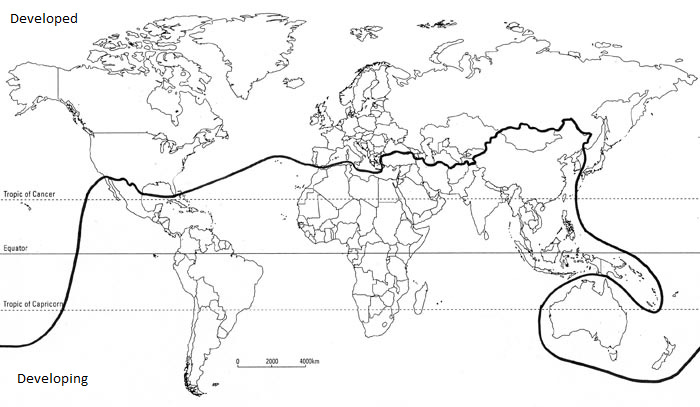
Four-and-a-half decades later this line still holds true, despite the intervening changes – the end of the Cold War, the war on terror, the global financial crisis and more – except for the growing ascendency of China. The Global South has diversified, but global inequality has increased, and the income gap between North and South has grown wider.
The picture is complicated by the break-up of the Second World which left its parts differently aligned. Some countries joined the European Union, others remain within the Russian sphere, and apart from China, the remaining communist states – North Korea, Cuba, Laos and Vietnam – have been marginalised. As for the ‘emerging’ countries of the BRICS, this is an artificial grouping which lumps together disparate countries of different political complexions in Asia, Africa and Latin America with post-communist Russia. They have little in common except a certain geopolitical influence, largely on account of their rich and diverse natural resources, whose exploitation in the face of the climate crisis is increasingly problematic. China’s new pre-eminence comes from its mutation of communism into a new highly dynamic form of state capitalism, while Russia has regressed to oligarchy and autocracy.
Jump forwards, and underlying the incoherence of Trump 2.0 is another shift with deep geopolitical implications, which followed the near-death experience of capitalism in 2008: the growth of the countries of the Global North has faltered or even flat-lined. The underlying health of the most advanced economies is in question. Their growth rate is outpaced by leading economies in the Global South, even though these too are reduced, even in China. Then the coronavirus pandemic put a further brake on the global economy from which recovery is slow, only to be impeded by the eruption of a war in Eastern Europe and then another regional conflict in the Middle East which regressed to colonial genocide, both of which violated the principles of sovereignty enshrined in the UN Charter and other international declarations of what is nowadays called the ‘rules-based order’. To which must be added Trumpitup’s incursion into Venezuela, his moves against Cuba, his threats over Greenland, and now Trumpanyahoo’s war on Iran.
If you enjoy reading this, please give it a like, leave a comment, or share
In How Europe Underdeveloped Africa, Walter Rodney wrote that
In some quarters, it has often been thought wise to substitute the term ‘developing’ for ‘underdeveloped’. One of the reasons for so doing is to avoid any unpleasantness which may be attached to the second term, which might be interpreted as meaning underdeveloped mentally, physically, morally or in any other respect. Actually, if ‘underdevelopment’ were related to anything other than comparing economies, then the most underdeveloped country in the world would be the U.S.A, which practices external oppression on a massive scale, while internally there is a blend of exploitation, brutality, and psychiatric disorder.
This was written just over half a century ago, in 1972, and it tells us what we need to know about any terminology that relegates ‘underdevelopment’ to the trash heap, and any attitude that repeats the same ideology of racist supremacy such as now pervades the far right in actually existing democracy, of which Trumpitup is the quintessence. But if underdeveloped countries are not developing, this is because they’re sucked up into a destructive economic machine, controlled by global corporations that overarch the state and are individually richer than many an underdeveloped country put together. The growth forever promised is never fully delivered, as if the underdeveloped country can never catch up with the metropolis. Such has been the experience of underdevelopment for decades, if not centuries. And the truth is that there’s no catching up, and there never can be, because the gap is systemic. Moreover, it’s ecologically unsustainable. In this perspective, Trumpitup is an avatar of the system, and he’s run amok. The disorder he’s created is also unsustainable, and will necessarily play out on a much shorter time-scale than climate change but just as certainly, although there’s no way of telling how events will unfold, how he exits the scene, and what will follow.
However, you can be sure there’ll be no going back to normal, no return to the status quo ante, which will plainly no longer exist, since it’s already dissolved. A collective awakening when the veil is lifted could become a space of opportunity for a shift in social consciousness. This isn’t just wishful thinking. Here in Britain, something like this happened at the end of WWII, when Churchill was trounced from power by an unexpected turn to Labour’s promise of radical social reconstruction. If the mass begins to think differently, what solutions might then emerge? It won’t be easy. But the old established parliamentary duopoly of Labour and Tory have shed support, and while the populist far right has a massive following, there are signs of it faltering while a radical radical left ecopolitics is gaining ground. We have entered a period when every election is a bellwether in which actually existing democracy is put to the test, and the Prime Minister’s leadership is being questioned.
The greatest danger is perhaps the threat of extremist violence, and a struggling government that doesn’t understand it can’t be contained by authoritarian measures. Nor can the vexing issue of immigration be put to bed by curtailing the rights of immigrants, while failing to open legitimate routes for those who continue to risk crossing the Channel. I won’t list all the other mistakes of Smarmer’s government, or the U-turns, this post is already too long. I’ll say only that under his leadership the British Isles, already cut adrift from Europe, is now at sea somewhere in the Atlantic, and doesn’t know where it belongs, just as the economic tsunami of the Iran war begins to pound our shores. I wonder: is effectively being at war enough to keep him in office? We shall see.
Gearóid Ó Tuathail, Critical Geopolitics, London: Routledge, 1996, p12
Comments
Nothing yet. Say the first thing.
Sign in to join the conversation.