
This month I listened to the audio books of A Complicated Kindness (2004) and A Truce That Is Not Peace (2025), both read by the author, Miriam Toews.
The first is a novel, and the second is a memoir, but there is so much continuity between the two that it’s hard to distinguish. Nomi Nickel is the 16-year-old protagonist narrator of the novel. In the memoir, Toews reads letters written to her sister by her 18-year-old self. They could have been from Nomi.
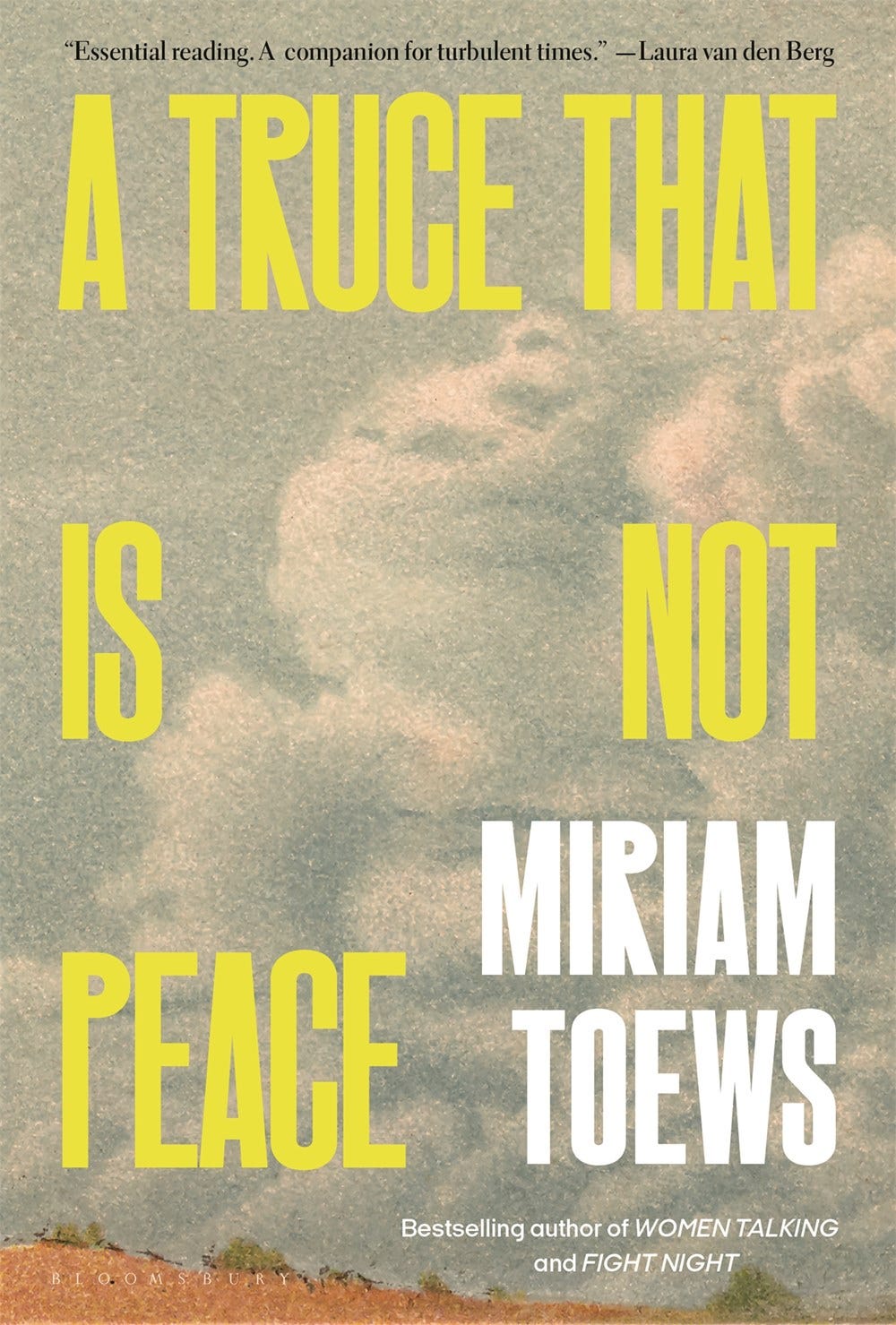
The primary difference between the two books isn’t that one is about a 16-year-old and the other the life story of a 60-ish-year-old. The primary difference is the author’s father and sister ended their lives by suicide, and at the beginning of her story, Nomi’s mother and sister have walked away from home, never to return. Their disappearance is never fully explained. Her father, though, is on the scene.
Are suicides ever fully explained? In her new memoir, Toews is still grappling with that question.
“A truce that is not peace” is taken from an essay by Christian Wiman (“The Limit,” The Threepenny Review, 2001):
I’ve come to believe, and in rare moments can almost feel, that like an illness some vestige of which the body keeps to protect itself, pain may be its own reprieve; that the violence that is latent within us may be, if never altogether dispelled or tamed, at least acknowledged, defined, and perhaps by dint of the love we feel for our lives, for the people in them and for our work, rendered into an energy that need not be inflicted on others or ourselves, an energy we may even be able to use; and that for those of us who have gone to war with our own minds there is yet hope for what Freud called “normal unhappiness,” wherein we might remember the dead without being haunted by them, give to our lives a coherence that is not “closure,” and learn to live with our memories, our families, and ourselves amid a truce that is not peace.
Toews quotes this passage in the memoir. As someone who has experienced profound loss and written about grief, I paused here because … this is very well said.
I will repeat this bit:
for those of us who have gone to war with our own minds there is yet hope for what Freud called “normal unhappiness,” wherein we might remember the dead without being haunted by them
Toews’s memoir is structured around a request she received to write a piece answering the question “What do I write?” She was invited to Mexico City to deliver her piece, but the organizers of the event rejected her contribution and rescinded the invitation. The memoir includes quotes long passages from letters 18-year-old Miriam wrote to her sister in 1982. They made a deal. Miriam would write and her sister would continue to live. Miriam continues to write. Her sister is no more.
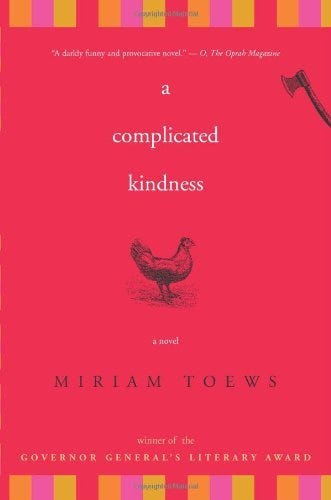
After I finished A Complicated Kindness, I turned to the Internet. What’s with the title? I found the novel a bait-and-switch — I brought to it certain expectations and it turned out to be something else. That’s all on me, of course.
If you want to read the book, read the book, as Douglas Glover wrote.
I read the book and immediately fell in love with Nomi, of course. She is vibrant, vulnerable, funny. But where are her mother and sister? Surely by the end of the novel they will return and the family will be reunited?
Nope. The mother and sister disappear into a void, and the father starts to sell off the furniture and the general collapse of Nomi’s world continues. Except Nomi doesn’t collapse. She carries on until she is, in the end, the last one standing. Offered the opportunity to … do what exactly?
Leave. Follow her dreams, which are, in part, to move to New York City and find Lou Reed. In her dream, of course, her family come with her. In her life, her family leave her to settle her own future. It’s, you know, a complicated kindness.
None of the above makes any sense until you know the geography of the story, which takes place is a Mennonite-centric town south of Winnipeg, Manitoba, the kind of place that demands conformity or expulsion. Grappling with the Mennonite inheritance has remained a constant across Toews career.
Here’s Nomi in full flow:
We’re Mennonites. As far as I know, we are the most embarrassing sub-set of people to belong to if you are a teenager. Five hundred years ago in Europe a man called Menno Simons set off to do his own peculiar religious thing… Imagine the least well-adjusted kid in your school starting a breakaway clique of people whose manifesto includes a ban on the media, dancing, smoking, temperate climates, movies, drinking, rock’n’roll, having sex for fun, swimming, make-up, jewelry, playing pool, going to cities or staying up past nine o’clock. That was Menno all over. Thanks a lot, Menno.
Strangely, I know a thing or two about Mennonites — though of a different sort. Earlier today I visited my mother in her retirement residence, which was founded by Mennonites in east Toronto. There’s a library room off the common area with a shelf of books by “Mennonite authors.” Two of my books are on that shelf, even though the world in which I am considered a “Mennonite author” is extremely narrow. It may be limited to that bookshelf and this online list.
What happened? Well, in the 1970s my non-Menno parents started attending a Mennonite church, and I spent my teen years there, though my experience was nothing like the one outlined by Nomi Nickel.
In 1983, a year after Miriam and her boyfriend, Wolfie, were backpacking through Europe, trying to decide if they were going to be revolutionaries or artists, the residence where my mother now lives opened, sponsored by two Mennonite churches. I spent part of my teen years, weekends, vacuuming the hallways and cleaning toilets there.
Out of interest I asked ChatGPT “Is Michael Bryson a Mennonite writer?” The answer was WTF are you talking about?!
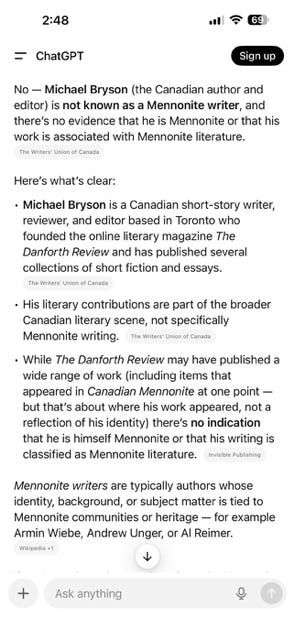
For which I am grateful, truthfully. I have some inheritance from those years, but nothing like what Miriam continues to bring to the surface. (Note: I have no idea what the AI is talking about regarding “items that appeared in Canadian Mennonite” also appearing in The Danforth Review. Um, nope!)
But enough about me, except full disclosure. Miriam moved to Toronto, and so did her mother, and her mother and my mother are now friends. LOL.
I haven’t written about Toews’s work before, though I did a piece here about the Women Talking film (2022), based on Toews’s book of the same name (2018). It has consistently remained one of the most popular pieces on this blog since.
I wasn’t kidding when I said that the narrative voice of the two books is similar. Of course, this might be because I listened to the author read both books, so the voice literally was the same voice. But what I mean, obviously, is the voice of Nomi and the voice of Miriam, especially young Miriam in the 1982 letters, overlap significantly.
In 1982, I was 14, Miriam 18, but the cultural references between line up surprisingly sharply. If we’d known each other in the 1980s, I would have seen Miriam as one of those older cool kids just as in her 1982 letters Miriam is looking up to her cooler older sister. She carries her sister’s LP for Joni Mitchell’s Blue (1971) across Europe. Nomi’s idea of Utopia is wherever Lou Reed is (New York City, obviously).
But the biggest shock to my system was to hear Miriam reference The Dead Kennedy’s Nazi Punks Fuck Off (1981). I’m not going to say I ever had this song on high rotation, but I had a roommate at university circa 1991 who did. Miriam ain’t restricted by the Menno boundaries listed by Nomi above. She fights with the boyfriend from Ireland to Italy in ways that are familiar. The boyfriend quote Kerouac’s “the only ones for me” passage from On The Road (1957). The great roman candle? Yep, I remember being entranced by that. Poor Wolfie, poor Miriam.
In the passage from “The Limit” above Wiman writes of “what Freud called ‘normal unhappiness.’” You may not be surprised that there is a Reddit thread dedicated to the question: What did Freud mean by that? Reddit leads with this bit from the master:
'…much will be gained if we succeed in transforming your hysterical misery into common unhappiness. With a mental life that has been restored to health, you will be better armed against that unhappiness.'
Common unhappiness. Regular sadness. Day to day life.
When you’ve suffered profound loss, frequently feel overwhelmed with grief, the promise of aw shucks, this sucks is greatly appealing. As it should be.
Normal unhappiness is actually a privilege. It’s okay to be not okay.
The self-help books won’t tell you that, but Miriam will.
It is a surprise, though, to consider that Nomi would conclude her journey with a landing pad shaped by a truce that is not peace.
What would Lou say? It’s all good, I’m pretty sure.
In one of Philip Roth’s novels — I’m thinking it’s maybe The Human Stain (2000) — Roth’s narrator drops in a quotation from a real world research article that concluded sadness in the state of normal. That is, psychology could not — should not — cure sadness. To do so, the narrator implies, would be to irradicate the human condition. Sadness is base reality. Awareness of loss. Awareness of death. Awareness of all that is fickle and unjust. Which is why I think it’s in that novel. Humanity is stained with imperfection, Roth is saying. Accept it. It’s not bad advice, IMHO.
If I have anything critical to say about A Truce That Is Not Peace, it might be that it feels incomplete. That is, there are levels of analysis that are hinted at but not developed. For example, at one point the author mentions being in a classroom of literature students — not unlike the classroom that opens The Human Stain, come to think of it — and one student tells her that her time is up. She should stop writing, stop speaking, start listening. This instruction is on theme, for sure, to the question “What do I write?” And the author rejects it; we have the book, obviously. But also she does not engage it as she might have, because it gets at a second question — not Why do you write? but Why don’t you write about other things? or Why is your writing world still so Menno? or Can’t you see what’s going on in the world? Have you nothing to say about — what’s out there, not just what’s in here?
Perhaps not a fair question, given the subject matter to Women Talking et al, but I would challenge the author to go big, go outward, more and more.
To be revolutionaries or artists? Young Wolfie and Miriam ponder the options. In the end, it seems neither is viable. Miriam gets a job delivering the weather news. She marries, has kids, loses first her father, then her sister to suicide. She writes.
Keep going. Keep passing the open windows.
Thank you, Miriam. Thank you thank you thank you.
No posts
Comments
Nothing yet. Say the first thing.
Sign in to join the conversation.