
This is the second of two complementary essays to encourage Canadians to think about our future. They are most powerful read in sequence. I hope you have already read Mediocrity: The Canadian Success Story which asks why a country blessed with extraordinary advantages so often falls short of its potential.
Prosperity with Integrity looks forward and asks what kind of future we want. It argues that prosperity and principle are not competing goals but complementary ones. It presents a vision of a Canada that develops its resources responsibly, protects nature, supports democratic values, helps build a more just world, and measures success not only by wealth but by the legacy it leaves to future generations. It explores what Canada could become if it matched its prosperity with responsibility, principle, and purpose.
I invite you to reflect on the ideas raised by these two essays and join the conversation. Canada has been blessed with abundance. The question is will we prove worthy of it.
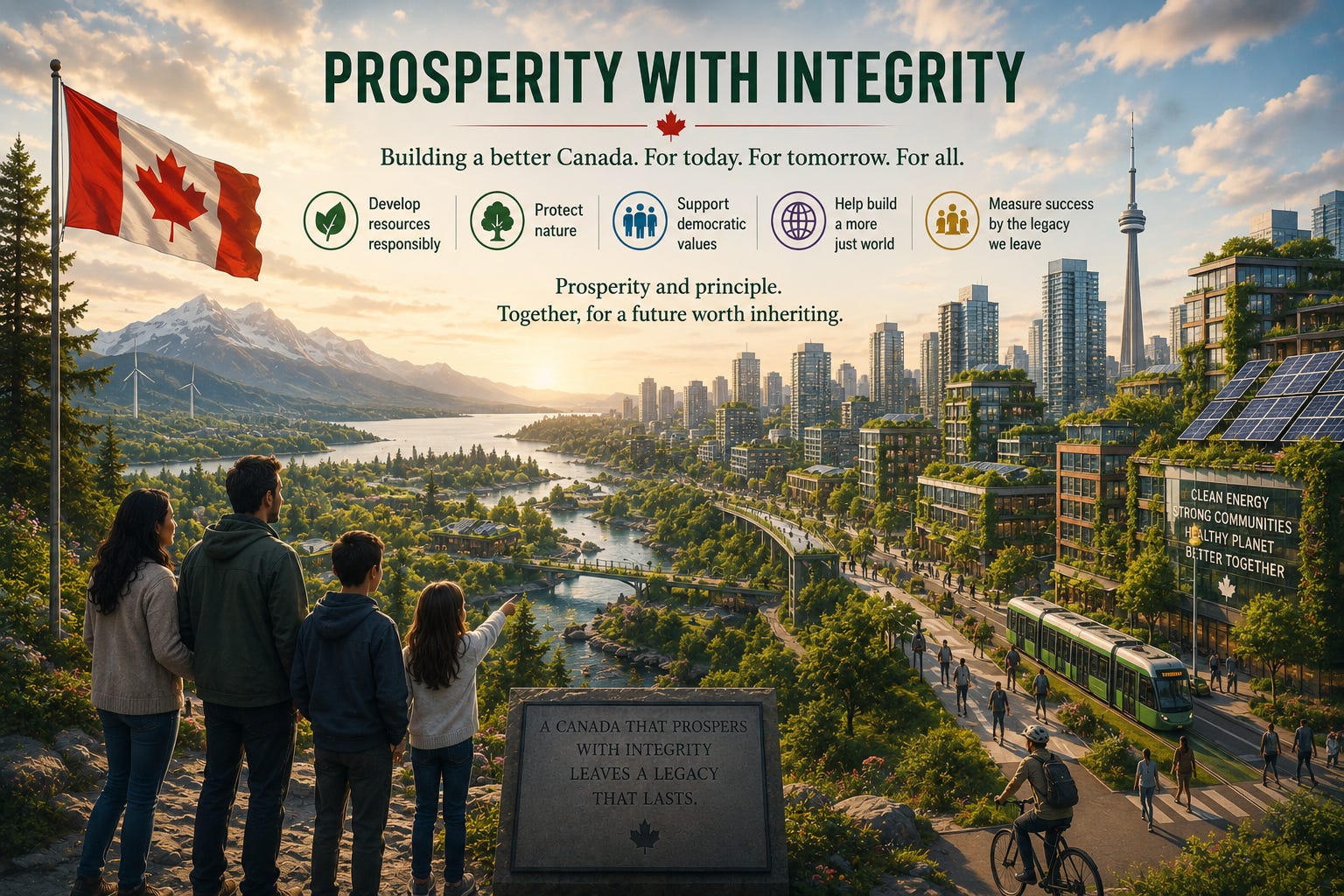
Canada is blessed with extraordinary advantages. We possess vast forests, fertile farmland, abundant freshwater, rich mineral deposits, and enormous energy resources. Few nations have been given more.
Combined with stable institutions and a highly educated population, these advantages give us the opportunity not only to live well, but to do much more for our people and the world.
Yet abundance has not guaranteed wisdom.
For decades Canada has measured success largely by what we extract, export, and consume. We commend ourselves for our values while often ignoring the consequences of our actions.
We speak of sustainability while depleting natural capital and damaging the environment. We champion human rights while overlooking abuses when economic interests are at stake. We praise our generosity while providing declining foreign aid that increasingly serves corporate and political objectives. We celebrate inclusivity while continuing practices that often favour the majority over others.
The question is not whether Canada should be prosperous. Prosperity creates opportunity, funds public services, and improves lives. The real question is whether our prosperity reflects the values we claim to hold and is used to advance them.
Prosperity without integrity is exploitation. Integrity without prosperity is unsustainable. Canada must strive for both.
Canada’s economy remains heavily dependent on resource extraction. We export coal, oil and gas while proclaiming climate leadership. We are among the world’s largest uranium producers and suppliers. We continue to cut forests, including old growth and critical wildlife habitat, and ship raw logs overseas rather than creating more value and employment at home through sustainable forestry.
In British Columbia, governments speak of biodiversity and sustainability while continuing to approve industrial activities in endangered caribou habitat and one of the world’s rarest ecosystems, the Inland Temperate Rainforest. We celebrate environmental leadership while allowing ecological decline to continue.
The issue is not resource development itself. Resources are one of Canada’s great strengths. The issue is whether development occurs responsibly, whether Canadians receive lasting benefits from the depletion of public assets, and whether we use our privilege to do good in the world.
A mature country adds value to its resources, minimizes environmental damage, helps others, honours its responsibilities to Indigenous peoples, and ensures future generations inherit more than depleted landscapes and broken promises.
The same questions apply to Canada’s global mining presence. Canadian mining companies operate around the world and contribute significantly to economic development, jobs, and government revenues. They are our largest economic presence internationally and, for many people around the world, the face of Canada abroad. Yet the industry has also been associated with environmental damage, harmful labour practices, corruption allegations, and conflicts with Indigenous and local communities.
If Canada wishes to be respected as a global leader, Canadian companies operating abroad should meet standards equal to or higher than those expected at home. Economic success should never depend on taking advantage of weaker regulations or vulnerable communities.
Our approach to foreign aid raises similar concerns. Canada was once recognized for supporting community development, education, health, and civil society. Much of today’s is increasingly tied to commercial interests and partnerships designed to reduce risk for Canadian corporations or enhance their public image. Since our pledge to contribute 0.7% of GDP we have fallen to a miserly 0.1%.
There is nothing wrong with business participating in development. The problem arises when public funds are used to subsidize corporations to meet environmental, labour, and human rights obligations that should already be part of doing business responsibly. Aid should empower communities, strengthen institutions, and help people escape poverty and the health, educational and social challenges that accompany it. It should not become a subsidy for activities that corporations ought to undertake on their own. And I don’t mean funding UNRWA to produce Palestinian textbooks that promote antisemitism.
Canada also faces important choices about its place in the world. As economic and political relations with the United States become less certain, diversification is prudent and necessary. But diversification should not mean abandoning our principles.
Rather than strengthening ties primarily with democratic nations that share commitments to freedom, transparency, and the rule of law, Canada increasingly seeks closer relationships with authoritarian regimes whose values differ sharply from our own. China has repeatedly demonstrated that it is not a reliable partner. Qatar remains a major sponsor of extremist movements and causes that undermine peace and stability.
Trade matters, but so does character.
A country cannot endlessly preach democracy, human rights, the rule of law, and environmental responsibility while becoming increasingly dependent on governments that disregard them. We must hold ourselves and our trading partners accountable.
These contradictions extend beyond economics. Canada often presents itself as a moral leader on the world stage yet frequently defends international institutions whose performance no longer matches their ideals.
Iran was elected to the UN Commission on the Status of Women. China and Cuba have sat on the Human Rights Council. UNRWA is infiltrated by Hamas. Agencies created to promote peace and development have too often become politicized, ineffective, or captured by vested interests. Canada should lead calls for meaningful reform rather than defending institutions whose performance no longer matches their purpose.
The deeper issue is not policy. It is integrity.
Too often Canada mistakes good intentions for good outcomes and aspirations for achievements.
We celebrate aspirations while avoiding accountability. We focus on appearances rather than results. We prefer the comfort of believing we are already virtuous to the harder work of becoming better.
Prosperity with integrity requires a different path.
Imagine a Canada that exported expertise rather than merely raw materials, added value rather than shipping resources abroad, protected biodiversity as carefully as it pursued economic growth, supported democratic allies, and invested foreign aid in helping communities become self sufficient as their nations build their own peaceful societies.
Such a Canada would be prosperous, respected, and confident in its purpose. It would demonstrate that economic success and moral responsibility are not competing goals but complementary ones. It would be a country its citizens would be proud of and proud to leave to their children.
A Canada where Prosperity with Integrity means treating forests, rivers, wildlife, oceans, and ecosystems as vital assets to be stewarded rather than inventories to be liquidated in our lifetimes. A Canada where mountain caribou still roam old growth forests, salmon return to healthy rivers, our prairies remain home to sage grouse and antelope, and our oceans remain safe for their rich biodiversity. Protecting our natural legacy is a sacred trust and a wise investment in the future, for both people and nature.
A Canada where Prosperity with Integrity means ensuring Canadian companies meet the highest standards wherever they operate, becoming known not only for their economic success but for environmental stewardship, transparency, labour rights, and respect for Indigenous and local communities.
A Canada where Prosperity with Integrity means supporting development that strengthens communities and people rather than subsidizing corporations. Aid that helps nations educate their children, improve public and environmental health, and strengthen local institutions as they build peaceful and prosperous societies.
A Canada where Prosperity with Integrity means choosing trading partners with an eye not only to profit but also to shared values, and where our commitment to democracy, freedom, human rights, and the rule of law is reflected in both our words and our actions.
A Canada where Prosperity with Integrity means reforming institutions that have lost their way rather than defending them out of habit or simply to be contrary to the United States.
Most importantly, a Canada where Prosperity with Integrity means measuring success not only by economic growth but by whether that growth contributes significantly to a more just, sustainable, and responsible society and world and respects the rights of other species and future generations.
Canada does not need to choose between prosperity and principle. We can develop resources while protecting nature. We can trade globally without abandoning democratic values. We can be influential in the world by walking the talk. We can build wealth while respecting human dignity. We can be both successful and ethical.
Canada’s challenge is not choosing between prosperity and integrity. It is recognizing that one cannot endure without the other.
The question is whether we have the courage to demand more from ourselves and our leaders.
Canada remains one of the most fortunate countries on Earth. Here is the extraordinary country we could become if we chose responsibility over complacency. We have the resources, the talent, the institutions, and the freedom to achieve it. What remains to be seen is whether we have the will.
The measure of a nation is not what it takes from the world, but what it contributes to it.
Prosperity built on expediency may enrich a nation for a time. Prosperity built on integrity can sustain it for generations.
Canada has been blessed with abundance. The question is whether we will prove worthy of it.
Thanks for reading The Wise Guy! This post is public so feel free to share it.
No posts
Comments
Nothing yet. Say the first thing.
Sign in to join the conversation.