
IN A NUTSHELL
For decades, Iran’s regime, funded by criminal networks of oil and drugs, has repressed its people while exporting terror abroad. Despite this, much of the world, including Canada, has chosen sanctimony and self serving inconsistency, while condemning the United States and Israel for doing what others have long avoided, freeing the Iranian people, and the world, from the tyranny of this nihilistic regime.
Canada and its allies issue statements, impose partial sanctions as though they will suffice. They condemn Iranian aggression while avoiding the responsibility to confront it. This is not balance, it is duplicity. While democracies choose comfort over responsibility, the Iranian threat grew. Neutrality in such moments is not prudent; it is a failure of courage. It is willful blindness, and history will judge us accordingly.
Canadian intelligence has already warned of regime linked people and activities within Canada. Distance does not guarantee safety and denial invites the very threat we hope to avoid.
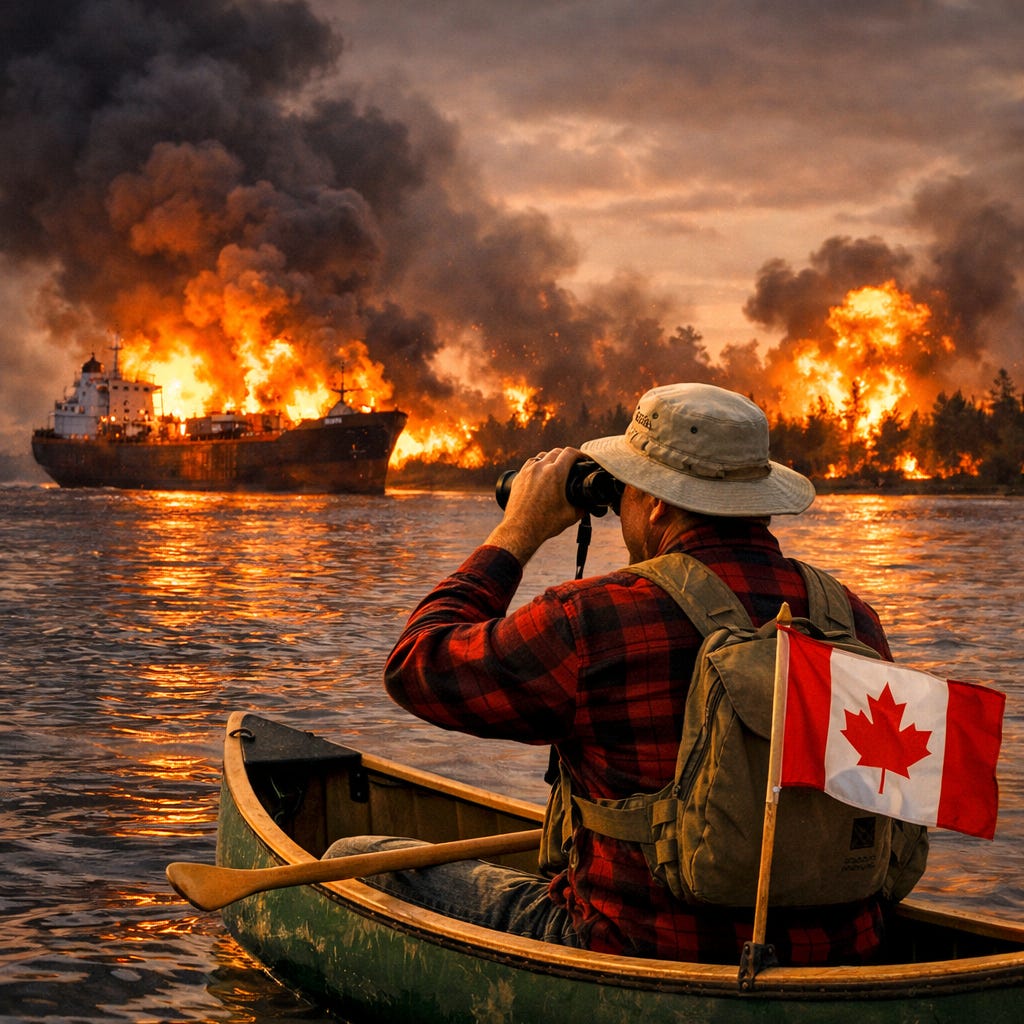
IN BRIEF
Neutrality Is Not Always Neutral: It Can Be Cowardice or Self Interest in Disguise
There are moments in history when neutrality is neither prudent nor wise. It is a lack of courage. We are living through one of those moments.
For nearly 50 years, Iran’s regime has combined repression at home with destabilization abroad. It jails dissidents, subjugates women, persecutes minorities, and exports terror through proxies like Hezbollah and Hamas. This is not speculation. It is well documented. Oppression at home. Violence abroad.
This system is sustained by criminal networks, sanctions evasion, and vast financial flows from drugs and oil that enrich elites while ordinary Iranians suffer. Wealth that could build schools and hospitals instead fuels an “axis of resistance” and personal enrichment.
The consequences are not distant. Canadians were among those killed when Flight PS752 was shot down. Iranian backed networks have carried out attacks globally. As Iran advances its nuclear and missile programs and aligns with Russia, China, and North Korea, the threat has become global.
Yet much of the world responds with hesitation.
Canada and its allies speak the language of human rights and the rule of law, but too often fail to act when those values are tested. Sanctions exist, but they are partial and inconsistently enforced. Some European nations cynically continue trade and diplomacy even as the regime’s malign conduct grows.
Neutrality has become a shield for avoidance of responsibility.
When democracies continue business as usual, it is not pragmatism. It is greedy self interest over responsibility. When governments say, “this is complicated,” they often mean they are unwilling to help bear the cost of doing what is right.
This carries risk. Threats ignored do not disappear. They expand. Canadian intelligence has already warned of regime linked people and activities within Canada. Distance does not guarantee safety nor does sticking our heads in the sand.
There is another troubling silence. This is a regime that brutalizes women, imprisons dissidents, and executes those it deems immoral. And yet many who champion human rights elsewhere remain muted. Silence, in this context, is not neutrality. It is complicity.
As Adam Zivo notes, Canada and its allies condemn Iran’s actions and speak of security, while refusing to act. They still promote diplomacy that has repeatedly failed. They ignore Iran’s role in conflicts from Ukraine to Israel, as if the same regime threatening global stability, were someone else’s problem.
This is not neutrality. It is willful blindness.
In moments like this, the choice is not between war and peace. It is between courage and cowardice, clarity and confusion, responsibility and self interest.
History will judge us accordingly.
THE FULL STORY
Neutrality Is Not Always Neutral: It Can Be Cowardice or Self Interest in Disguise
The world’s failure to confront Iran’s regime exposes the cost of looking away
There are moments in history when neutrality is neither shrewd nor prudent. It is a lack of courage.
We are living through one of those moments.
For nearly 50 years, the regime in Iran has been sustained by repression at home and destabilization abroad. It is a regime that jails dissidents, subjugates women, persecutes minorities, exports terror, and openly calls for the destruction of other nations.
This is not speculation. It is well documented. Oppression at home. Violence abroad.
Iran’s regime of terror is central to how it operates. It is funded by billions from covert oil networks, smuggling operations, drug running, and shadow fleets designed to evade sanctions and sustain itself.
The Islamic Revolutionary Guard Corps (IRGC), funds, trains and arms proxy groups across the Middle East, including Hezbollah and Hamas.
Inside Iran, the cost is borne by its own people. Dissent is silenced through intimidation imprisonment, and violence, while denying basic rights.
Over decades, wealth that could build schools, hospitals, and opportunity has been diverted to sustain the regime’s “axis of resistance.” It has also enabled senior officials to enrich themselves, eg purchasing luxury homes in London and elsewhere in the west.
And let’s not forget the Canadians who died when the regime shot down Flight PS752. Nor the people murdered in the bombing of the Jewish community centre in Buenos Aires.
As the regime advanced its nuclear and missile programs, the stakes were no longer regional, they became global. Aligned with Russia, China, and North Korea, Iran is part of a broader axis of instability that openly threatens the democratic world.
The World Dithers and Obfuscates
Despite this, much of the world, including Canada, has chosen inaction and self-serving inconsistency, trading with China and Qatar, yet quick to condemn the United States and Israel for doing what others have long avoided, fighting to free the Iranian people, and the world, from the tyranny of this nihilistic regime.
Yes, there are sanctions. And Canada eventually designated Iran a state supporter of terrorism and listed the IRGC as a terrorist organization.
But these actions are not enough. The reluctance to confront the full implications of the Iranian threat is deeply troubling.
For decades, many European nations, notably Germany, France, and Italy, have maintained trade channels, sought diplomatic normalization, and even created mechanisms to preserve commerce despite sanctions.
Even countries that pride themselves on neutrality, such as Switzerland, have continued financial and commercial engagement, raising uncomfortable questions about whether neutrality has become complicity as was the case during WWII.
Why? economic interests and political expediency often outweigh moral clarity.
Neutrality has become a shield, not for peace, but for avoidance.
Neutrality, Cowardice, Self Interest
Let us call things by their proper names.
When a regime funds terrorism and threatens regional and global stability, neutrality is not balance. It is abdication.
When democracies continue business as usual, it is not pragmatism. It is greedy self interest over responsibility.
When governments say, “this is complicated,” what they mean is they are unwilling to help pay the price of doing what is right.
Neutrality in the face of aggression does not reduce conflict. It prolongs it.
It signals to regimes like Iran that the cost of their behaviour is manageable, negotiable, survivable.
The Illusion of Safety
There is another illusion at work: distance provides safety. It does not.
Canadian intelligence has already warned of Iranian linked threats operating within Canada. We know that regime connected individuals have found haven here, as have their children who study in the very democracies their leadership threatens.
The idea that one can remain on the sidelines while such a regime expands its reach and threats is not neutrality. It is denial. It may well be suicidal.
History is clear on this point. Threats ignored do not disappear. They metastasize.
The Silence of Conscience
There is another silence that is harder to explain.
Where are the voices of the human rights community? Where are the women’s organizations, the defenders of freedom, the advocates for LGBTQ rights?
This is a regime that brutalizes women, imprisons dissidents, and executes those it deems immoral. And yet outrage is muted.
Dislike for a particular US administration is not a credible justification. It is an excuse and a lack of moral consistency.
Or perhaps something more troubling is at work. A reflexive hostility toward Israel that distorts judgment and blinds many to the nature of the regime itself.
Silence, in this context, is not morality. It is complicity.
The Moral Line
This is not a call for reckless escalation or endless war.
It is a call for moral clarity.
The actions of regimes like Iran place them outside the norms of the international system by actively undermining the foundations of stability and human dignity.
When faced with such regimes, the choice is not between war and peace.
It is between clarity and confusion.
Between courage and cowardice.
Between responsibility and self interest.
A Test of Character
Canada and its allies speak the sanctimonious language of human rights, democracy, and the rule of law. Those words matter only when backed by action. Otherwise, they become something else entirely: rhetoric without meaning, values without value, leadership without credibility.
Neutrality in such moments is not a virtue. It is a failure of character. And history, as it always does, will remember the difference.
As Adam Zivo noted in a recent piece, Canada and its allies condemn Iran’s actions and speak of security, while refusing to act and calling for diplomacy that has repeatedly failed. Worse, Western allies ignore Iran’s role in Russia’s war against Ukraine and its war against Israel, as if the same regime threatening global stability were suddenly someone else’s problem. This is not neutrality. It is willful blindness, and history rarely forgives it.
Most telling is what passes for “action.” Canada, alongside the United Kingdom, France, Germany, Italy, the Netherlands, and Japan, now expresses a “readiness” to help ensure safe passage through the Strait of Hormuz. They say planning is underway while the burden of action falls to others. Time will tell if this Is leadership, or moral posturing dressed up as caution?
No posts
Comments
Nothing yet. Say the first thing.
Sign in to join the conversation.