
Many moons ago I wrote a deep dive article on the house of Le Labo, examining the brand ethos and reviewing every perfume they had released up to the date of publishing in 2021. (You can find a link to the article below). Since then I’m sometimes asked if I intend to add each new Le Labo scent to that article as they are released. I’ll admit that the completionist in me is tempted to do exactly that. But the article is long enough already, and there’s a bigger instinct in me to let the post rest exactly as it is, capturing a moment in time in perfect stillness like a black and white photograph.
But Le Labo keep releasing perfumes and I keep having opinions about them. I’m on a trip away this weekend to the city, where I hope to smell many new and notable things, so today I thought that we could revisit some of the newer releases from the house and see how one of the great perfumery experiments of the 21st century is faring.
Becoming reacquainted with the Le Labo naming system feels like catching up with a bitter enemy. The familiarity I feel enrages me. And yet here we are, staring down a bottle of The Matcha 26, a tea perfume that once again smells nothing like its name.
For those who are new to the Le Labo way, each perfume is named after the ingredient with the highest dose in the formula. (Though I have always wondered how they ‘calculate’ this - weight? Cost per ml? Divination? The mind boggles). This often leads to perfumes that are named one way and smell another, leading to mass confusion in the consumer who start to believe that a sweaty cumin note smells like a rose, or that violet leaves smell like sandalwood. Only in perfumery could you do this, though there is an argument to be made that you shouldn’t just because you can. Le Labo didn’t listen.
The best thing to do with a Le Labo sample set is to have a loved one or a dear friend to spray the samples for you so that you can smell them blind. This way you avoid the problem of getting angry at the name and can judge the perfume on its own merit. This is impossible when you’re standing at the booth with the bottle in your hands, alas, and once again I felt the football being yanked out from underneath me as my nose went hunting for matcha where none could be found.
And I’m curious, here - are Le Labo really expecting us to believe that they dissolved actual matcha powder into this perfume? Did they use ceremonial grade? How can this be the base material if it is an accord? Are we put on the earth merely to suffer in silence and in solitude?
Anyway, the perfume. My initial and abiding reaction was, ‘This is a room spray’. That is mainly due to the fact that it smells like a room spray. The base structure is of a light, aerated fig-vetiver, not worlds away from the spiky, cedary The Noir 29. It’s fine. You can never say that a Le Labo scent is incompetently done, which is why it is so frustrating when they are also never brilliant. It’s an aromatic amber that hits all the beats it needs to as a perfume, like ticking off boxes - top notes, heart, dry down. Fig, tea, vetiver. Check, check, check. Kafka would love this perfume. He would wear it at a typewriter and weep.
Smelling The Matcha is like dealing with a student who has buckets of talent and no ambition to apply it, and instead uses all their cleverness to create elaborate prompts for Chat GPT. The class is passed; the perfume is wearable; the mediocrity corrodes until there is no one left to make anything weird or brilliant or dark or strange.
Le Labo was born out of a desire to scent the lobby of the world’s fanciest hotels, and the bones of this mission are shoved into the skeleton of The Matcha 26. Of the named matcha I can smell barely a hint, and that’s if I really try. I think there is a grassiness to the scent, mainly from the vetiver, that could slot against matcha’s green, powdery bitterness if one strains imagination and credulity. A perfume’s name is an expectation to the consumer, almost a promise, and it’s fascinating to me how this brand seems intent on breaking the covenant at every turn.
There is a homeliness to The Matcha in the sense that it lingers, quietly, on the edges of your attention. It is never absent but also never the focus of your thoughts. It smells like walking back into your house after a long trip away, when the idle smell of your rattan diffusers, your candles, those sachets you threw in your cupboard are novel again for a moment or two. There is nothing unfamiliar here, but nothing of much interest either. When I wore it, I found myself thinking of how long it had been since I had dusted my bookshelves.
As a brand, Le Labo sells two types of perfumes: the original line up and City Exclusives. Within those lines, Le Labo creates two types of perfumes: linear cedar-nothings that linger like spa water after a cleanse, and fuck-you chaos grenades that knock down walls and destroy the plaster.
Myrrhe 55 is the second kind.
Naturally this is the type of perfumery that I am partial to, far more than the motionless boredom of Le Labo’s other face. I am surprised by how much I like Myrrhe when I first sniff it. It’s a huge, bombastic white floral amber in a deliciously slutty, vintage style. There are echoes of Le Labo’s monstrous she-beast Ylang 49 here. But I’m also reminded of the great white floral ambers of the 70’s and 80’s, Opium and Coco and Poison, which have clearly influenced its structure.
There’s a heady, perhaps aldehydic, opening that makes me think of the shellacked hairspray smell that covered the walls of hairdressers when I was a child. It is striking how easily one can recall the humid, slightly acrid smell of blown-out hair. It’s a smell that many people would call perfumey with a wrinkled nose, and associate with a shrill aunt or a henpecking grandmother. Myrrhe is a perfume, in other words, for a woman who could eviscerate you.
The wonderfully 80’s opening bleeds into a jasmine-patchouli that is, structurally, a chypre, even if there are no real chypres to be had anymore. A jasmine need not always be whoreish, but I find I always like it better when it is. This is jasmine done pitch perfectly, huge and sickening and so coldly floral that it feels like the shimmering scent that probably hung around the set of Steel Magnolias. Jasmine is not necessarily a tropical floral but it always feels tropical, somehow, gorged on humidity and dampness both, bulging petals and chewy indolic sillage. A good jasmine really is one of the great scents of the world. Myrrhe 55 knows this, and does a damn good job of showing it.
A huge base of patchouli grounds the scent. It is a wet patchouli, gnarled like the roots of a mangrove tree, and refreshingly devoid of any hint of the gourmand. But there is a sweetness to this perfume that feels a little sickly. That would be the myrrh, which with the right shaping can smell ambered and sticky and saccharine like spilled root beer.
There’s a strange coolness that myrrh gives to a perfume that I sometimes think I can even feel when I spray it on the skin, like it’s lowering my body temperature. It’s probably the most challenging resinous note to do well, though it has been getting some love in recent years from houses like Bon Parfumeur and Tom Ford. Its slipstream cool sweetness adds to the perfume's chypre feeling. A good chypre should always smell a little bit like a just used bathroom, steamy and a bit dirty, and that’s exactly the feeling that Myrrhe gives.
It’s great - a solid, clear eyed, punchy perfume. I’m so annoyed when one of the City Exclusives is great, because their prices are so ludicrous. But I’ll use the sample on days where I feel like I need shoulder pads and teased hair.
So here’s the thing. I really, really try to keep an open mind about every note and accord in perfumery. When I was younger I believed there were some notes that I would never like, some scents that just weren’t for me and never would be. Then I grew up, smelled a lot more perfume, and realised that there are facets to every note that can be stretched and blended and made into something your nose can learn to love.
This is one of the lessons that perfumery taught me that I cherish the most, to keep an open mind. There are always more things to learn, and your understanding needs time and experience to deepen.
That being said… I have always struggled with neroli.
I can’t puzzle my way out of this. I love oranges. I love the smell of an orange. I love the spray of essential oil that zips from the zest of a citrus fruit. I love the smell of orange blossom and of petitgrain, and it’s all part of the same damn tree, so why can’t I learn to love neroli?
She eludes me. There’s something about the balmy fatty thickness of this note that turn my stomach. It smells like the residue that dried up Play-Doh would leave on my hands as a child, like the plastic-rubber tang of cheap balloons. In the olfactive language of perfumery, neroli is a happy smell, a bright smell, the scent well tanned skin, of lazy beachside afternoons. To me it smells like a suburban children’s birthday party that has partly descended into hell. Such implications are hard for the mind to shake.
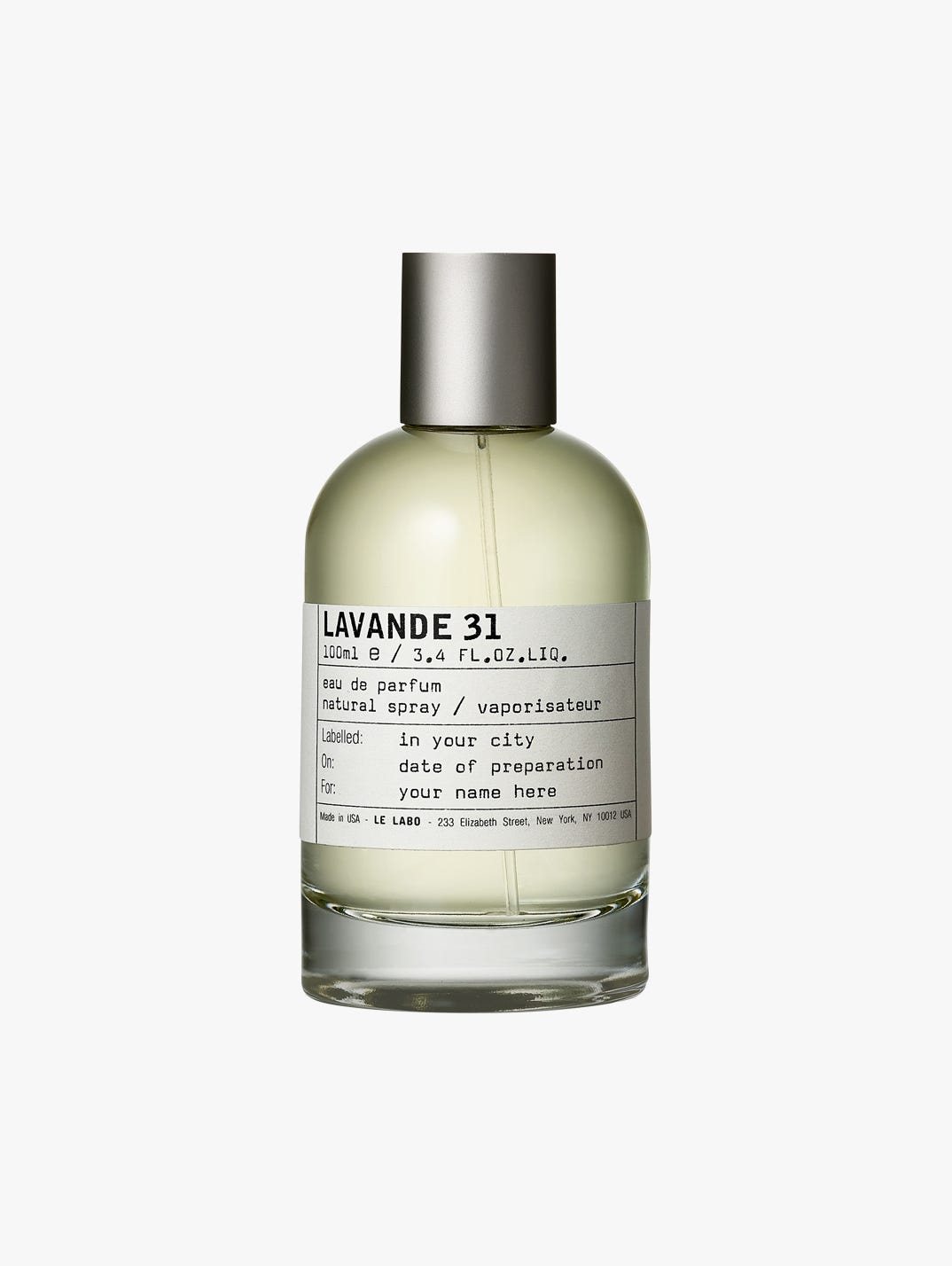
This is all to say that Lavande 31 is primarily a neroli perfume and that’s probably a big reason why I don’t like it. I say this because sometimes I don’t like a perfume because it is not good, and sometimes I don’t like a perfume because I don’t like it, and this is the latter. In fact, I’m not sure if I could tell you if this is a good perfume or not, because for me it is bad and beyond that it’s anyone’s guess.
I will say that this is, structurally, a fougere. That’s easy to guess from the title, and lavender-neroli is a good combination to give the iconic steamy-soapy effect that a good fougere should have. In fact I would say the entire thesis of this scent is ‘fresh soap’, as if a bar of soap could somehow be fresh, as if it sprang out of the ground that morning.
The risk with a soapy lavender is that it will smell a bit like pot pourri, which this perfume does. I don’t think that is a bad thing (and as a child quite loved running my hands through the bowls of pot pourri we had around the house - perhaps as an antidote to the Play-Doh), but does take the scent out of purely masculine coded territory to sit more comfortably in the realm of your grandmother’s handbag. There’s a nostalgic thread to the smell, a comfort in its familiarity that is also common to get from a fougere, but it does feel dated.
All Le Labo scents are created for the beanie wearing, single origin coffee bean sipping hipster that lurks in the streets of your country’s biggest city. I judge their perfumes based on whether this elusive creature would wear them.
Here’s the conclusion I came to for Lavande 31: there is something almost too earnest about a neroli fougere. It is too bright, too hygienically clean, too suffused with a forced enthusiasm for anyone who has ever felt a shred of cynicism to wear seriously. Lavande 31 is not even a perfume you could wear ironically. It is a perfume designed to be bought by rich and gormless men and then stolen spray by spray by their beautiful girlfriends to spray over crisp shirts and designer jeans, on a beachside, in the summer.
I wish every purchaser of Lavande 31 a happy, sunny life with their bottle. In fact, please buy two - the more neroli that goes into this perfume means less that I have to smell in other, better perfumes from other, better brands. Buy Lavande 31. Save my nose from further torment. ▧
Comments
Nothing yet. Say the first thing.
Sign in to join the conversation.