
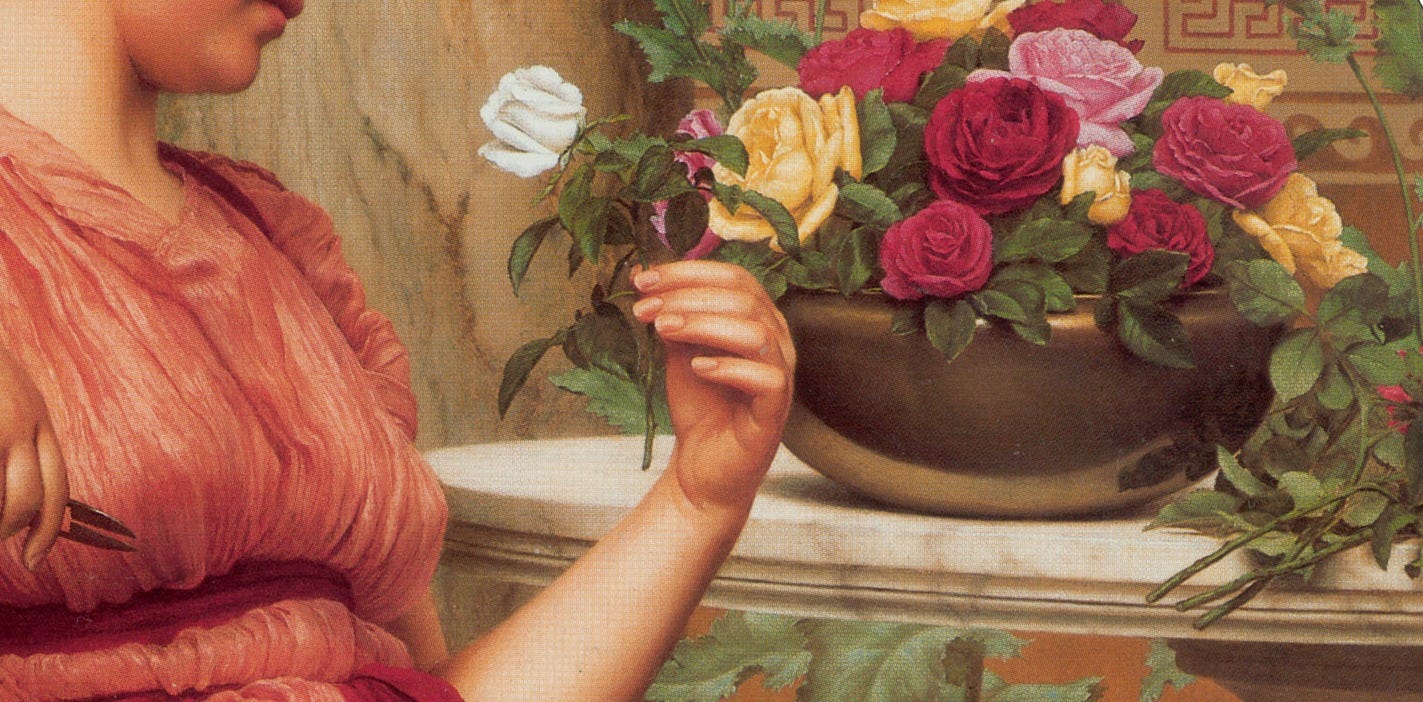
Do you know the story of Tam Lin?
Like all folk tales there are a hundred versions of this story. All are true and none are true, the story changing shape through the teller. Here’s the story as I know it:
The scene is set in the mists of the Scottish Borders. A woman, named either Janet or Margaret, wanders into a field or a forest called Carterhaugh. There she picks a double-stemmed rose, and is immediately forbidden from leaving by the spectre of Tam Lin, a ghostly knight. Tam Lin demands tribute from all the young maids who pass through the forest: their mantle of green or their maidenheads.
Janet eventually wanders home, and eventually discovers she is pregnant. Presumably not too thrilled about the idea of carrying a half-spectre’s baby all on her own, she flees back to Carterhaugh and plans to poison herself and negate the problem. She’s stopped again by Tam Lin, who tells her that they can be together and raise the child if she can solve the problem of his magical entrapment.
He launches into an elaborate backstory of how he was trapped in Carterhaugh by the Queen of Faerie, who plans to use him to pay her yearly tithe of flesh to hell. To save him Janet must lie in wait for the faerie folk to ride on Halloween, pull Tam Lin off his steed and hold on to him as the Queen changes him into a lion, a snake, a bear, a wolf. In time he will turn back into a man, and be free to leave with her. It all turns out for the young lovers, and the Queen rides off leaving them to their happy ending.
The story of Tam Lin and Janet is at least five hundred years old, and probably older. It is sung as a ballad and experienced a folk revival in the 60’s, which you should go and listen to immediately. I love Tam Lin. It’s one of my favourite fairy stories, able to be interpreted in so many contradictory ways. It is, fundamentally, a story of agency, which is probably why it was so popular with third-wave feminists of the 1970’s. They saw in Janet’s determination to get rid of her pregnancy (one of the few unchanging beats in every version of the ballad) an early example of female autonomy in what we can safely call some difficult circumstances. It is Janet that must show courage, that must take action and play the saviour.
I love that this is a story that defies simple interpretation. Like the best fairy stories, what you think you know inverts half way through - is Tam Lin the villain? Does he force Janet into an impossible situation? Or is he the victim, trapped in Carterhaugh by the fairy queen and needing to be saved by Janet and her devotion? Maybe it’s both. Maybe it’s different based on who is playing the song, and who is hearing it. The story changes shape with the telling, and all versions are true.
Tam Lin is a story about autonomy, and consent, and sometimes true love, and the strange magic that weaves through the folklore and history of Britain. It is also a story about roses. It is a rose that triggers the meeting of Tam and Janet, and in many versions it’s a rose that Janet pulls and plans to poison herself with when she returns to Carterhaugh. A rose of love, and death, and destiny.
There are so many rose perfumes on the planet that you couldn’t smell them all even if you smelled one every day for the rest of your life. The olfactive complexity of a rose has given us so many synthetic derivatives that it is perhaps truer to say that every perfume is a rose perfume. There are bright roses and jammy roses, roses for a sunny day and roses for the rain. There’s a rose perfume for every occasion that marks a life, births and deaths and weddings and funerals, roses for trips to the post office and roses for your holidays.
But those aren’t my favourite roses. I like a rose that’s dark around the edges, coloured like a bruise; like most floral notes, I think a rose is best when the perfumer gives it a touch of decay. I always like to smell a green and happy young rose, but what I yearn for is a rose as dark and as thick as blood.
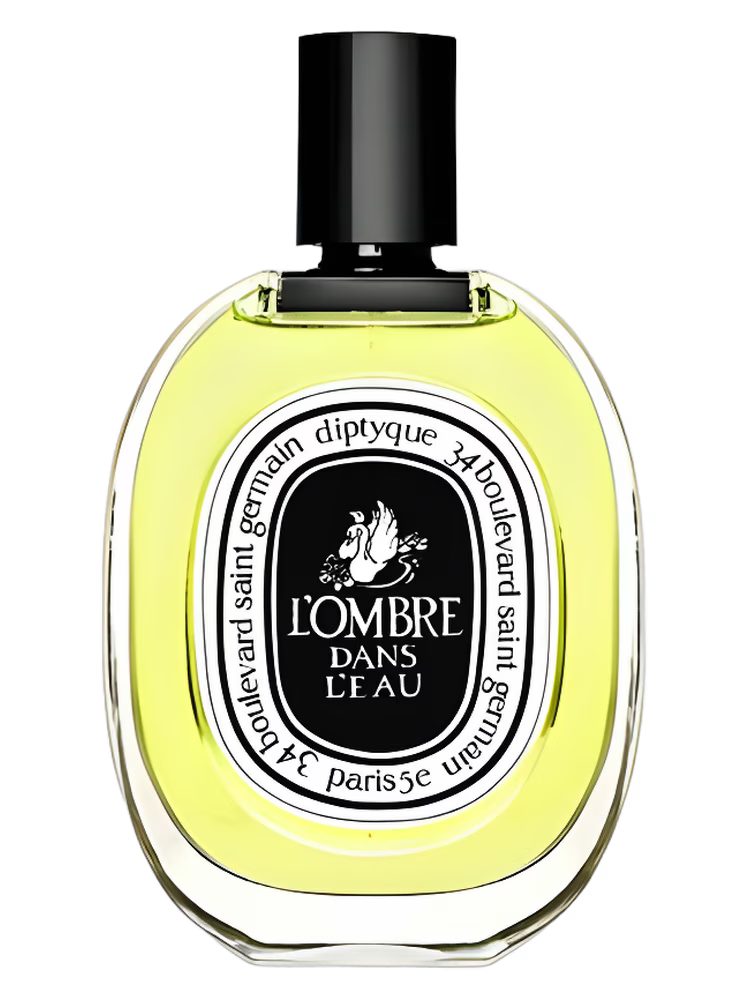
Of gothic rose perfumes there are many, some brilliant and some banal. When I smell a rich, decadent rose perfume my brain jumps to images of vampires in crypts, the Phantom of the Opera, women in dresses running away from castles. But there’s only one that made me think, immediately, of Tam Lin, and that was L’Ombre Dans L’Eau.
Every perfume house has their own unique take on the rose. Andy Tauer, for example, favours a rose accord that is so peppery-metallic that it fizzes like sparkling wine on the palate; Chloe, by contrast, loves a rose that is powdery and soft like a forgotten lipstick at the bottom of a vintage purse.
I have never been much of a fan of the Diptyque rose. Like many of their notes it is a wan thing, like a portrait painted in watercolour, barely present on the page. This is a theme in the world of Diptyque. It drives me mad sometimes, the limpness of their perfumes - it’s as if they want their scents to smell like they’ve been run through a water diffuser. Some may call this elegant - I call it halfhearted. Sometimes it works (Tam Dao). Most of the time it doesn’t (L’Eau Papier).
My expectation of the house watery-gossamer style is why L’Ombre Dans L’Eau blew me away when I first smelled it, and every time I have smelled it since. It is an interpretation of the iconic Baies candle, a blackcurrant and rose scent of immense presence and force.
Blackcurrant and its other half, cassis, are the kind of notes that set the olfactive tourists apart from the real freaks. There’s a distinct note of ammonia to the stuff, which can smell delightfully astringent and biting in small doses, and like a dirty cat litter when dosed in poor judgement. Blackcurrant the kind of note that needs restraint and balance to work in a perfume, which is where Diptyque’s characteristic moderation comes in to play.
When used on quiet notes this style reads as boring; when used on the big hitters, you can get something magical. L’Ombre walks the tightrope with its blackcurrant, balancing it with a green, peppery rose that blends into a warm cedary drydown. The force of a blackcurrant note feels like a slap of icy cold water to the face when you first smell it, so sharp and bracing and green. I have never grasped a fist of nettles but I imagine it would feel like this, a sting of such verdant force that it feels as if nature is, at last, biting back.
A rose is so versatile that it can accompany pretty much every note in perfume in one way or another. It can exaggerate the sharp bite of blackcurrant by reinforcing those green, peppered edges, or soften it with a velvety roundness like the soft touch of a rose petal. It can even do both, all at once, and so it does it in L’Ombre. You could lose yourself in the olfactive universe of a rose. When I smell this on my wrist I can’t help but smile, because every hour it shifts into something strange and beautiful and new.
L’Ombre is not a complicated perfume. But it is a very beautiful perfume. It’s the kind of perfume that lifts you out of the drudgery of your day, the endless void of manufactured anger and targeted advertising on your phone screen, to somewhere else entirely.
The thing about blackcurrant, and about a really beautifully rendered rose note, is that they somehow smell ungovernable. Your nose understands that these are smells too strange and complicated and wonderful for a human to have created. Your nose knows that these are the smells of nature; the smell of an ecosystem so much older and cleverer than our small civilisation.
There are some perfumes, like a fairy tale, that have a sense of timelessness that hangs like a sheen around them. A sense of unreality. Unseelie. This is different from the way you can smell something modern (typically loaded with musks and woody ambers) compared to something vintage (typically deeper drydowns and more natural materials). There are some perfumes that smell like they have always existed and will always exist, as if they were simply out there in nature waiting for a clever perfumer to find and bottle them.
When you smell these perfumes you are transported not into the shoes of any person, or to any particular time or place in the mortal world. They take you instead into the looking-glass world, the world beyond the world, the place where it is always twilight and the earth is balanced on the precipice before the night.
It’s a strange truth that the world we live in is so drenched in modernity that the deep smells of nature are enough to transport us to the realms of fantasy.
I suppose it’s the wildness of L’Ombre Dans L’Eau, its timelessness, that made me think of Tam Lin. There’s a seamy underbelly to the ballad and to the perfume, a sense of shadows moving just beyond your eyeline in both of them. And I think there’s a sense of violence in both of them as well. The confronting bite of the blackcurrant and its medicinal-poison edge; wrapping your arms around a man as he changes from beast to beast to beast, scratching you, hurting you, before turning back into something you could love. A beautiful and poisonous rose plucked by Janet’s hand.
The violence is not a flaw in the construction, but the very reason why they work in the first place. The contrast of the violence with the beauty is the point. Or at least it is, in my interpretation. Perhaps all perfumes are like a folk story, shifting as they move through time.
The perfume changes shape with the smelling, and all versions are true. ▧
Comments
Nothing yet. Say the first thing.
Sign in to join the conversation.