
Comfort Food follows the most practical part of my magic practice—recipes. Here’s what keeps my household healthy.
I’m aware that I’ve posted a chicken adobo recipe before—I called it adobong manok, same difference. It was the post that started this Comfort Food series! The recipe below is the current evolution of that previous one, adjusted to fit my pantry, taste, and current lifestyle. (But I did reuse the image from the old recipe for this post, sorry!)
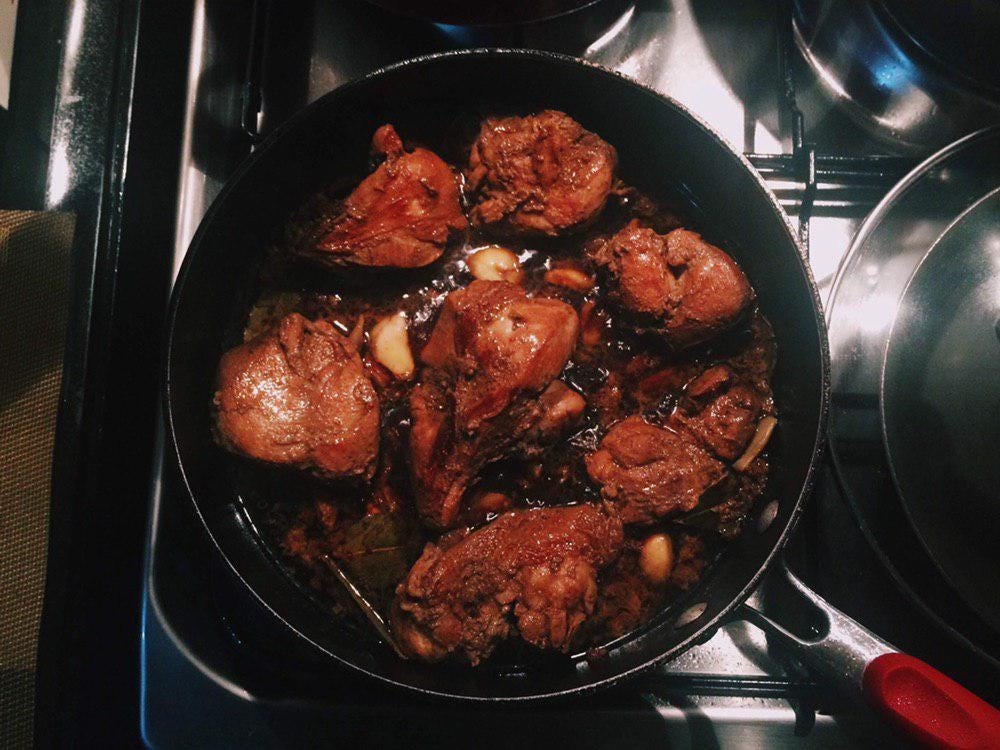
Let’s get this over with before we start: I DO NOT put onions in my adobo. Onions belong in bistek and not adobo. I said what I said. If your family adds onions to adobo, follow their recipe. I also don’t put Reno liver spread in my adobo—or use it in my kitchen at all, because it was previously not FDA-approved (although it is now)—but I grew up with a family that did add it sometimes.
450g chicken, cut into bite-sized pieces1
120g (1/2 cup) soy sauce
60g (1/4 cup) vinegar2
30g (2 tbsp) granulated sugar3
30g garlic, minced
1 tbsp animal fat or neutral oil4
1 tsp chicken bouillon paste
1 tsp garlic powder
1 tsp kosher salt5
1 tsp black pepper, ground6
1–4 bay leaves, dried
You’ll also need a sealable plastic bag (I use Ziploc) or bowl and a pot or sauté pan.
Prepare the chicken. Cut the chicken into bite-sized pieces (approximately 1–1.5-inch cubes). This isn’t traditional, but it works for my cooking style and my lifestyle in general. (If you’re using chicken with skin on, remove the skin first and set it aside to fry by itself. This makes two things: fried chicken skin that you can use as an appetizer or a crumbled topping over your adobo, and chicken fat that you can use later on in this recipe and in other dishes.)
Marinate the chicken. In a sealable bag or bowl, add the chicken, soy sauce, garlic powder, and a little bit of the vinegar—something like 1 tbsp from the 60g required by the recipe. The latter is added to help tenderize the meat. Ideally, you should leave this in the fridge for 4–24 hours, but you can also cook right away if you don’t have the time.
Brown the chicken in the pot/pan. Add animal fat or neutral oil to your pot/pan over medium-high heat. When the fat/oil is hot/glistening, add the chicken (without the marinade—save that for later) and try to brown each side for 2 minutes at a time. I usually wait 2 minutes, then toss—about three times in quick succession. The goal here is just to get color on the chicken, not to cook it completely. Add garlic and stir for 1 minute or until fragrant.
Simmer the adobo. Add the marinade, bay leaves, and chicken bouillon paste. Wait for it to boil, then turn the heat down to low, cover, and simmer for 10 minutes.
Adjust the flavor to your taste. After simmering, add the sugar, salt, and black pepper—the amounts listed in my recipe are based on my own preferences. You can adjust the amounts to fit your taste. Cover and simmer for 5 minutes more.
Optional: Sear the chicken separately from the sauce. When I have the time, I separate the sauce from the chicken before serving, and I do one or two things. First, I sear the chicken without the sauce in the same pot/pan it simmered in, just to lock in the flavors and maybe add some crisp to the outside. Then, if the sauce is too watery—it rarely is, because my adobo recipe doesn’t use water at all—I set aside the chicken and add the sauce back in the pot/pan and simmer over low heat until it’s at a consistency I like.
Can you use this recipe to make pork adobo? I haven’t tried it, but I assume it would work. Use pork belly or shoulder, cut into 1–1.5-inch pieces. You probably won’t need the extra animal fat or neutral oil when browning the meat, though. My family’s adobo recipe—different from mine—actually uses a mix of chicken and pork, with the chicken not cut into bite-sized pieces.
Can you use other types of vinegar apart from the ones I mentioned? You can try! I have also used plain white vinegar and fermented cane vinegar (sukang Iloko).
Can you use chicken stock, chicken bouillon powder, or a chicken bouillon cube instead of chicken bouillon paste? Of course, but that would affect how much salt or pepper you’d need to add at Step 5. Using chicken stock would also introduce more liquid to the recipe, which would definitely require the second thing mentioned at Step 6. I developed my chicken adobo recipe specifically to not have a watery sauce—I like my adobo sauce to be glossy and a little thick. That’s actually why I cut the chicken into small pieces—so I don’t need to add water to cover the big chicken pieces before simmering. Do you want more sauce, but don’t want to spend time reducing it over the stovetop after adding water? You can double and even triple the soy sauce, vinegar, and sugar amounts, as long as the ratio remains the same—4:2:1.
Any time! This dish pairs well with rice and a vegetable side, like sautéed green beans or spinach and mushrooms. But, honestly, adobo tastes best the day after… or beyond. What I’m getting at is that it tastes better as leftovers in the fridge that you heat up in the microwave or a pan on the stovetop. You can even use just the sauce and bahaw (leftover rice) to make adobo fried rice!
I also have a baked miso and sesame chicken recipe that’s close enough to adobo—in that it uses many of the same ingredients—that you can do if you want to make a set-and-forget meal and don’t feel like babysitting a simmering pot/pan to make a meal. My former co-workers loved this recipe, and I think I unintentionally led them to believe that it was an adobo recipe when I introduced it to them.
If you’ve enjoyed reading this or something else I’ve written, please consider clicking the subscribe button or buying me a coffee. ☕ Thank you!
I typically cook boneless/skinless chicken thighs from Costco, and each pack is just a little over 450g, anywhere from 500g to 575g. Because I don’t like refreezing defrosted chicken, I usually just use whatever’s in the pack—but the origins of this recipe started with 450g.
I find that a mix of different vinegars gives the adobo a more layered flavor profile. I typically use a mixture of rice vinegar and apple cider vinegar.
Again, a mix of different sugars can add to the layers of flavor. I use a mixture of white and brown.
Typically, I use chicken fat or avocado oil.
Kosher salt is not the same as table salt! If you’re using the latter, use less than what’s required by the recipe. I think the ratio is something like 2:3—so, in this recipe, use 1/2–3/4 tsp table salt if you’re not using kosher.
Traditionally, whole black peppercorns are used in adobo. But I broke from tradition because I was tired of fishing peppercorns out of the stew before serving and even while enjoying my meal.
Comments
Nothing yet. Say the first thing.
Sign in to join the conversation.