
I’ve been reading the old Benteen Fargo series.
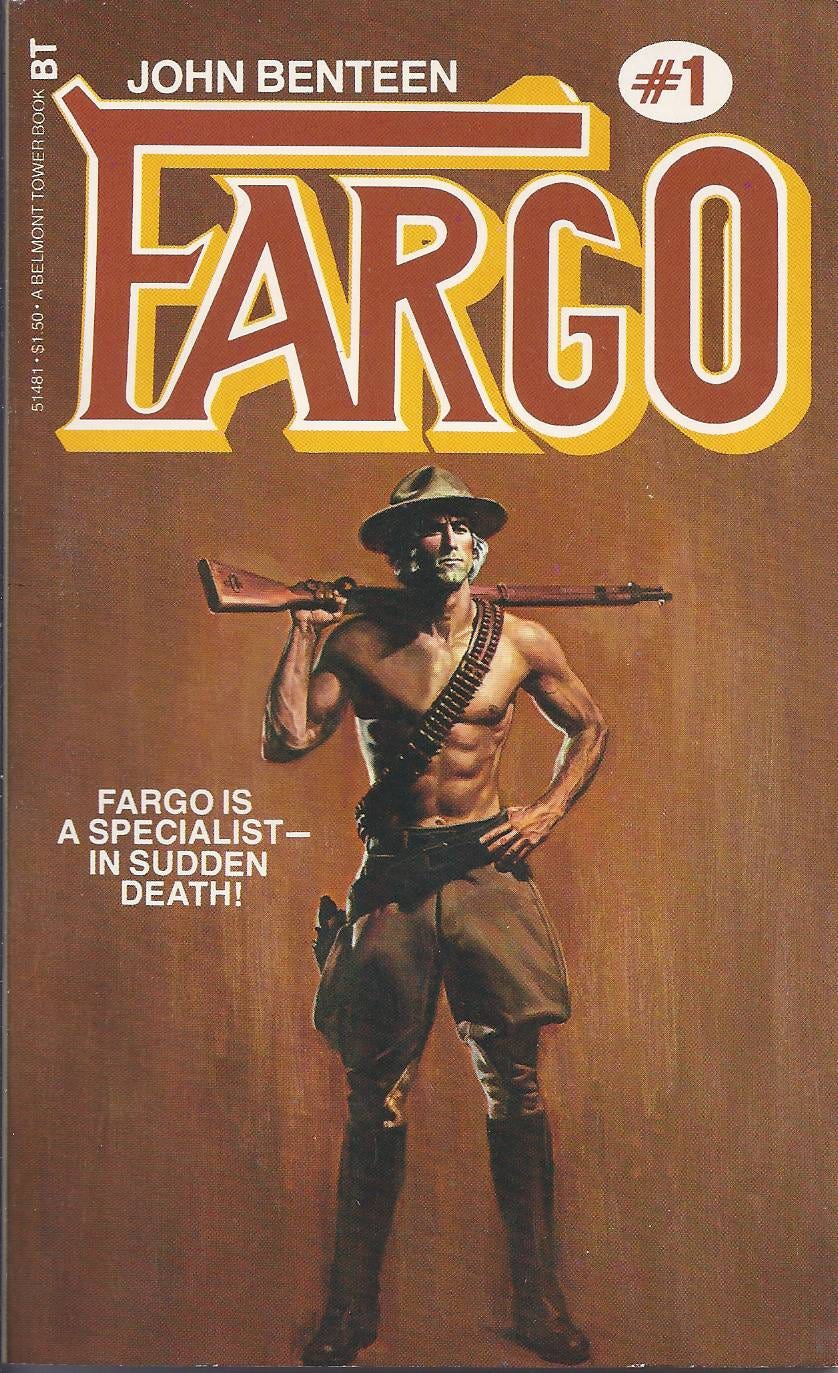
What’s that got to do with a High Medieval setting?
Fargo is old-fashioned highly commercial 1970s Men’s Adventure, tightly written, and highly readable — Young Indiana Jones, but with a veteran soldier as the lead, more sex and torture, and less name dropping.
The thing is, Fargo’s 1900s settings — Mexican Revolution, Central America, Alaska… are not so different from the archetypal Sword and Sorcery milieu. Distances are great, power is local, law is patchy, complex themes are best resolved through the medium of interpersonal violence. The landscape is a brooding presence.
I think it might be fun to try to write a Fargo book, but as Sword and Sorcery. Since the High Middle Ages is what I know best (contemplates sword scar), I’m building myself a vaguely 15th century fantasy setting. Hopefully the end result will be more Witcher than Westeross.
To this end, I did for myself what I usually do for my clients…
Worlds have layers, and they’re fractal. In this case, the place to start is with the human view and work outwards later if required.
I built the Conflict Diagram by iterating through two questions:
Who or what is a Factor in this setting?
What Nodes are they struggling over?
As I dumped them into Scapple, I started making connections, which made me think of more Factors, more Nodes, and so more conflicts.
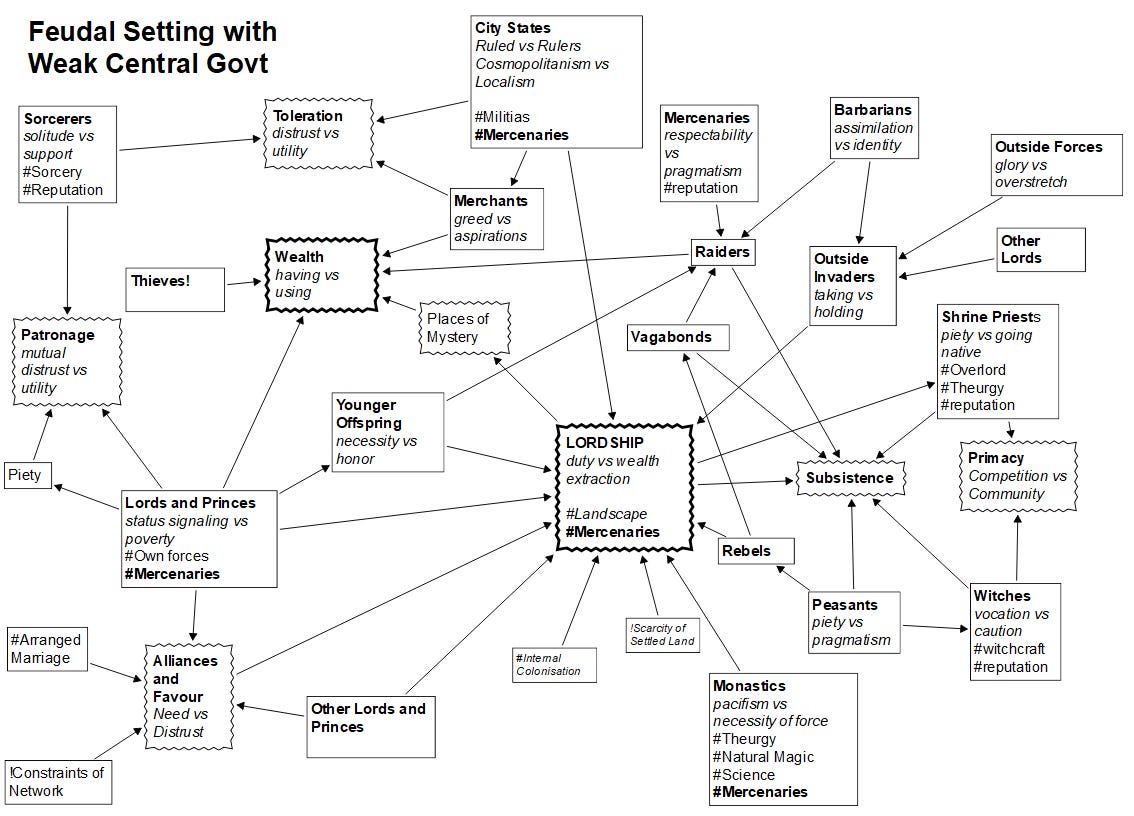
You can see the diagram I made at the top of the article — maybe right-click and open in a separate window.
Here’s the key:
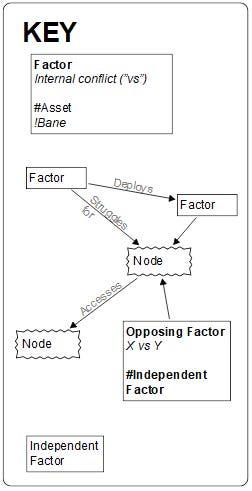
A Factor is anybody or anything that’s a player or force in this setting. Anything from Old Man to Sea, Magician to Mountains, from Blues Power through to the Power of Love.
Factors often have internal conflicts, assets and banes. You can imagine a warrior who struggled with “kindness versus moral compass”, was an amazing swordswoman, but in a nasty male dominated world, found being a woman was a bane.
Some Factors are agents notionally deployed by other Factors. Juliet deploys Old Nurse. Smaug deploys Dragon Fire. These are really assets unpacked, which is only worth doing if they create secondary conflicts, e.g. saving the town from Smaug’s fire.
Finally, some Factors are independent and hover on the edges waiting for a connection specific to a story.
Nodes are just things that Factors struggle over and sometimes occupy. Occupying one Node might give you automatic access to another node. That’s not always a good thing! Occupy the Cabin in the Woods and that next Node might be Your Life. Oh, and Mad Billy the Axe as an opposing Factor…
There’s more, of course, including depicting Traps and Schemes and even Dungeons… but that’s for another time.
Done properly, you end up with a picture of all the interesting conflicts in your world. It’s the equivalent of doodling a fantasy map and making up stories about the places, except you’re doing this on the level of relationships and connections and creating a very powerful tool for creating plot specific to your milieu.
You’ll notice much of the resulting conflict centres on Lordship. Who owns what and what are their rights and responsibilities? And, how does one acquire lordship in the first place?
However, Lordship itself — meaning whoever is the lord at any given moment — is also caught up in a struggle over Subsistence.
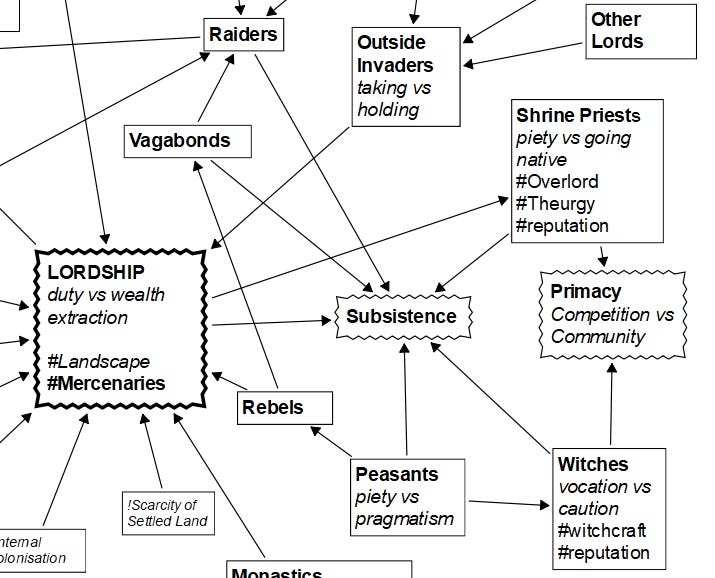
Let’s take a closer look at that:
The Lordship extracts resources, the Peasants evade the extractions.
The Lordship has Shrine Priests onside, but the Peasants deploy Witches.
Rebels compete for the Lordship, but they spawn Vagabonds and Raiders who then compete for Subsistence.
Witches and the Shrine Priests are also in competition.
Everybody grapples with their own internal conflicts:
Lords: Duty vs Wealth.
Peasants: Piety vs Pragmatism
Witches: Vocation vs Caution.
Shrine Priests: Piety vs Going Native.
Primacy (whenever anybody has it): Competition vs Community.
Maybe the Vagabonds and Raiders have mixed feelings as well?
Story ideas just fall out of this!
However, before we talk about that, let me draw your attention to a real bonus: you don’t need the explanatory text.
Sure, if it’s for a third party, if it’s for a client’s setting bible, then you do need to write it all up in prose.
However, if it’s your Conflict Diagram for your project, then you’ve internalised the world as you created it. There’s no need for pages and pages of detailed notes. Better still, you can tinker with the dynamics of your story world directly, without having to chase down references in your notes — this can also work with a client who likes the diagramming style.
Thus, the Conflict Diagram turns out to be both a creativity tool and a memory palace.
Personify any of the Factors and you have the premise for a tabletop roleplaying adventure or a hardboiled Sword and Sorcery novel. Maybe one of the Younger Offspring is trying to assert Lordship over a forgotten domain, and the locals don’t want him to?
So far so generic! Actually, “generic” is good because it’s generic for this story world. Just like Benteen writing his Fargo stories, and Tolkien in Middle Earth, you’re playing with types that embody the setting, bringing it to life so that the players/readers can escape into it.
It’s like those spectacularly detailed model railway layouts that come alive as soon as a little train whizzes across them!
However, you can make the story less generic by adding more local conflict and connections: what if the Shrine Priest and the Witch are in lurve? Or the Rebels are led by somebody with a (legitimate?) claim to the Lordship? What if there are ALSO Barbarian Raiders? The extra Factors and Nodes further illuminate the story world and are thus specific to it.
This approach stops you from reaching for a conflict that’s out-of-scope for the setting and reduces it to a skin. It gives you a Feisty Princess, yes, but one navigating the world she actually inhabits, rather than trying to impose 21st century values on it. She’s probably trying to punch above her weight in the marriage market, or to avoid it entirely to become — say — an Abbess. Falling in love with the stable-hand will be an inconvenience. She won’t necessarily value the love, and might even wonder if she’s been bewitched. Yes, she might scheme to make it all work, but the idea that she might want to escape status and rank would be alien to her… maybe even morally wrong. She’s more likely to feel genuinely attracted to a high-status match (think “rock star”) and regard managing the resulting marriage as an intriguing game.
And so, once you have a good Conflict Diagram, the story almost writes itself… or at least the plot does.
This really works for fiction, but it’s also incredibly powerful for GMing a tabletop roleplaying game; you can use the Conflict Diagram as a primer and make up everything else on the fly.
You can also — well I can, anyway — prep a complex adventure, complete with operational objectives — dungeons, places of mystery — all in about 45 minutes, but that’s for another article…
I’m always glad to talk worldbuilding with potential clients. Find me on LinkedIn, or message me direct… It’s all good!
I’m also happy to chat with everybody in the comments…
Comments
Nothing yet. Say the first thing.
Sign in to join the conversation.