

This week, I released Remarc - a macOS-native way to provide contextual feedback to AI agents. You can highlight any text in any app, annotate a screenshot, select a web element, and have your agent pick it all up and resolve it in a structured way.
And mostly nobody needs this.
So why did I build it? Why did I invest many weeks and late nights into obsessively designing, building, and polishing this shiny gizmo that will quietly sink into the annals of the internet? That’s what I’ve been asking myself for a while.
For the most part, the answers are simple but uncomfortable to face - I let myself get carried away with a shiny toy that I could keep infinitely tweaking with shiny new tools. It’s an experience that I suspect is becoming all too common as people go down vibe-coding rabbit holes.
It’s not all bad, though. Unconstrained exploration is sometimes the best way to learn new things, learn about yourself, and just have fun. And, in the end, that was my goal. At least, that’s what I tell myself anyways.
Like any side project, it had its innocent beginnings in my own problem - there was no good way to provide contextual feedback to AI agents on their own output. Let me explain.
Social media may make it seem that building with AI goes something like this - ask for the thing, blindly approve whatever plan it comes up with, get the thing you asked for. Post it on social with a caption “omg claude just one-shotted blah”. Profit.
But if you’ve ever worked on a real consumer or enterprise product, you know that every step of the process is followed by a dozen feedback loops and iterations. Have a PRD, design, or an early build? Here are a hundred comments, replies to those comments, and iterations based on those comments. The only way to build something great is through lots and lots of feedback and QA - from the team, from your users, and from yourself. Nothing good in this world is ever one-shotted.
There are a plethora of tools to collaborate with other humans, but surprisingly little to collaborate with AI. And while I’m a fan of chat as the primary AI interface, it just wasn’t cutting it for detailed contextual feedback I wanted to give to my agent. This thing you wrote here in this implementation plan? Change it to that. And that other thing - what did you mean here? And you see this button over there? Here’s a screenshot, I circled it. It’s missing a hover state. And this sentence in the 3rd paragraph of that draft - can you rephrase this?
If you’re an opinionated builder who wants things in a very specific way, this quickly becomes a nightmare. You either end up with paragraphs of voice-dictated feedback or a slog of resolving everything one by one. AI is great at parsing through messy feedback, but the rule of garbage-in-garbage-out still applies - if your feedback is vague and all over the place, the result will be about the same. You may be past one-shotting, but you’re nowhere near high quality. Congrats, you’re now in the messy middle, gripped by the sunk cost fallacy and overstimulated by managing 13 agents running at once.
And that’s where I found myself - I could easily get products to 90% completion with the current tools, but that last 10% of polish that makes products actually stand out was unnecessarily clunky. In other words, building with AI has a last-mile problem. And the reality is that many people don’t bother with this last mile, so there aren’t many tools out there to help you get through it.
So I decided to build one for myself.
Glad you asked. Many things:
I can spend all my time pontificating on the value of craft, the last 10% polish, and such, but all of that is pretty moot when whatever you’re building is not something other people really need. In other words, when it’s a vitamin and not a painkiller.
I learned that pretty quickly after putting out Remarc to early testers - it resonated with some people, but for the most part it didn’t become core to anyone’s workflow. Frankly, I noticed myself not reaching for it as often as I’d expect in my own work. That’s a red flag. But I ignored it because I was in love with the idea of this product.
I truly believe that many problems in this world, large and small, can be attributed to becoming disconnected from reality. Not being honest with yourself. Ignoring the data. Seeing reality for what you want it to be versus what it really is. Some delusion can be quite good, but how much is too much?
In a 1914 lecture on writing, Arthur Quiller-Couch dropped a timeless piece of advice that applies to a lot of creative pursuits beyond writing:
If you here require a practical rule of me, I will present you with this: ‘Whenever you feel an impulse to perpetrate a piece of exceptionally fine writing, obey it—whole-heartedly—and delete it before sending your manuscript to press. Murder your darlings.’
Today, AI effectively killed all the friction of following your impulse and psychologically increased the friction of murdering your darlings. I followed my impulse, followed it far, but couldn’t pull the trigger - either to kill it or release it faster to see if it can swim. Which brings me to my next point:
In the last year, everyone in tech has been coming to terms with this new, often uncomfortable, reality - software is now a commodity and the friction to building is now almost non-existent. In practical terms, this means that if you stumble upon a good product or a feature idea, someone has either already built it or will do so imminently. Don’t get me wrong - this was always true. Ideas are cheap. But AI took it to the next level.
Neither Claude Code nor Codex had native apps beyond a CLI when I started. Now they have full native apps with their own mechanisms to provide contextual feedback (although they’re pretty rudimentary). Great solutions like Agentation also came out in the process.
This is a sign that the problem space of last-mile feedback is real. And, as I argued myself, speed is now sometimes the only edge. Most were fast to build their own solutions. I wasn’t.
Should I have released sooner? The product manager in me is screaming “YES” at the top of his lungs. The designer in me wants to keep polishing until there’s nothing but pure reflection. The PM used to always prevail over the designer, but the advent of AI changed the power dynamic. If anyone can get to good enough in no time, do you want to be just another good enough in the sea of good enoughs? Wouldn’t it be just so easy to add a little extra? Which brings me to my last point:
Vibe-coding has been aptly compared to gambling and gaming on many occasions already. And anyone who’s gone down a few rabbit holes can attest to that - the temptation to do just one more change, one more feature, one more polish, or even one more product is increasingly hard to resist when the results are near-instantaneous and mostly spot-on (the first 90% that is).
First, I wondered if I could build an app that would let me leave comments on any text on my screen. I was quite surprised to see it was actually possible. “Why don’t I add screenshots to that?” I thought. Screenshots are key to good feedback. Right? And why don’t I add voice transcription? Voice typing is so much better now and most of the tech is open source. And if I’m working on multiple projects at once, I need a way to separate my feedback into sessions. Otherwise it’s not a complete product! And wouldn’t it be great if the comment flew towards the menubar icon when it’s saved… How hard can it be?
For someone who’s been building products for over a decade and learned to derive tremendous satisfaction from seeing your ideas and designs come to life (which often took many, many months), vibe-coding is basically office-friendly crack on tap. And I was all too happy to go on a bender.
The picture I’ve painted so far may seem pretty bleak. Was this all a waste of time? Am I full of regret? Not at all, actually. I’m glad I built Remarc, if for no other reason than:
Earlier this year, I left Netflix. While I loved my time there, I was missing the type of fun that comes from more hands-on, bespoke product crafting - the space where you have infinite freedom to explore and try new things. For a moment, Remarc filled that gap for me. More crucially, it filled my head with more ideas and rekindled the drive to keep building and exploring.
AI already completely changed how we build products. And we’re still so early. Getting to play with these new and rapidly improving tools on your own terms is the best way to learn because it makes you want to figure things out (not everyone gets to play). As I was building Remarc, I developed countless new workflows, skills, and mental models that are now compounding in my new work.
Most importantly, I’ve learned about my own propensities around these tools and how easy it is to get carried away when the cost of (early) execution hits the floor. As I wrote, when execution is free, direction is everything. But the best way to learn that is to try many wrong directions first.
Not everything you build needs to see the light of day (especially true with AI today). And most things you release will fail. That said, it’s better to produce consistently to hone your craft, exercise the building muscle, and compound opportunity. This is one of the main reasons I decided to take it to the finish line - it’s a new jumping-off point and a part of my journey as a builder.
Sometimes it may feel like you’re building with no purpose, but the path of building is often the way to discover the purpose.
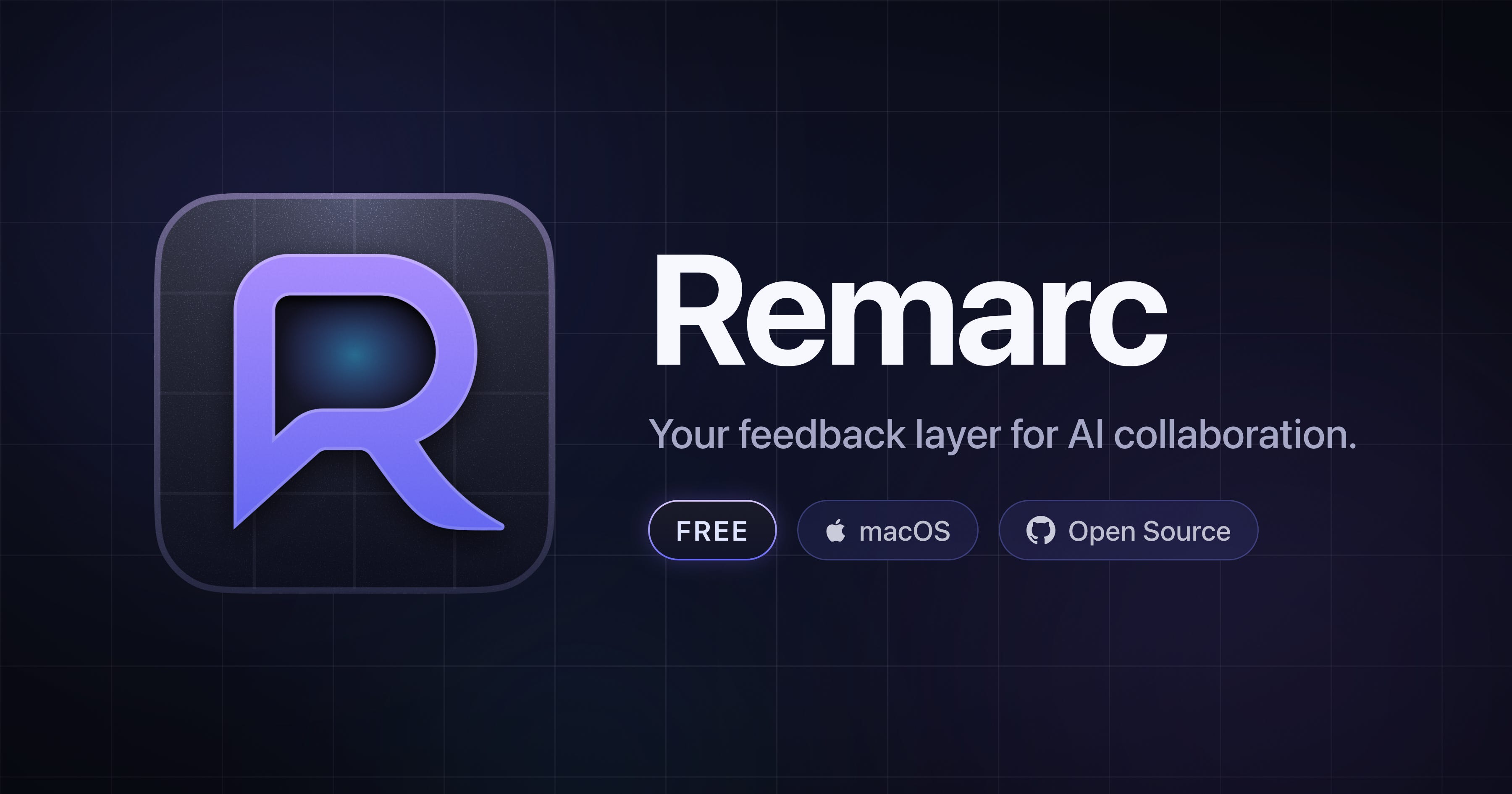
Remarc is out and it’s open source - others may find it compelling enough to experiment with and evolve it. The problem space of human <> agent feedback loops in general has many fascinating angles and threads to pull (Proof is another fun take on this for documents). I’m continuing to explore this and the agentic consumer space in general, while documenting what I’m seeing and learning in this newsletter. Lots more to come.
Metedata Subscription
All my core content will remain free and value-packed. If you do become a paid subscriber, here are some additional value you can expect:
Access to agentic templates, skills, and workflows I use to build and design with AI.
Access to subscriber-only chat for more detailed Q&A with me and an opportunity to connect with like-minded builders.
Draft previews and the roadmap of things I’m exploring and diving deeper into before they turn into more detailed posts.
Influence the direction of this publication. You’ll be coming in on the ground floor of this community.
If this sounds interesting to you, I hope you consider subscribing.
No posts
Comments
Nothing yet. Say the first thing.
Sign in to join the conversation.