
“I have created nothing really beautiful, really lasting, but if I can inspire one of these youngsters to develop their talent I know they possess, then my monument will be in their work”.1
While I do not agree with the first part of that statement (Augusta Savage created beautiful work), this quote has made me interrogate the way I think of teaching within my practice.
The question is not about whether teaching is art. The question is whether and to which extent teaching is part of the artistic practice. While I love teaching and it is often a place of great creativity and satisfaction, in the craft space it is widely regarded as something we have to do in order to maintain a studio or, when done in a less traditional way, to connect to the wider public. (Any social media manager will tell you to create “educational content” to provide “value”, as if art itself had not value - but I digress).
Teaching is an act of transmission and dialogue. It is an exchange from which both parties benefit. If clay forces us to pay close attention, then teaching the way we work with clay heightens our senses. As M.C. Richards said “In order to teach, you must be able to listen…you must enter again into a dialogue… The experience of the potter listening to his clay strengthens this capacity….One must listen carefully in order to serve as a proper midwife to the birth of consciousness in the student”2. M.C. Richards was talking about the way working with clay helps being a better teacher, but it goes both ways.
The experience of teaching, of listening to expressions of doubt and fear force us to decenter ourselves, to decouple our work from our experience and, in turn, improves our ability to be receptive to the clay. Students come in with a set of doubts and notions about themselves (“I am not a creative person”). Our job is to help them be rid of the fear of failure. It is part of life and it is part of ceramics. When I explain to my student how the process works, the time in the kiln and the science behind it all, I am reminding myself that I do not have control over every aspect of my own work.
From a practical point of view, there is no doubt that teaching makes us better at our craft. We are constantly confronted by different problems, different shapes and ways in which it can all go wrong, and we need to think on our feet to help out our students.
Augusta Savage did not separate art from teaching. She saw it as part of her legacy as an artist.
I can only hope that people walk away from the experience in my studio having learned something and having a newly found curiosity for the world around them. If that is my legacy, I guess it’s not bad at all.
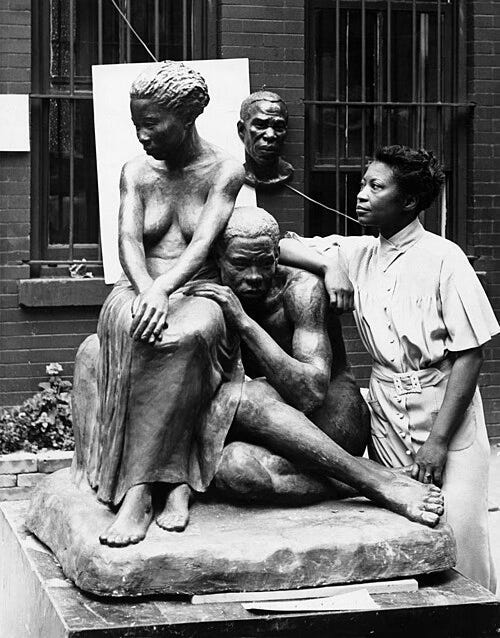
Augusta Savage (1892-1962) was a sculptor and educator born in Florida, US. She started making clay figures at a young age. After moving to New York to purse an art education, she worked as a sculptor mainly creating busts of prominent people. Her work was featured at the 1930 Salon d’Automne at the Grand Palais in Paris. In the 1930s, she founded the Savage Studio of Arts and Crafts in Harlem, a studio school where she nourished and championed her students and actively created opportunities for them. Even after moving out of New York City and to the Catskills Mountains, having lost her position at the Harlem Community Art Center, she kept teaching children at summer camps.3
Chotsani Elaine Dean and Donald A. Clark, “Contemporary Black American Ceramic Artists”, Schiffer Craft 2022, p.26
M.C. Richards, “Centering in Poetry, Pottery, and the Person”, Wesleyan University Press, 1989, p.21
See Smithsonian American Art Museum, “Augusta Savage”, https://americanart.si.edu/artist/augusta-savage-4269 accessed 11th February 2026
No posts
Comments
Nothing yet. Say the first thing.
Sign in to join the conversation.