
Beijing hopes that ending the mismatch between where people are registered for public services and where they live and work could boost the economy, says Alexander Davey.
As slowing domestic demand and an uncertain export environment force China to look for new sources of growth, Beijing is tackling one of its biggest structural constraints – the country’s “hukou” household registration. The system has forced hundreds of millions of migrants to work in cities without equal access to public services, discouraging permanent settlement and household spending. The measures announced by the State Council on May 22 deliver in a new way on promises made at the 2013 Third Plenum, Xi Jinping’s first long-term policy meeting after taking the helm of the Chinese Communist Party (CCP).
The new reform aims to “gradually eliminate factors linking basic public services to hukou” status – every citizen’s official place of residence, often based on where they were born. That marks an important shift from earlier measures that sought to make it easier for migrants to obtain local hukou. A 2014 reform abolished the distinction between agricultural and non-agricultural hukou, eased settlement restrictions in smaller cities and introduced a residence-permit system, while reforms from 2019 onward further relaxed settlement requirements.
More than a decade of reform has not closed the gap between where migrants live and where they are registered. China’s entire administrative apparatus was built on hukou as an organizing principle – it determined grain entitlements, labor allocation and urban food rations, while reducing fiscal pressure on cities by limiting who could access education, healthcare, housing and other social provisions. Breaking this administrative link will mean unwinding decades of administrative path dependency rooted in socialist economic planning.
Since China began reform and opening in the late 1970s, economic transformation has reshaped the labor system, but the administration of social entitlements has remained largely static. Given this, the hukou reform now on the table is surprisingly ambitious. Extending across all basic public services for over 357 million people living outside their place of household registration, China’s leadership aims to reduce the mismatch between an economy built on mobility and an administrative system built on rigidity. Some analysts have criticized that the reform does not resolve deeper urban-rural welfare inequalities. But it still addresses a fundamental problem – providing basic services where people live and work.
The real challenge is implementation. Cities will not be able to expand schools, hospitals and other services as quickly as migrant populations grow, creating a widening gap between entitlement and capacity. Even Fuzhou, an early mover in hukou liberalization, illustrates the problem. Although Fujian’s provincial capital abolished most barriers to local hukou conversion in 2021, more than one million residents are still not registered there. Under the State Council’s new measures, the population eligible for services will rise by one-sixth in a city whose public spending in 2025 exceeded locally raised revenue by EUR 3.5 billion.
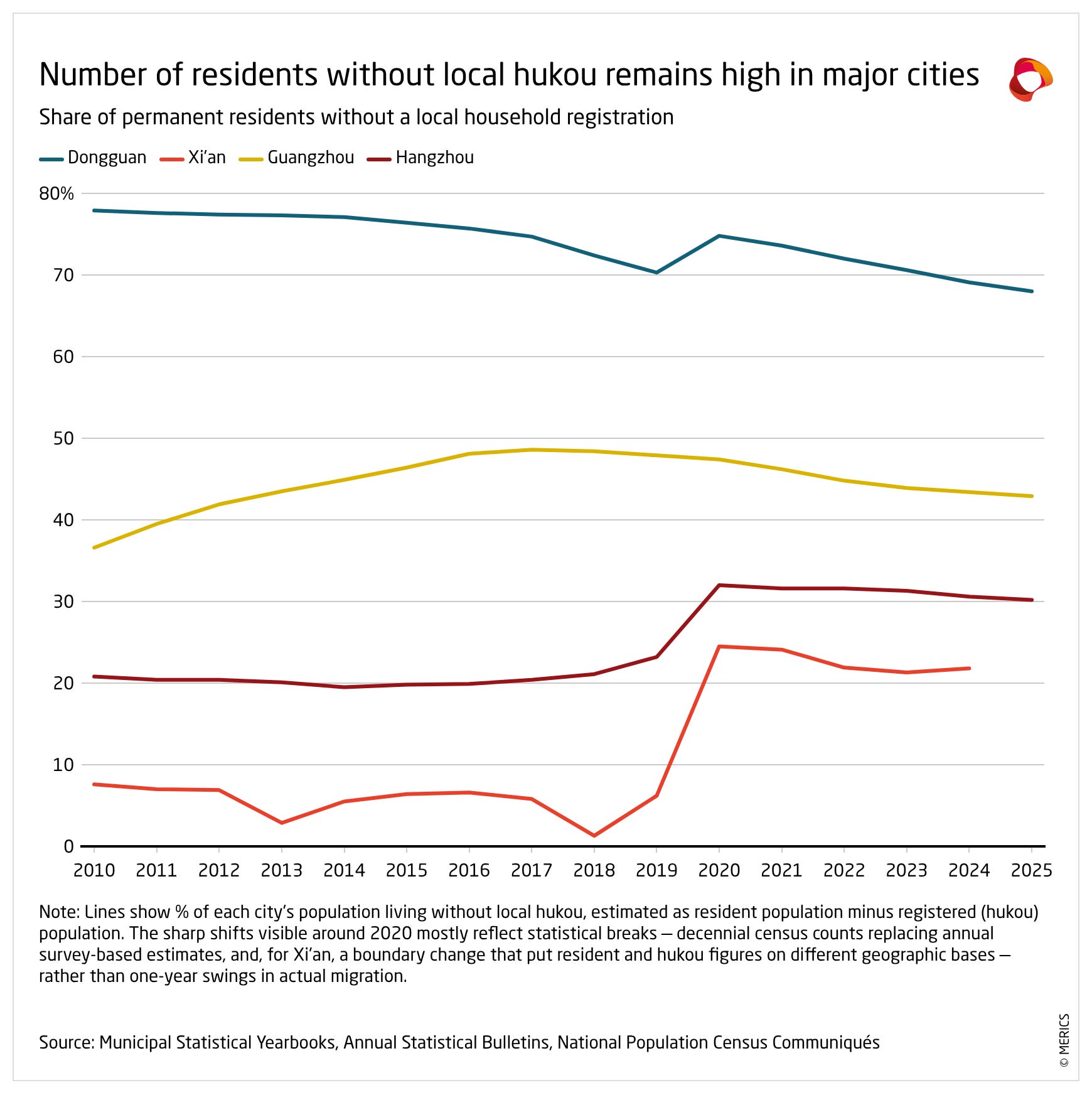
Capacity pressures are already a concern elsewhere. Tier 1 cities such as Guangzhou, Dongguan, Hangzhou and Xi’an, where the share of residents without local hukou has risen or remained high over the last 15 years (see exhibit1), have all issued warnings that the number of school-age children eligible for enrolment in 2026 will exceed available places. Under the new measures, cities now have an additional obligation to better guarantee migrant children access to public-school places or publicly financed places in private schools, raising cities’ expenditure without necessarily increasing pupil numbers in public schools.
Fuzhou in 2026 instructed school districts to admit migrant children primarily on the basis of residence permits rather than hukou status and expand public-school capacity. But it also told districts facing a shortage of places to accelerate school construction and issue early warnings of continuous supply problems. The city’s implementation of the policy while recognizing that it lacks the infrastructure to meet demand capture Beijing’s sequencing problem: the central government is expanding local obligations while infrastructure will take time to catch up. Beijing does acknowledge that cities will need fiscal support, but it does not clearly define financing. This suggests local governments will bear much of the cost.
With seven million – or two-thirds – of Dongguan’s residents and eight million – or two-fifths – of Guangzhou’s residents lacking local hukou, the risk of patchy implementation is high. The greatest obstacle will be resistance at local level. Despite the policy’s explicit prohibitions, local governments have incentives to maintain barriers through administrative practices or restrictive points systems that continue to favor higher-skilled migrants – and thereby limit new fiscal obligations. Established local hukou holders, meanwhile, will likely also fear competition from newly eligible migrants for school places and hospital beds.
The State Council measures explicitly call for cross-regional co-operation, for example to ensure that people who move from one local jurisdiction to another can continue to access basic public services. This is meant to tackle China’s long tradition of local protectionism, but without clear mutual benefit, this will depend heavily on direction from Beijing – and even then, implementation will be uneven as cities seek to comply on paper while protecting their own interests in practice. If local governments succeed in diluting the reform, much of the country’s two-tiered urban system will continue and major class inequality will persist.
But local governments will from now on have to justify this state of affairs rather than rely on it as accepted custom. The political baseline has shifted. The reform establishes a new contract between the center and the regions – access to public services should follow residence and employment, making migrant exclusion harder for officials to defend. The discipline inspectors of the CCP and the state will be keeping a close eye on those who deviate from national policy. What does remain uncertain is whether the system can deliver at the speed and scale implied by Beijing’s pledge of May 22 – and how quickly improved labor mobility can translate into higher productivity and stronger domestic consumption.
No posts
Comments
Nothing yet. Say the first thing.
Sign in to join the conversation.