
This analysis is part of the Q2/2026 MERICS China Economic Indicators, our quarterly analysis of China’s economic data. You can find the most recent data here.
China’s leadership set a feasible-sounding 2026 economic growth target of 4.5 to 5 percent during the National People’s Congress in March. Yet they have done little, so far, to tackle a structural imbalance that threatens economic growth in the long run: consumption remains weak, so Beijing relies heavily on exports to drive growth.
There has been much lip-service to rebalancing the economy toward consumption. In 2020, the idea was codified in Xi Jinping’s explicit call for protective self-reliance. His so-called Dual Circulation Strategy (国内国际双循环) promotes a mix of more domestic consumption and innovation-driven growth, to reduce China’s dependence on external demand. But this has not materialized. Net exports contributed 1.6 percentage points to China’s GDP growth in 2025, or nearly one-third of the total, and still 0.8 percentage points in H1 2026.
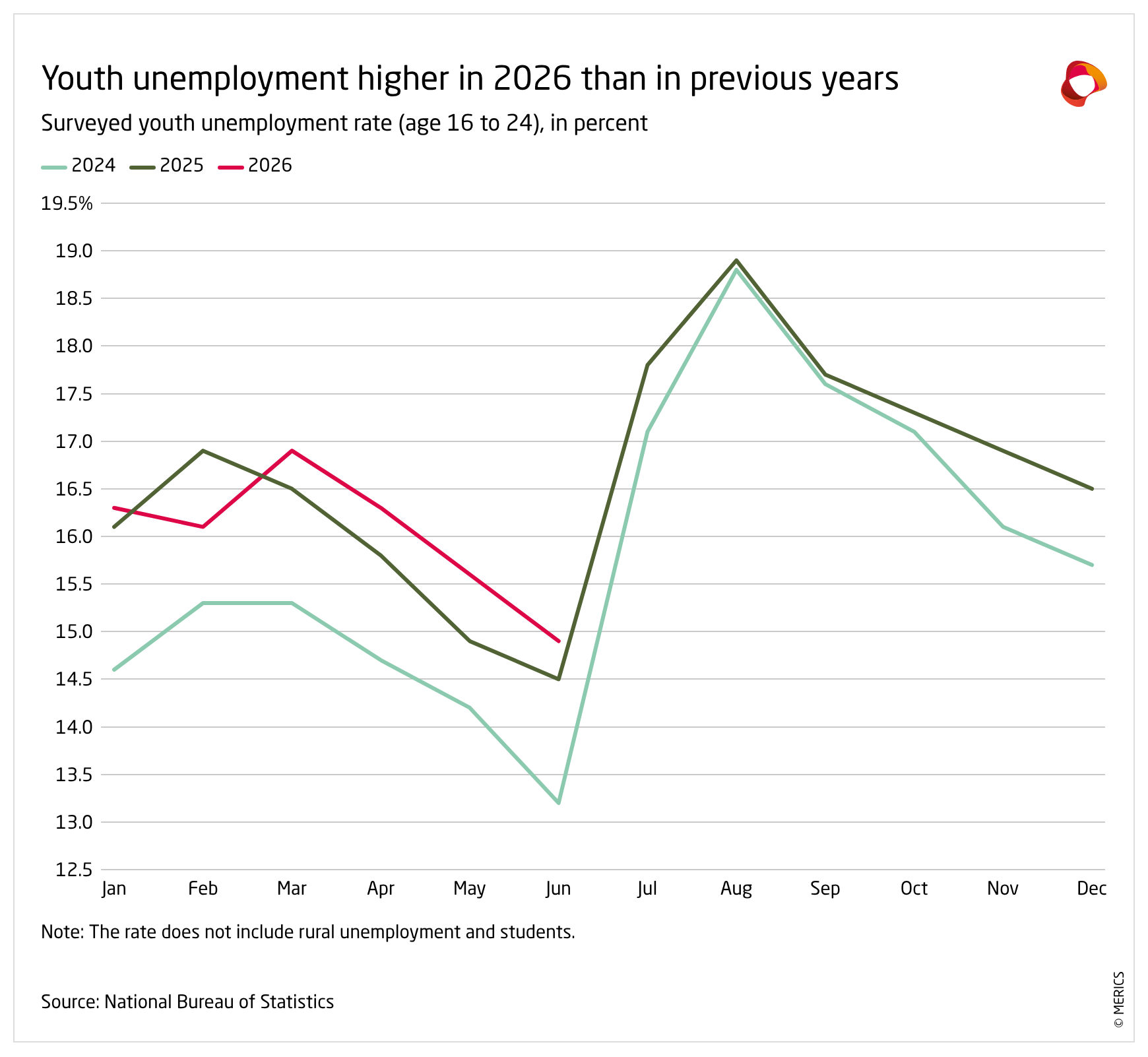
China’s weak consumption is rooted in structural features of the economy; a weak labor market, a persistent real estate crisis and limited social safety nets. These show no sign of easing. A record 12.7 million students will graduate from Chinese universities in 2026, roughly 4 percent more than 2025’s record cohort. Competition for high-skilled jobs will be intense; youth unemployment was already at 15.6 percent in May. Only 21 million jobs were created in the last five years, less than half the total for the preceding five years. Poor graduate employment prospects ratchets up the economic pain for China’s middle class. Middle-aged workers have to support their working age children and aging parents when the real estate investments they used to rely on keep losing value.
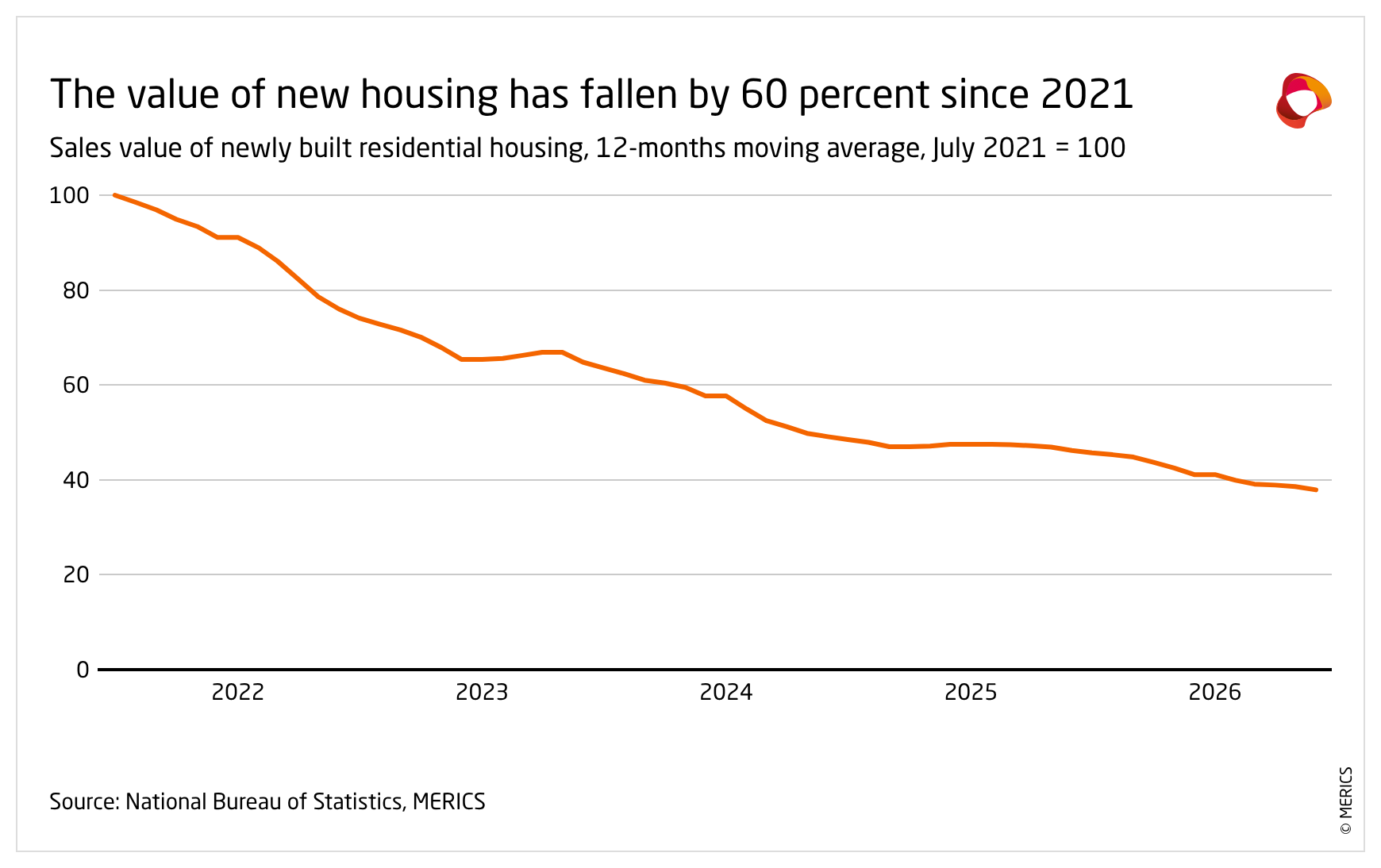
The ongoing decline in home prices has far-reaching consequences for the middle class. Many households are still repaying mortgages agreed when property valuations were significantly higher. The financial burden restricts other spending and creates psychological pressures.
These structural issues feed prolonged public pessimism about economic prospects, so people spend less, thereby reinforcing weak consumption. This pessimism is visible in a recent online trend where young consumers share their extreme money-saving strategies.
Policy signaling ahead of the release of the 15th Five-Year Plan (2026-2030) in March raised hopes that serious efforts would be made to strengthen the domestic market through increased social transfers and household support.
However, consumption-boosting policies have been far too limited to match this ambition. The 15th Five-Year Plan lists “building a strong domestic market” as a top priority but puts it third, after modernizing the industrial system and pursuing technological self-reliance and leadership. Ambitious steps like increasing the monthly pension for rural residents or hiking up salaries would imply diverting resources from the first two priorities, already identified as strategic. Beijing has not signaled that it is about to make that switch. Such actions might resemble the “welfarism trap” (福利主义的陷进) decried by Xi Jinping.
Consumption-boosting measures since 2025 have shown only incremental progress on structural issues. They have largely focused on short-term economic measures to boost the supply side and stimulate demand, such as trade-in subsidies for buyers of big-ticket items.
None of the moves aimed at China’s structural issues (low incomes, the limited social safety net and weak labor market) come close to the necessary and costly reforms. Despite regular minimum wage rises across most provincial jurisdictions in 2025,1 the monthly minimum wage is still between 2,740 and 2,070 CNY (352 to 266 EUR). The average monthly pension is only 246 CNY (31 EUR) for urban unemployed and rural populations and 3,825 CNY (492 EUR) for retired urban workers. As for the nationwide rollout of direct childcare cash transfers for newborns, the sum remains trivial for higher-income regions, though in lower-income ones like Henan Province it can equal at least half the median monthly salary.2
Even with increasing pressure from the central government to guarantee public services for all registered permanent residents, including those without a local household registration or hukou, implementation will prove difficult for debt-ridden local governments. Employment support measures consist of broad calls to support youth and vulnerable groups (like gig workers) that lack meaningful detail.
All the signs show the government is sticking to its usual playbook of lifting consumption through short-term measures, aimed mainly at the supply-side. Any demand boost should come from firms investing to upgrade their supplies of goods and services, such as electric vehicles, AI-enabled home appliances, travel and elderly care services. There is, therefore, little perceived need to increase welfare payments or wages.
The consumer goods trade-in program for vehicles, household appliances and electronics did initially help lift retail sales; they rose 3.7 percent year-on-year in 2025. Its impact is already waning. Retail sales fell to 0.6 percent growth in May this year, their first drop since 2023, suggesting a rush of one-off purchases rather than any meaningful rise in household spending.
Even the newly released five-year plan to expand consumption – the first of its kind – doubles down on this supply-side strategy. Responsibility falls on an already cash-strapped private sector to promote wage and employment growth, and to scale and upgrade its services and goods offering at an attractive price. Yet this also has drawbacks, as already-low prices constrain business performance and drag on wage growth and employment, further constraining household confidence and consumption.
China’s leadership has clearly identified weak consumption as a structural problem, and is highlighting the issue in its rhetoric. But actual measures taken show that the priority remains to boost industrial demand and demand for services. Beijing has chosen to manage the weaknesses rather than tackle the underlying problems.
Beijing is likely to stick to its strategic choices to systematically prop up industrial enterprises over consumers. A true shift toward increasing social transfers and welfare benefits to boost spending would require a costly overhaul of the economy and re-shuffling of priorities which support the current export-reliant growth model. As long as third countries continue absorbing Chinese exports, Beijing will not need to change course.
Endnotes
1 | The increases are determined at the local level and are regularly reviewed based on local living conditions and costs.
2 | The direct cash transfer is RMB 3,600 per child per year, until the age of 3. According to data from the National Bureau of Statistics, the average monthly salary in Henan is RMB 7,183 for urban non-private employees and RMB 4,218 for private enterprise employees.
No posts
Comments
Nothing yet. Say the first thing.
Sign in to join the conversation.