
There was a time in the English-speaking world where, if you disagreed with someone’s opinion, you could commit to a duel with them. Pistols at paces.
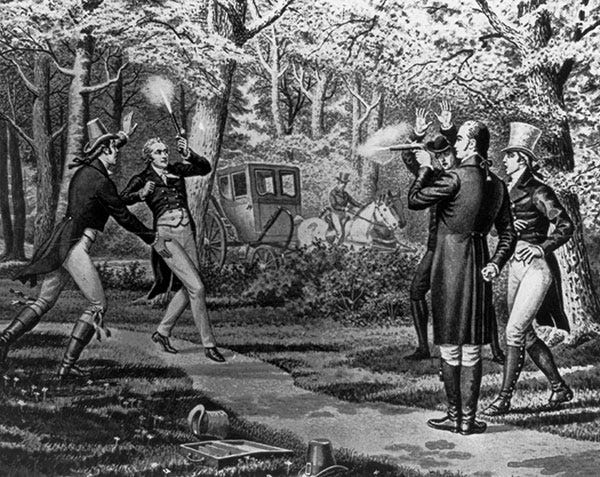
The Burr-Hamilton duel of 1804 (above), for instance, built out of political rivalry that finally got to be too much to bear. It was often, maybe always, honor that was on the line when two men decided to try gunning each other down in a civilized manner.
Philosopher Kwame Anthony Appiah investigated the practice of dueling, as well as other honor-coded practices like foot-binding in China. More specifically, he wanted to know why people engaged in these bloody practices, and then how they fell out of fashion. What he found he put into an excellent book called The Honor Code.
My favorite finding of his regarding dueling is summed up in this NPR interview. I bolded the important part:
Prof. APPIAH: Francis Bacon - who’s most famous to us, I suppose, as an essayist, though if you’re a legalist, he was also attorney general of England and lord chancellor. And he, at the beginning, in prosecuting one of the cases, said to the judges, look. This is going to stop when what he called rude mechanicals in other words, people who weren’t gentlemen start doing it. The trouble was...
CONAN: That would be you and me, right?
Prof. APPIAH: That would be us. The trouble is, it took several hundred years before that happened. But nevertheless, Bacon got the point right, I think, at the start of the modern duel in England, which is that it can only work to generate honor for gentlemen if only gentlemen are allowed to do it.
In other words, Appiah found that the honor gained and/or saved by dueling had to do with class. Once gentleman of less means started engaging in dueling, it became ridiculed and eventually disappeared altogether.
I thought of Appiah’s work when reading the WSJ article about more Americans breaking into the upper middle class. An excerpt regarding a family that went from middle to upper class (3x’ing their income, basically):
Instead of worrying about paying for groceries, Martinez said, they worry about how to make sure their children aren’t spoiled in a town where some teens drive luxury cars to high school.
Not throwing shade at this person! But it’s an instructive idea.
The data backs this up. Pew reports that the upper class share of Americans is growing, while the middle class is shrinking, and the lower class has expanded marginally.
Yet at the same time, consumer confidence is as low as it was during the depths of Covid. Back when people were getting laid off and the entire world closed! Via the Conference Board:
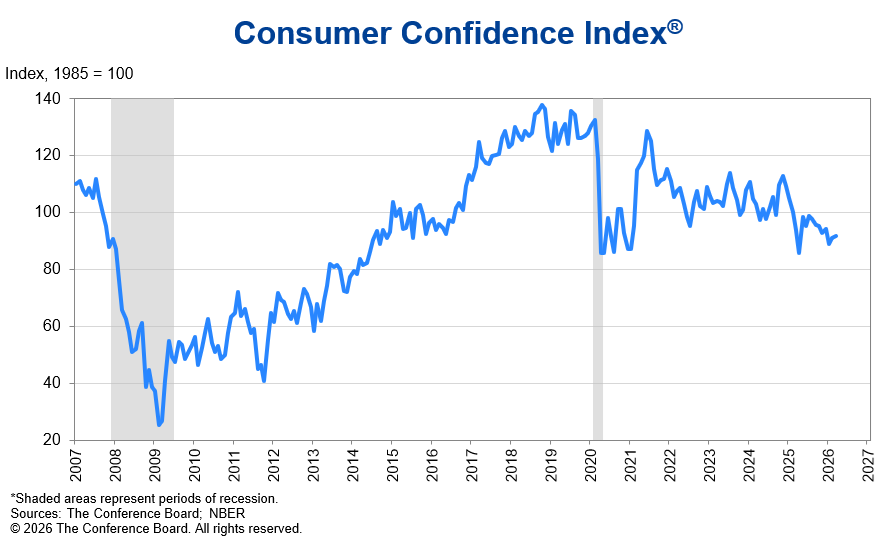
What’s happening here? People are getting richer in America, but are still miserable. Uncertainty reigns.
Well, I submit that being upper class ain’t what it used to be. The spread between the ultra wealthy and the upper middle class has become so pronounced that it makes some of the people featured in the WSJ piece look poor.
Duels used to be cool. But when everyone can do it, it seems way less interesting and/or unique. Being able to buy a new HVAC system out of your checking account? Also boring.
Peter Turchin’s “Elite overproduction” idea has something to say here. I think it explains some of the unhappiness. Turchin’s idea:
The rewards for being at the top are then especially lucrative, both in terms of earning power and political influence, and those who miss out feel their loss more keenly. The feeling of resentment is particularly strong among people brought up to believe that they ought to be in the elite. Worse still, societies tend to produce ever more would-be elites, in part because access to education tends to improve over time.
Too many successful people breeds social unhappiness.
Unfortunately, it also seems like the true marker of being an elite in our society is to also be involved with sex traffickers. Certainly makes you think twice about what it really means to be in that .1% elite.
Will Caverly writes about history and the outdoors. His book HERE, the BEES STING, is a beekeeping thriller. Find more of his work at www.willcaverly.com.
No posts
Comments
Nothing yet. Say the first thing.
Sign in to join the conversation.