
If the Devil exists, he works through ticks.
To contribute to the perennial fight against bloodsucking parasites, this post shares I’ve learned about this seasonal fight in my home state of Pennsylvania.
What follows isn’t a professional opinion on anything. Caveats are in this footnote1.
On structure: I’m going to start with practical actionable advice. And I’ll work backwards from there. Rather than start this piece out with personal experience, I’m going to end with it. I’ll link to research where I can, but consider some of this folk wisdom.
I’m also going to try my best to keep this all lighthearted. That might be difficult, given the serious subject matter. A little bit like making car crashes hilarious. But imagine for a moment a fender bender between a car full of pigeons and a car full of wolverines. Hilarious!
Once I heard someone remark that when we were kids, nobody carried a water bottle, but every kid these days had one. Did everyone get thirsty? Are kids sweating more? Do they really need all this water?
Ticks, like modern children, get thirsty. It’s well-documented that ticks are wimps when it comes to water. They can subsist on ambient water vapor, but in dry conditions will dive deep under leaf litter or other material looking for traces of trapped moisture. The upshot is this: ticks require over 80% humidity in order to survive. When there’s areas of bare ground, or short grass with little mulch, ticks will vacate and/or die.
Tick thirst is a major weakness to exploit if you’re managing land.
That’s why a USGS researcher said the following about why southern tick encounters are so different: ““In the North, when you walk through the woods you’re walking right through tick habitat,” said [Howard] Ginsberg, leader of the USGS Patuxent Wildlife Research Center’s field station in Kingston, Rhode Island. “In the South, you’re walking on top of the habitat. We think that is a crucial difference.”
My practical advice is to make your property as much like the deep south as possible. Here’s a visual depiction of that:

Joking aside, you want to create conditions where ticks have no choice but to dive for cover or just die a miserable death in the hot sun.
As a landowner, and to deny ticks moisture, I try to get the sun to do the dehydration work for me. If the sun can reach down to the dirt, the ticks won’t have anywhere to hide. I slash my grass low (half of it is invasive bullshit anyway) and clean up litter where I can. I am not afraid of bare dirt in my yard. Who am I trying to impress?
We have serious tick problems in my neck of the woods. Pennsylvania doesn’t have a shortage of rain in most years. The years when it’s wet, the ticks can be horrendous. Ironically, climate change might make the tick problem less of an issue in coming years in PA, but only if it takes the form of dry summers.
If you’re on a tree-populated lot and close to a stream, I have bad news: it will be tough. Someone from the northern tier of the state complained to me that his dog is covered in ticks whenever he lets it out of his creekside house. He talked about how it’s just a constant source of anxiety.
For as much success as I’ve had on my property in controlling ticks, below picture is a moss-covered piece of rope from an old hunter’s tree stand. The tree itself had fallen over. In that area, creekside, the place is crawling with ticks. Deer that I have taken there are covered in engorged ticks.
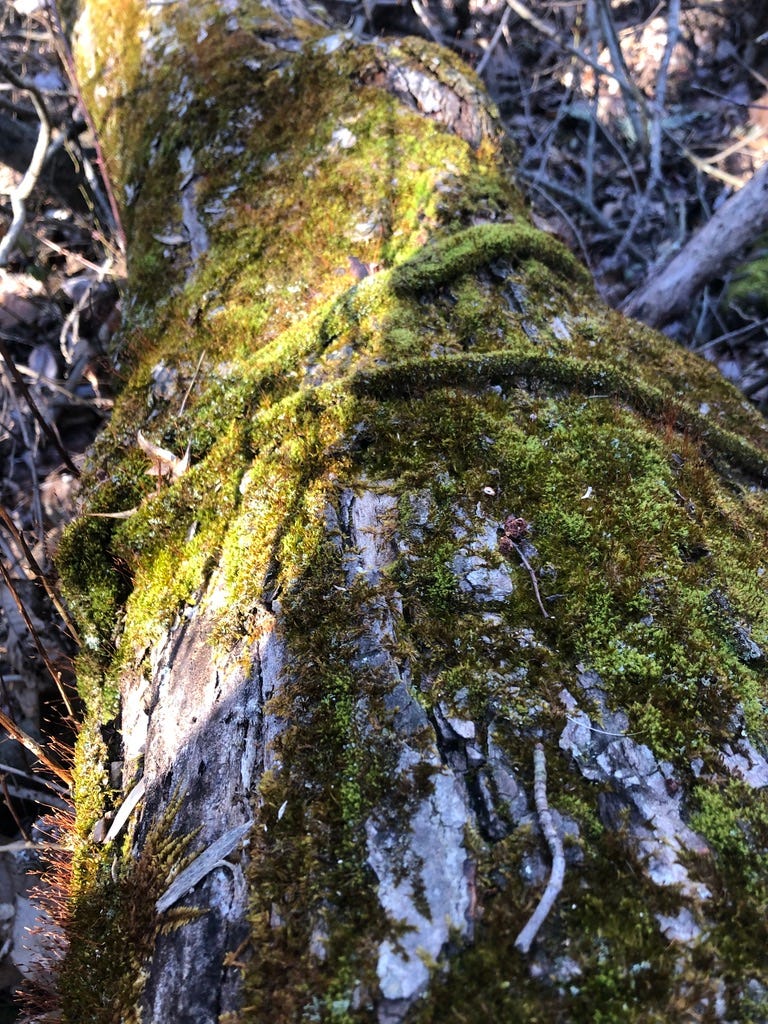
Landowner lesson: When in doubt, dry it out.
DEDICATED CLOTHES: I keep a set of outside clothes for outside chores that will take me into tick territory: woodland edges, tall grass, and so on.
TREATING CLOTHES: I treat these clothes with Sawyer’s permethrin every four weeks or so. A few things about permethrin. Once, I saw a guy spray his wife and baby with it. That’s not you’re supposed to use this stuff, it’s not bug spray. You don’t want it on your skin. You pretreat the clothing and let it dry out. If you have cats, be careful, because apparently permethrin will kill cats. If you are truly lazy, you can get pretreated clothing.
USING THE DRYER: Given the propensity for dehydration, a quick tumble in your dryer for ten minutes will kill any ticks still on your clothes dead. So when I’m done with my outside chores, I get undressed (bow chikka wowow) and throw everything in the dryer for ten minutes to kill anyone trying to get inside.
Some of this I covered in my piece for Front Porch Republic, called The Year We Went Inorganic.
Landowner lesson: Clothes are the first things ticks touch unless you go outside in the nude.
(Who Knows if They Work But it Makes Me Feel Proactive and Warm Inside, Like a Sixth Cup of Coffee Before 11AM)
Tick tubes target the source of Lyme disease (and probably other nasty shit), namely mice. White-footed mice are the primary reservoir for Lyme disease spirochetes. Tick larvae will ride around on them all winter, from what I understand. Ticks don’t get Lyme from their parents, but instead from the mouse reservoir2. So if you can target mice, you’re targeting an essential link in the disease progression.
It’s a tube that’s filled with fuzzy nest-building material treated with permethrin. Mouse finds it, brings it back home, and it kills off the parasites. Simple!
I cut a length of PVC pipe into six inch sections. Every spring, I soak saved dryer lint in permethrin overnight. Wearing gloves, I stuff the lint into the tubes and then put them in strategic places. Here’s some notes on placement:
You don’t need them to live in it, just use it as nesting material
Places that I’ve seen mice before (under or in sheds/outbuildings, etc)
Firewood piles are a guaranteed success
Any place that is relatively sheltered and kept dry
At the edges of things - mice run the edges, not out in the open.
I try to run about ten at a time.
I always forget where I put them.
Thermacell makes premade tick tubes, but it’s satisfying to do and probably doesn’t take you more than thirty minutes a year if you add up saving lint, ordering the Sawyers, and doing your mad scientist stuffing thing in the driveway. Do it in broad daylight to start conversations with your neighbors.

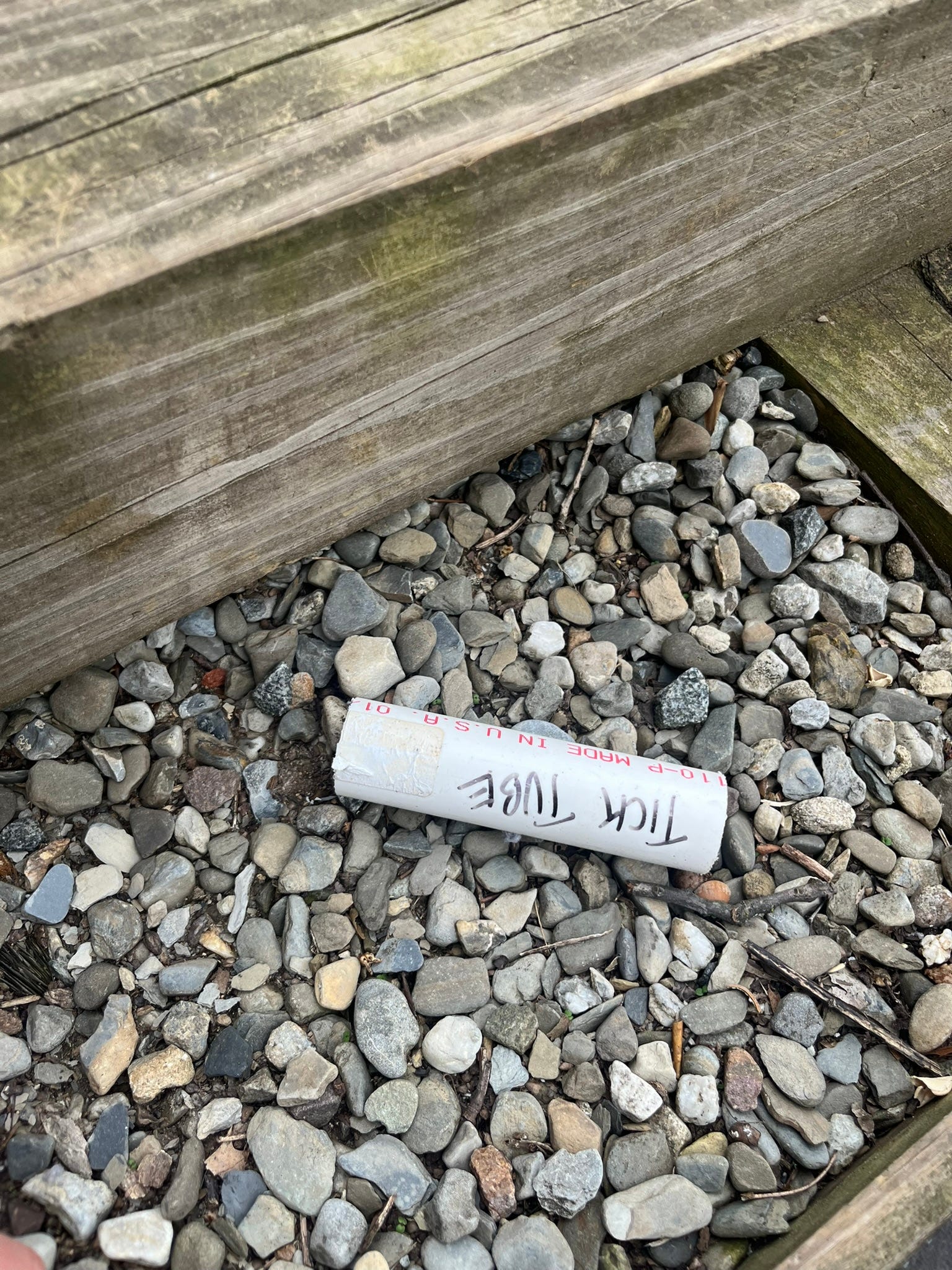
Landowner Lessson: Tick tubes are a great way to make you think you’re doing something useful.
No, absolutely not. But using targeted application, like tick tubes and treated clothing, means you aren’t just broadcasting chemicals into your local environment and potentially onto the feet of your kids etc. There’s all kinds of tick pellets on the market that might work, if environment isn’t a big issue for you. I don’t use them because I’m not sure they work and I’m not a fan of broadcasting chemicals.
Landowner Lesson: Killing ticks with chemicals will land you in Hell forever. You have to decide if it’s worth it.
There’s a lot of bad advice out there about taking off ticks once attached to your body. Instead of going through a list of bad ideas, consider just looking at the tick twister (or the many knock-offs). It’s essentially a finely forked piece of plastic that can slide easily under the tick so that when you pull the tick, its head comes out with it. There’s no twisting involved. These are great tools to have around and it’s a dollar. I’m not an expert but I don’t suggest you use any other method if a tick is attached.
Landowner Lesson: Talking about “Ticky Twisters” in polite company can backfire.
Let’s face it: some of us have to do the worrying for others.
Kids don’t listen to adults as a rule. If you’re a parent, talking to your kids about risks probably ends with them wanting to touch the hot stovetop, so to say, either out of curiosity or just to piss you off.
Dogs don’t speak English. Or much English.
Hold on, before I move on, if I can understand English words but can’t speak them, does that mean I speak English? Does a person who was born without the ability to speak “speak English”?
Anyway, I got distracted.
Stupid people will come and go in your life.
Or stay, if you’ve lost a bet.
If you love these helpless creatures, you will need to do the work for them. Nightly tick checks at bathtime for the kids. Dog collars and tick checks for the dogs. And for stupid people, just do your best. As the saying goes, God loves drunks, babies, and the United States of America.
Landowner Lesson: Some people are too dumb to take care of themselves.
We talked about tick tubes above because white-footed mice will use permethrin treated material as nesting material and killing ticks on their body.
Unfortunately, chipmunks don’t use nesting material the same way. They live underground in burrows. Maybe there’s a way to get into the chipmunk’s bedding that will work.
One invention does treat both chipmunks and mice. It’s essentially a bait box but instead of killing the pest animals, it brushes them with permethrin or an acaracide before/after they eat and sends them on their way. Rinse and repeat. Both species use it. I have not built one of these but I’m considering doing it and putting a camera on the entrance to see if and how it’s used. Exterminators are licensed to sell products that do this.
Many states do not let you kill chipmunks. PA game laws have them protected. So your options with chipmunks are limited. Write me if you think of anything that’s legal and effective.
Landowner Lesson: The more you know about ticks, the less you respect mice and chipmunks.
Are they diseases that can maim you for life? Absolutely. Are they getting worse? Seemingly. Could you be in a situation where you face this challenge everyday? For sure.
That said, I spent a year panicking about Lyme. I won’t get too specific but there was midnight Googling, hyperventilating, and some tears. All I have to show for it is some more gray hairs and all this esoteric knowledge about ticks.
For instance: I don’t control the weather, so I can’t control moisture. I can barely keep up with my yardwork, let alone do it immaculately. I also can’t control my neighbor’s yard. I can’t control climate change, so can’t control which ticks start thriving in my area. I can’t control the animals that run through my yard at night dropping tick larvae or whatever.
What I can control: building a program that I believe in, with evidence to support every step. What I can control: sticking with the program and adjusting as needed.
Persistence and stubbornness is going to serve better than panic. Just my two pennies.
Also, we know a tremendous amount more about tickborne illness than we did when I was growing up. Nobody got diagnosed with Lyme. I once had a clinic doctor tell my parents that I was bitten by a mutant spider because I had a weird lesion on my leg.
Today, I’d challenge you to find someone who doesn’t know that ticks carry diseases, or can’t name one of them.
Landowner Lesson: Have you tried not worrying about it?
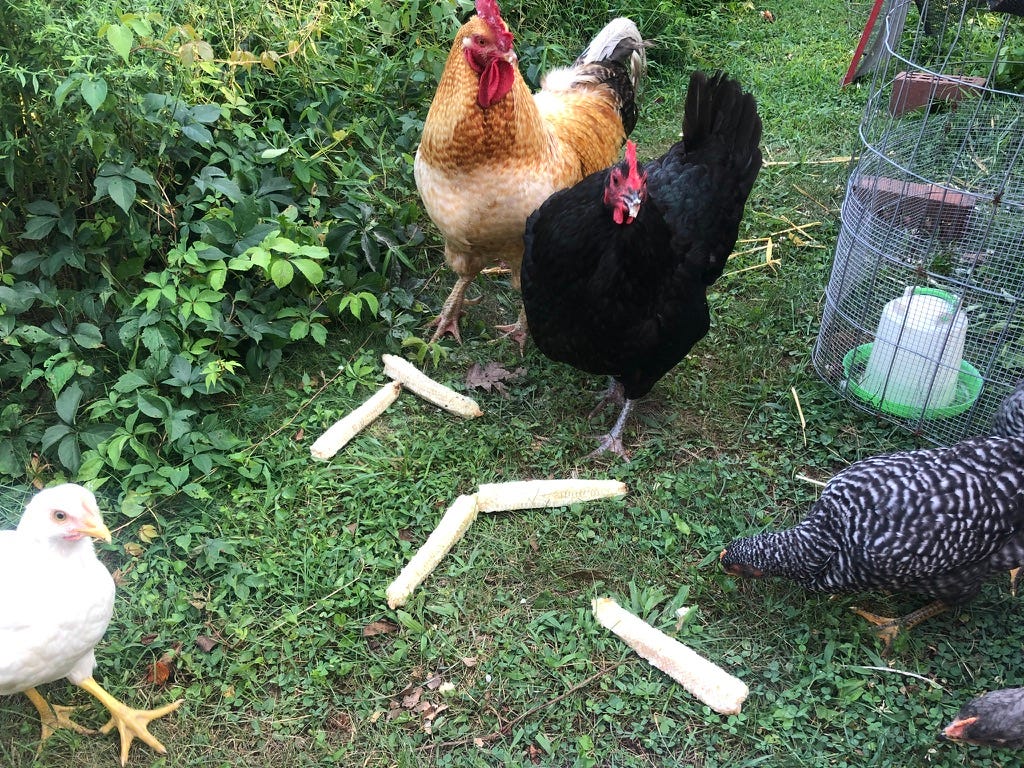
I really do try to keep my mouth shut when people have terrible ideas. Call it tolerance, call it people pleasing, but one of the things that happens in middle age is that you stop trying to correct people’s misguided views.
One belief that I do try to dispel is that chickens eat ticks. Chickens are many things: stupid, sweet, egg-layers, bird flu vector, poop machines. Chickens are not, however, in the business of tick eradication. I know this from the better part of a decade of owning chickens and watching what they eat. And what they don’t.
I have seen chickens eat:
Toads, salamanders
Snails, caterpillars, pillbugs
Praying mantids, crickets
I have had chickens refuse to eat, including from my hand:
Ticks (dog and deer)
Invasive ladybugs
Invasive spotted lanternflies
Squash beetles (which destoy our garden)
Invasive stink bugs
If you examine the two lists, you will see that chickens typically eat all the things that are useful, neat, and native, while they will reject all the shit that you actually need them to eat, including garden pests, invasives, and ticks.
Do not buy chickens if you are interested in tick removal. I have heard guinea hens do a lot of work on ticks but I have never seen any evidence that they do a good job of it.
Landowner Lesson: If you think your chickens will eat ticks, you’d best get out the crock pot.
We’re lucky enough to have a possum that lives under our garden shed. His name is “the possum that lives under the shed.” Once, when my daughter and I left the house one night after dark, we almost stepped on him where he loitered at the back door.
One myth about possums is that they eat several thousand ticks a day. Apparently a lot of this stems from a 2009 paper.
Some enterprising researchers split open the guts of a whole bunch of dead possums to check their stomachs. What did they find? Little to no pulverized ticks.
I do have a soft spot for possums and I don’t mind the one in our yard. For one, they eat mice and probably chipmunks, meaning they can take some of that Lyme out of circulation. Second, they are ugly as hell and I sympathize.
To sum up, Fur Takers of America’s Facebook page shit-posted this instructive AI generated image:
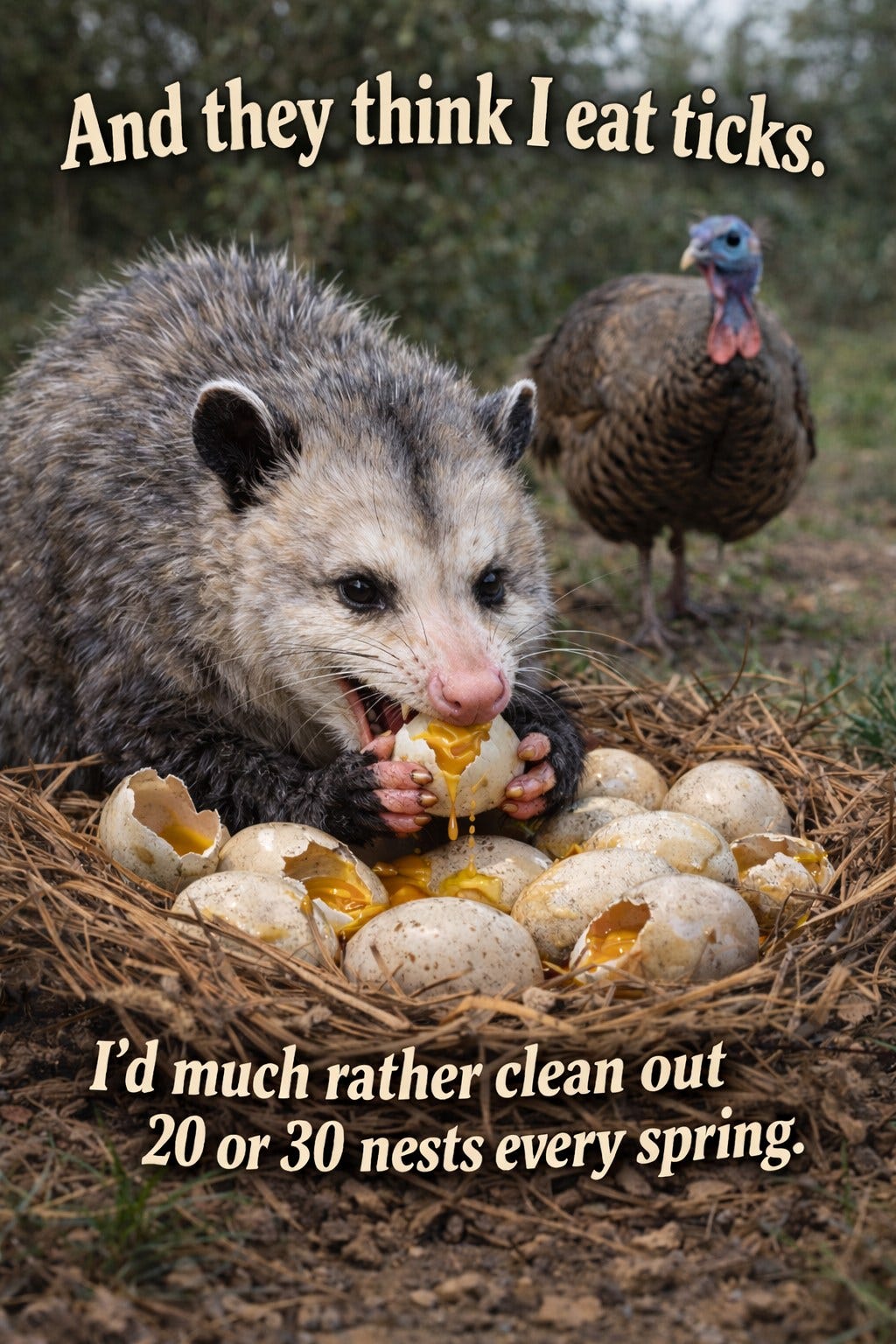
Landowner Lesson: Possums are cuddly marsupials that might or might not eat ticks.
Consider this my bona fides when it comes to being bitten.
There I was at the office, getting settled for a dropoff3. I look down and saw two embedded ticks, one on each thigh. They looked like they’d coordinated because they both dug in at the mirrored location on my legs.
My heart sank. The skin around their heads was swollen, meaning they’d be in for awhile.
Took them out (tick twister) and visited the doc. Because she didn’t see the ticks and we didn’t know how long it had been since attachment, she said she would either wait and see, or prescribe me two weeks of horse pills (Doxycycline). I’d sent the ticks off for testing, though the doctor can do that as well.
I waited. Started getting weird dizzy spells when driving, heart palpatations. I figured what you probably would figure. Took my medicine, it went away, end of story. Fear and diarrhea were probably the worst part.
Since then, I have made it my mission to do as little work as possible to fight the tick menace, but still put in enough effort to feel like I’m doing something positive. This low effort post will hopefully move the needle in a positive way.
Landowner Lesson: Turn your frown upside down!
This has been a low effort post. I’m thinking of expanding it into a book called The Little Landowners Guide to Ticks, wherein I’ll also cover subjects like Lyme conspiracy theories, How To Think Like a Tick, the signs of a coming tick-pocalypse, subnivean layers, daily affirmations about ticks, poetry, and other deep thoughts.
Landowner lesson: If you are thinking of writing another book, lay down until the feeling passes.
Will Caverly writes about history and the outdoors. He’s an active member of the PA Outdoor Writers Association and you can find more of his work at www.willcaverly.com.
If you want official guides to dealing with ticks, please check the CDC, or Penn State Extension or your state’s extension office. Nothing in this post should be considered medical or legal advice, because I’m not a doctor or a lawyer. I am not an academic with a degree. I am just some guy who hates ticks. Please be responsible and lawful with the information provided here. Your local laws may prohibit some of what I suggest, for example.
Mouse Reservoir would be a great name for a band
No posts
Comments
Nothing yet. Say the first thing.
Sign in to join the conversation.