
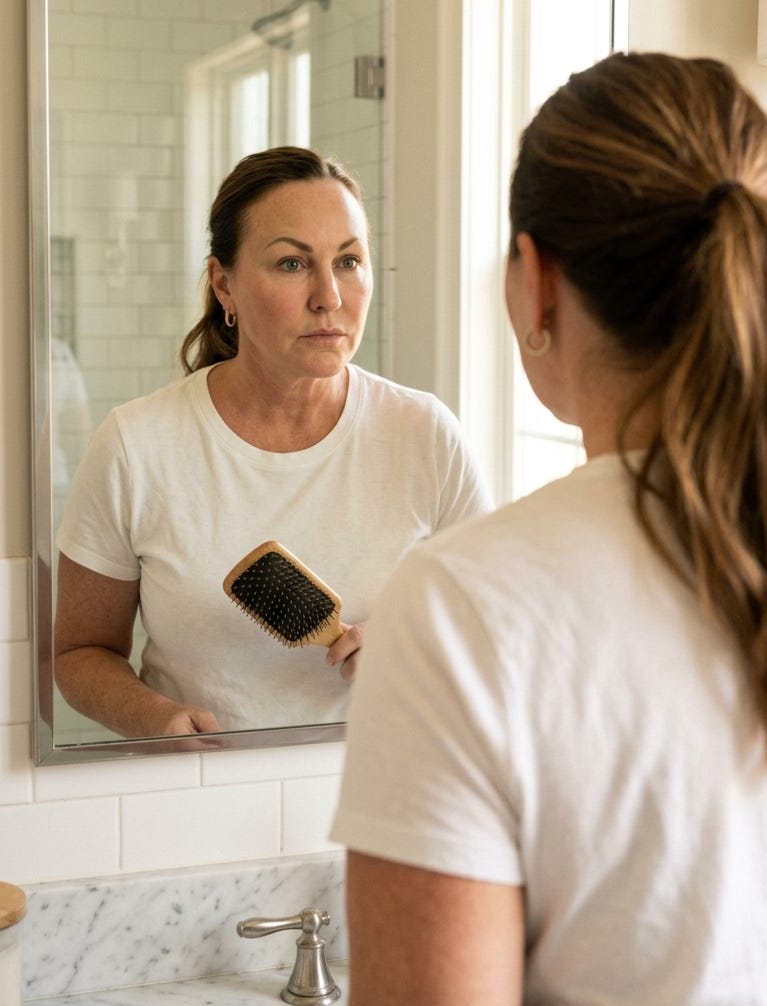
You noticed it in the mirror first.
Maybe your part looked wider than it used to. Maybe the hair right at your temples had gotten softer, wispier, and shorter, like the front of your hairline was retreating a millimeter at a time. Maybe your ponytail felt thinner when you pulled it back. Maybe you saw more hair in your brush than you remembered from a year ago.
Or maybe none of this has started yet, and you are just watching your mother, your aunt, or the woman ahead of you at the grocery store and quietly wondering when the countdown starts for you.
The countdown may have already started.
More than half of postmenopausal women develop noticeable hair thinning. Female pattern hair loss alone affects up to 38 percent of women over 50. And perimenopause, the years before your last period, is when the process actually begins for most women.
So if you have not noticed anything yet, your hair follicles may already be shifting under the surface.
Which is why every woman I know is currently taking or considering something for this. Trends are all over social media.
Pumpkin seed oil. Saw palmetto. Biotin. Collagen. Rosemary oil. Some multi-ingredient hair supplement with a soft pink label and a woman with waist-length hair in the marketing.
I want to tell you something that took me too long to figure out, and which the wellness industry is going to be very unhappy that I am saying out loud.
Almost every hair loss supplement being sold to women was designed to treat male pattern baldness. Menopausal hair loss is a completely different disease.
The mechanism most of these supplements target is not the mechanism causing your hair loss.
Which means most of what you have been taking, or considering taking, or have on your Amazon cart right now, is doing very little for what is actually happening to your hair.
And one of them may be actively sabotaging the blood tests you need to figure out what is wrong.
Let me give you four things about your hair loss supplements that nobody selling them to you has told you.
The single most-cited study on pumpkin seed oil for hair growth is the 2014 Cho study published in Evidence-Based Complementary and Alternative Medicine.
It enrolled 76 men with androgenetic alopecia.
They took 400 mg of pumpkin seed oil daily for 24 weeks. The men had a 40 percent increase in hair count.
Now, I’m not scrutinizing the results. But “androgenetic” is the word doing the work here. It means driven by androgens (such as testosterone). Which is male pattern baldness.
Pumpkin seed oil blocks the enzyme that converts testosterone into DHT, which is the hormone that drives male pattern baldness by shrinking hair follicles.
DHT plays a role in some postmenopausal hair loss, but it is one contributor among several.
Female pattern hair loss in menopause is driven mostly by estrogen decline, with DHT usually a secondary factor. Which means blocking DHT alone leaves the biggest driver, and four other drivers, completely untouched.
The one small topical study in women showed some effect, but the oral supplement being sold on Amazon is the male protocol, at the male dose, based on the male study.
You bought a supplement that blocks one hormone. Your hair loss has several other drivers that supplement is not touching.
Saw palmetto is also a 5-alpha reductase inhibitor. Same mechanism as pumpkin seed oil.
Same DHT-blocking target.
Same disease it was designed for - male pattern baldness.
Almost all of the clinical trials on saw palmetto for hair loss have been conducted in men, or in mixed-gender populations without menopause-specific analysis.
Notes from the lab
I’ll just throw this out you for you to interpret… there is one 2026 study that showed a proprietary saw palmetto extract reduced shedding by up to 70 percent in menopausal women. But guess who funded the study? Yup, the company that makes the proprietary extract. I’ll let you decide for yourself if you trust all the hype they now self-promote on tiktok selling their product through influencers discussing the research (and getting paid to promote the product)…. nothing to see here, my friends.
(Same industry-funding pattern the collagen manufacturers use, which I already exposed in my recent peptides post.)
The saw palmetto in your medicine cabinet is probably not that proprietary extract.
It is the standard extract, at the standard dose, based on studies in men.
And it blocks the same one hormone that pumpkin seed oil does. Which is a small piece of what is happening to your hair.
Biotin is great, right?
Biotin is in almost every hair, skin, and nail supplement being sold to women. It is often at doses of 5,000 to 10,000 micrograms per serving, which is 166 to 333 times the daily recommended intake.
There are zero randomized controlled trials showing that biotin supplementation helps hair growth in healthy adults who are not biotin-deficient.
And true biotin deficiency is genuinely rare in women eating a normal diet.
That is not the concerning part.
The concerning part is that high-dose biotin, at the levels found in hair supplements, interferes with the specific laboratory technology (immunoassay) used to run your thyroid function tests, your hormone panels, your vitamin D, and even your cardiac troponin if you ever end up in an emergency room with chest pain.
Biotin can produce falsely low TSH results, which makes hyperthyroidism look like hypothyroidism. It can produce falsely elevated free T4, which makes normal thyroid function look hyperthyroid. It can distort estradiol, testosterone, and cortisol results.
The FDA issued a formal safety communication warning that biotin interference has already caused misdiagnosed heart attacks, one of them fatal.
The Journal of Oncology Practice published guidance in 2025 telling providers that patients on biotin supplements must stop them for two to three days before blood draws, or the results cannot be trusted.
Almost nobody tells women this.
Not the supplement companies. Not the wellness influencers. Not the compounding pharmacies.
Which means the supplement you are taking for your hair may be the exact reason your doctor cannot figure out what is causing your hair loss.
Your thyroid panel comes back normal because the biotin distorted it. Your provider tells you your hair loss is “just menopause.” You keep taking the biotin. You keep losing hair. And the underlying thyroid issue never gets diagnosed.
If you have been on a hair supplement for more than three months, and you have had any blood work in that time, the results may not be reliable.
You already read my collagen breakdown in the peptide post, so I will keep this brief.
Once you swallow collagen, your gut breaks it into amino acids. Your body uses those amino acids wherever it needs them at that moment. It does not preferentially route them to your hair follicles because you bought a hair product.
There is some mixed evidence on collagen for hair thickness.
Most of the strongest positive studies were funded by the collagen manufacturers, which is exactly the pattern I exposed in the peptide post. Independent research shows the effect largely disappears when the manufacturer stops funding it.
Interesting, no?
Your $34 tub of collagen is delivering amino acids. Any protein source in the same dose range delivers the same amino acids. The word “hair” on the label is doing marketing work.
Your body was already using amino acids to build hair before you added the powder. What is actually stopping it from building hair is not an amino acid shortage.
It is one of six very specific things happening upstream.
Here is what is not being said to us.
Male pattern baldness is primarily driven by DHT. Testosterone gets converted to DHT by the 5-alpha reductase enzyme. DHT binds to hair follicles on the top of a man’s scalp and shrinks them over time. This process is called follicular miniaturization. Every DHT blocker on the market, from finasteride to pumpkin seed oil to saw palmetto, targets this single pathway.
In men, that single pathway is most of the story.
In menopausal women, DHT is one piece of a much larger picture.
Estrogen is one of the most important hormones for hair follicle health.
Estrogen receptors are present throughout your hair follicles. Estrogen extends the anagen phase, which is the active growth phase of your hair cycle. When estrogen declines during perimenopause and postmenopause, the anagen phase shortens. Your follicles spend less time growing hair and more time resting.
That decline happens whether or not you have any DHT problem at all.
Then add thyroid, iron, cortisol, and GLP-1 medication effects on top of the estrogen decline, and you have a hair loss picture that has almost nothing to do with the one hormone the supplements are trying to block.
Even in women where DHT is contributing, blocking DHT with an oral supplement designed and dosed for men leaves five other drivers completely unaddressed.
The wellness industry is selling you one puzzle piece while pretending it is the whole puzzle.
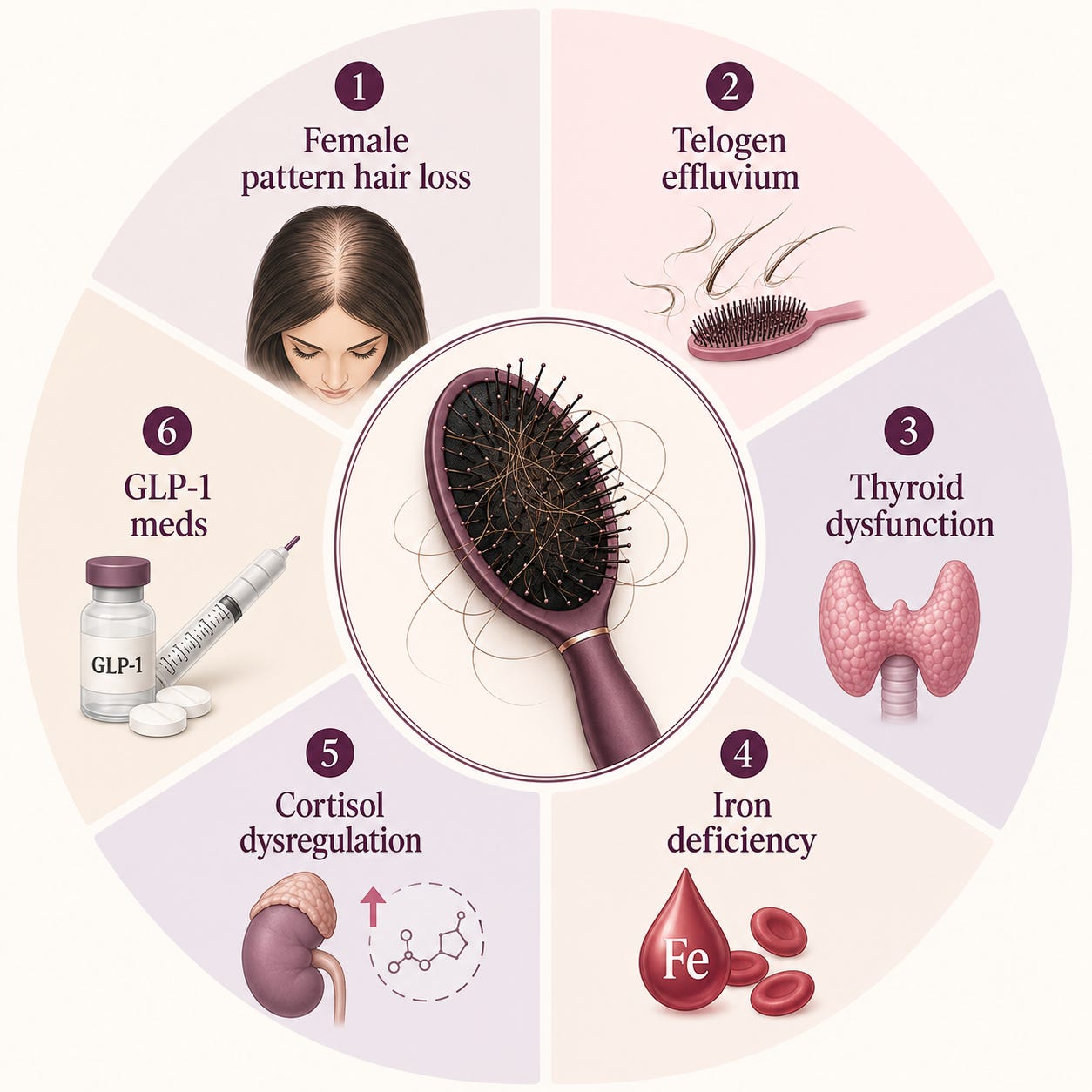
Every woman losing hair in perimenopause and postmenopause has one, two, or sometimes three of these six things happening at once. And each one has a completely different treatment.
Cause one: Female pattern hair loss, driven mostly by estrogen decline.
Cause two: Telogen effluvium, a stress-triggered shedding event that most women misread as regular hair loss.
Cause three: Thyroid dysfunction, which is one of the most-missed diagnoses in women over 45.
Cause four: Iron deficiency, which is far more common in perimenopause than most women realize.
Cause five: Cortisol dysregulation, which directly shuts down your hair follicle stem cells.
Cause six: GLP-1 medication side effects, which prescribers are not warning women about.
Every hair loss protocol being marketed to women lumps these six causes into one bucket and treats them all with the same DHT-blocker stack. Which is why the supplements are not working.
Most women reading this have three of the six running at the same time. The question is not which one you have. The question is what to do about each one, in what order, starting with which. Because two of the six will resolve on their own if you address the right upstream driver. One of the six responds to a treatment nobody markets. And one of the six is being made significantly worse by a supplement most women are currently taking.
Let’s walk through the solutions, in order, for every one of the six causes.
You will know the specific tell-tale patterns that identify each of the six causes, so you can figure out which two or three are yours in ten minutes.
You will know the one FDA-approved hair loss treatment that actually regrows hair in postmenopausal women, which the wellness industry does not talk about because it is not sold in a supplement bottle.
You will know which one of your current supplements is very likely sabotaging your body right now, and the exact washout period before your next blood test if you want reliable results.
You will know why women on Ozempic and Wegovy are shedding hair at rates their prescribers did not warn them about, and the four-part food protocol that reverses it.
You will know the one hormone conversation almost no postmenopausal woman is being offered, that has genuine peer-reviewed evidence for regrowing hair, and how to bring it up with your provider without her dismissing you.
You will know which two of the six causes will resolve on their own if you address the right upstream driver, so you can stop treating all six at once.
You will know the exact ORDER to address your combination of causes, because most women have three at once and they cannot all be tackled in the same week.
And you will know the five food-based interventions that support four of the six causes at the same time, at zero dollars a month, and why they are working while the $340 in supplements in your cabinet are not.
Your hair is not falling out because you failed.
It is falling out because something upstream is not being supported. Let’s find out what to do about it.
Comments
Nothing yet. Say the first thing.
Sign in to join the conversation.