
Women often come to me simply because they don’t feel like themselves. She has trouble sleeping. She is losing her hair. Maybe her body has changed, she’s not as sharp as she used to be, and she just doesn’t have the energy to keep trying things that aren’t working.
Trust me, I get it!
But I keep seeing something.
More and more women on GLP1’s coming to me.
Monday I had my first meeting with Tina. She’s mid-50s and has recently lost significant weight. She was really excited to be able to fit into clothes she hasn’t worn since 2018.
But she lost more than weight.
She came to me because she noticed that she was losing strength and hair, and she claimed to be skinny-fat (her words, not mine). She was thrilled to drop from a size 16 to size 8. But she was unhappy because her shape wasn’t the same as it was when she was the same size ten years ago.
This is the trend I’m noticing. When it comes to weight loss, Ozempic and Wegovy and tirzepatide and all the GLP-1s are doing what women want them to do. They’re losing weight. But when it comes to women in perimenopause to postmenopause, they’re also losing muscle. Some are losing their hair. Their skin’s changing. Women are worrying about their bone health.
And then, on top of all of that, they face a big hurdle:
They can’t eat enough.
When your appetite hormones are suppressed and your fullness hormones are boosted and your stomach’s emptying slower, you simply don’t have an appetite to eat the amount of protein that your muscles need. You don’t have the capacity to eat the carbohydrates your brain needs to be fueled. You’re not eating enough fat to support your cell membranes. Women are not getting the micronutrients that their skin, hair, and bones need desperately.
What they notice is results on the scale.
They notice dropping four dress sizes.
But the scale doesn’t show you what’s going on with your bones, or what’s going on with your gut, muscle, or skin.
And so even though everyone was congratulating Tina on how great she looked, she knew something was off. Because when groceries were delivered and she picked up that 24-pack of bottled water to put in the pantry, it was heavier than usual.
Was it actually heavier than usual? Heck no.
But she had lost strength.
And our muscle is one of the things we want to preserve the most from perimenopause through all of our postmenopausal decades. Muscle is our metabolic engine. It can also help us regulate our insulin resistance and help in protecting our bones.
If you are considering GLP-1s, starting one, on maintenance dose, or about to go off it completely, this article is for you.
Because we can’t protect our bodies if we don’t know that there’s a problem. And here is what I want you to remember more than any words on this page:
A smaller body does not mean a healthier body. Period.
This is an extremely important distinction to make especially when it comes to women over 45. There is an incredibly real difference between a smaller size and healthier size.
I face this distinction every single day in my programs. Nearly every single time, it’s a battle to get her to stop weighing herself every single day. We’ve been trained for decades to judge our health based on our weight-to-height ratio.
But the scale doesn’t measure the strength you build, or movements you do to protect your bones, flexibility, and mobility.
If you want a smaller waistline, I fully support you. I totally get it. When my waist started exploding in perimenopause, when I could no longer buy a single item in White House Black Market, the feeling I had inside wasn’t just about a number on the scale or that I had sized out of regular women’s clothes or that I was wearing all elastic-banded pants. I just didn’t feel like me. So, I truly get it.
Many women want to be smaller.
I want for you to be smaller, healthier.
So that you protect your long-term health, mobility, strength, and bones. And you aren’t just a smaller you… but a healthier, stronger you.
After 45 this matters even more because we are already navigating loss of bone density and age-related muscle loss (sarcopenia).
Sarcopenia affects both men and women over 40. However, because of our fluctuations in hormonal levels, women face greater losses in muscle mass each decade relative to our male counterparts. This leaves us with less room to lose muscle before it begins affecting our strength, balance, mobility, and independence.
Our body composition also changes over these years. Women tend to store more fat around the abdomen (including the deeper visceral fat associated with insulin resistance and cardiovascular risk).
Now, on top of all of this, let’s plop a drug that drastically suppresses our appetite.
She’s in calorie deprivation, eating half as much as she used to. And the scale keeps dropping. Her dress size gets smaller. Her jeans fit again. Maybe she thinks she looks fantastic.
Wonderful.
But what did it cost her? And what could we have protected along the way if she knew what to protect?
So I don’t want to have a conversation about the pros and cons of GLP-1 or whether or not you should be on GLP-1. That’s not what this is about. The last thing women need is another reason to attack one another, being shamed for being on weight loss meds.
A lot of women are using these medications. A lot more are considering them.
We need to protect the women who take them.
So let’s get into the actual science.
Premenopausal women respond to these drugs. Perimenopausal women respond. Postmenopausal women respond too.
There’s no doubt in the efficiency of losing fat. An analysis found that postmenopausal women who received tirzepatide lost approximately 23% of their body weight, compared with approximately 3% in the placebo group. Their average waist reduction was 7.8 in (~20 cm).
That is significant.
But let’s go deeper than whether these medications help women lose weight. We already know they do.
What those percentages cannot tell us is the cost in her strength, her bones, her health, and her longevity.
The big question is: What can women do to protect their strength, balance, mobility, and independence while on the meds?
Let’s walk through the 5 concerns for your body while on these weight loss medications and the four-step protocol to combat all five.
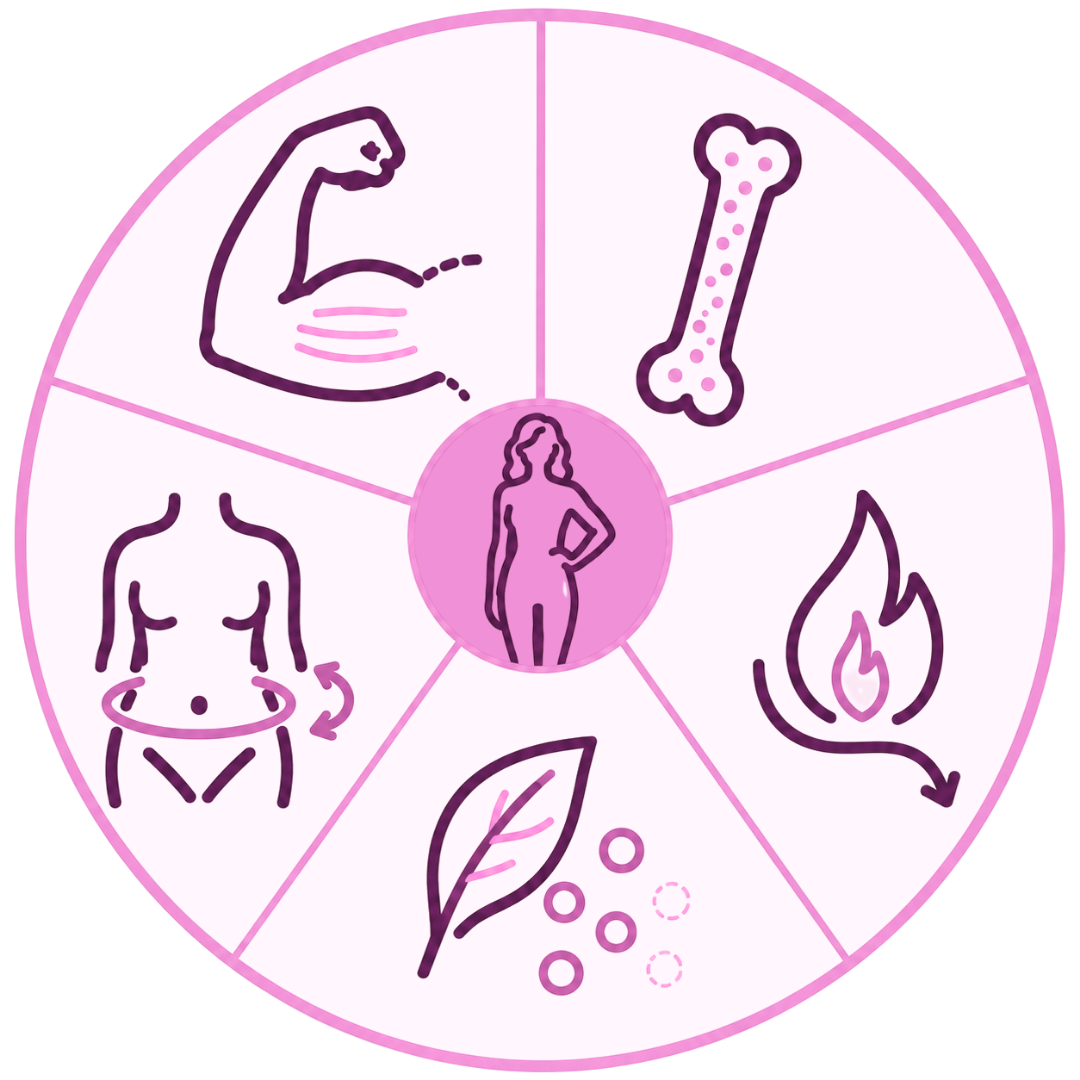
Are you getting on the scale every day? Watching the numbers tick down and celebrating each loss? We make the assumption that this loss is all fat
Would you be as excited if that loss was actually muscle?
For women on GLP-1s, somewhere between 25-40% of what you’re losing is indeed not fat. It’s your muscle. It’s your connective tissue. It’s your bone density. It’s the stuff that actually keeps you strong and functional and independent.
And for women over 45, our percentage is often in the high end of that range. We are already losing muscle every year from sarcopenia. So the drug itself isn’t pulling muscle out of you. It’s compounding what your hormones are already doing to your muscle loss.
These three things: (1) being over 45, (2) being female, and (3) eating less protein are all independently linked to more muscle loss on semaglutide.
All three of those describe you.
So when Tina couldn’t lift the take the case of water to the pantry, she really was weaker. Measurably weaker. Even though her scale told her she was winning, her loss of strength let her know that something deeper was happening.
For me personally, it’s the bone piece that scares me the most
So I secretly sneak it into all my programs.
Bone loss is like a shark lurking underwater. You’re swimming, you’re having fun, you’re enjoying life, and you don’t know the shark is there until the moment it decides to bite.
The loss of your bone mass is something you can’t feel happening. You don’t know it until you’ve fractured a leg… or until a DEXA scan comes back 8 years from now with an osteopenia diagnosis… or until your posture starts hunching over in a way that makes you look far older than you are.
Weight loss and bone loss walk hand in hand. And if you know me, you know I’m not pulling this out of thin air. This has been documented for decades, even with early bariatric surgery patients. The same thing happens on GLP-1s. When you lose weight fast, your bones stop getting the mechanical load they need to stay dense. Bones respond to load. Less load, less density.
Now let’s stack this on top of the bone loss that happens naturally once our estrogen starts depleting, from our perimenopause years through the rest of our lives. women lose up to 20% of their bone density in the first five years of post-menopause. that means for many women reading this, you’re already in the highest risk decade of your life for bone loss.
I wish this math wasn’t real.
Every pound of muscle you have burns about 6 calories a day just sitting there doing nothing. Every pound of fat burns 2. This is the energy it takes for those cells to stay alive.
So when you lose 10 pounds of muscle on Wegovy, you’ve permanently dropped your resting metabolism by around 60 calories a day. Every day. FOREVER. (Unless, of course, you rebuild the muscle… which is harder in a menopausal body)
Over a year that’s 25,000 fewer calories your body burns doing diddly squat.
That’s about 7 pounds of fat that will show up if you go back to eating your baseline diet.
This is why so many women go off Ozempic just to gain the weight back… and they often gain more than they lost.
If you’re weight has yo-yo’d up and down the scale, you’re probably having an “ah ha” moment right now. I hope all that pressure and guilt of feeling it was you, that you lost willpower or got lazy, is off your shoulders. Because what was really happening each diet was you were making your metabolic engine smaller and smaller. Every attempt lose the weight is harder position than it was the time before.
If you’re on a GLP-1 right now, this is exactly what my GLP-1 Survival Kit is for. It walks you through what to do every day to protect your muscle, your bones, and your metabolism. Grab your GLP-1 Survival Kit here.
This is another concern when your appetite drops and you’re not able to eat enough.
And just like the bone loss, it’s another problem you can’t see (or feel) coming.
the GLP-1s are very successful at suppressing appetite hormones. This is one of the reasons people take them, but what can result is that you’re not eating enough:
protein
iron
calcium
magnesium
vitamin D
B12
I could go on and list all the trace minerals your body needs just to function, but we have character limits on Substack.
Add all of this on top of the fact that, for a lot of women, once we hit perimenopause, we already have low reserves. If you had crazy perimenopausal bleeding, you might already be low on iron. Many women are already borderline vitamin D. Calcium absorption drops when our estrogen drops. Not to mention that B12 absorption gets worse as we age
Now you’re eating 40% less than you used to.
So we slowly become deficient in micro and macronutrients that our body needs for survival. By the time we feel it, some of the damage is done.
I’m not sure why nobody talks about this one.
2/3 of people who start on GLP-1s, stop in the first year. Two out of every three. women stop for a plethora of reasons, maybe because of side effects or the cost or insurance issues. Maybe some women just hit their goal weight and think they’re done.
But the research on what happens when women stop taking these drugs is quite clear. Most women gain a significant portion of the weight back within the first year of stopping. but worse than that is that when the weight comes back, it doesn’t come back where you lost it. Perimenopausal and postmenopausal women whose fat distribution has already shifted, a lot of this can come back as visceral fat.
Yes, around the belly.
So women are starting these medications with a certain body composition. They’re losing weight, shrinking down. Not even a year later, they’re heavier, but not in the same way. Now they’re shaped more like an apple than an hourglass with the weight packed on the belly
You find that your body simply looks different than when you started. Not only that, but your metabolic risk is higher than when you started because of the visceral fat. Your muscles are gone, your strength is gone, your bones are weaker.
some women opt to go back on the drug and then cycle on and off, yo-yoing up and down the scale. Others have a maintenance dose for the rest of their lives
But if you are caught in this loop, it’s the reason the protocol below matters so much more than the drug itself.
Here’s your four-step protocol. Start it today.
Whether you have been on GLP-1 for a while, you’re considering starting, on a maintenance dose, or trying to come off… These protocols don’t change.
The only thing that changes is your urgency of when to start.
Comments
Nothing yet. Say the first thing.
Sign in to join the conversation.