
This is the largest mudbrick building in the world and one of Africa’s most iconic landmarks. The Great Mosque of Djenné in Mali was first built in the 13th century and rebuilt in 1907.
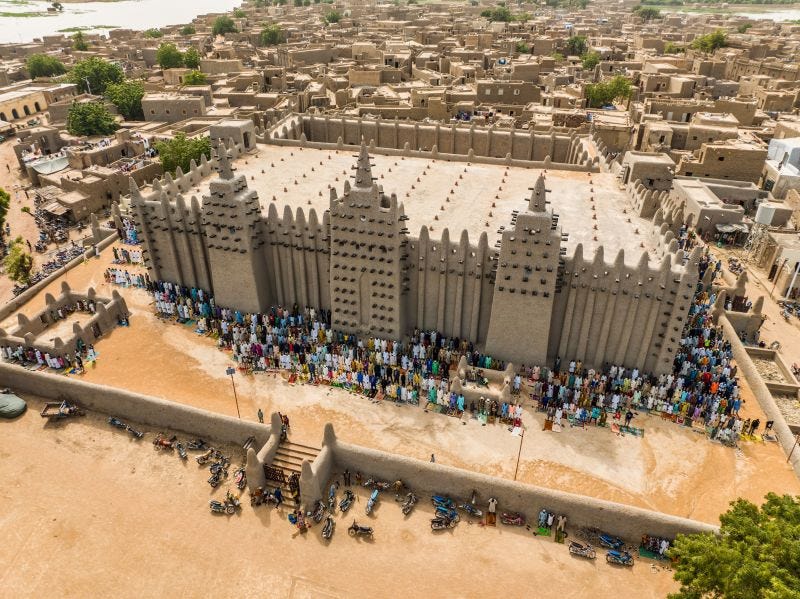
What makes it stand out? It’s a prime example of Sudano-Sahelian architecture, a style found only in West Africa. The local go-to material was adobe—a mix of mud (soil, clay, sand) and straw or husks as a binder. They shaped it into bricks and let them harden in the sun. Adobe, or mudbrick, isn’t unique to Mali; it’s used worldwide. The Mesopotamians built their ziggurats from mud bricks, for instance. Or take Shibam in Yemen, famous for its mudbrick high-rises. These structures also feature wooden stick bundles embedded in the adobe, coated with mud-and-clay plaster. Those wooden bundles serve structural and aesthetic purposes and also double as built-in scaffolding. Adobe’s cheap and adaptable, but it needs upkeep. The sticks make it easy to climb up and slap on fresh plaster or adobe. And it will last longer than almost all modern buildings.
It is worth knowing what water does to a balcony because every summer, someone turns one into a swimming pool. This video from Brazil in 2017 shows a boy cooling off in a plastic-lined pool built directly onto an apartment balcony.
Probably makes structural engineers wince. Makes me wince. Plenty of people do not understand how heavy water is. A residential balcony is designed to support roughly 200 kg/m², which is the code's assumed load for people and furniture. A cubic metre of water weighs 1000 kg, so it hits the design load at just 20 cm depth. That’s just above your ankle. Not a lot. And surprising for many people. Fill it to half a metre, and you’re at 2.5 times the design load; fill it to a full metre, and you’re at five times the design load. Balconies are often cantilevers, projecting out from the building and supported only at the fixed end (although this one is not fully cantilevered) The worst bending moment is right at that connection. And it increases with both the load and the distance from the support. And that’s before the plexiglass parapet, which is built to stop people leaning out, not to hold back the sideways pressure of 80 cm of water. So why is this balcony still holding? Because of the factor of safety — the built-in margin engineers add on top of the design load. Structures include extra capacity (via load factors, capacity reduction factors, material overstrength, etc.) for the things we can’t perfectly predict: construction defects, corrosion, long-term ageing, or rare overloads. The pool is testing those limits and safety factors. It sits there holding because the design had a margin for the day someone gets a little too hot and asks their balcony to carry a few extra tonnes.
This is the largest land vehicle ever constructed. They call it the Bagger 293. (there are a few sibling Bagger's as well, but he is the biggest)
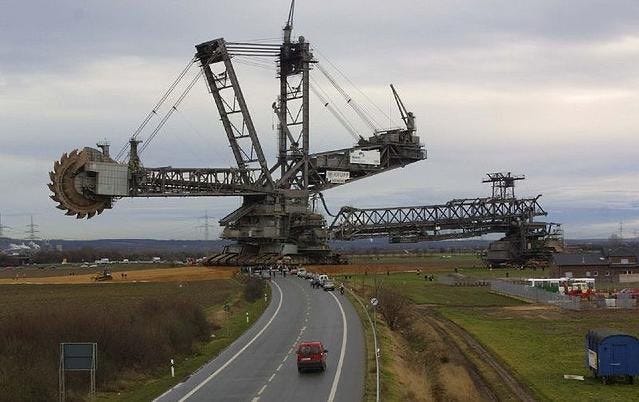
Standing 96 metres tall and weighing over 14,000 tonnes, it operates in the Garzweiler lignite mine in western Germany. Built in 1995, it was engineered for one purpose: to move earth at a scale no other machine on land ever has. This bucket-wheel excavator can shift 240,000 tonnes of overburden in a single day. That’s the equivalent of digging up the entire volume of 100 Olympic swimming pools every 24 hours. Its rotating wheel carries 18 buckets, each with a capacity of 15 m³. As the wheel turns, these buckets carve continuously into the landscape, feeding a kilometre-long conveyor system that transports material out of the pit. It’s an industrial assembly line fused into a moving structure the size of a cruise ship. Engineers designed it to work nonstop. It travels on 12 crawler tracks that spread its immense weight evenly across the soft mining floor. The structural engineering challenge of keeping something this massive both mobile and stable is immense, especially while it excavates and processes material in real time. Despite its scale, it only takes five people to operate. Each system — mechanical, structural, electrical — is integrated to function as a single coordinated unit. Bagger 293 isn’t just an excavator. It’s a monument to what engineers can achieve when scale, purpose, and precision are pushed to their limits. I actually googled to see if I can view it when I am in Germany next month. It's close to where I will be! Apparently, there are some lookout points, but you can't get too close, and might need binoculars even to see him operate.
I have curated a bunch of industrial art that I love. I will start posting them on Sundays. Here is the first: "Symphony of the Sixth Blast Furnace".
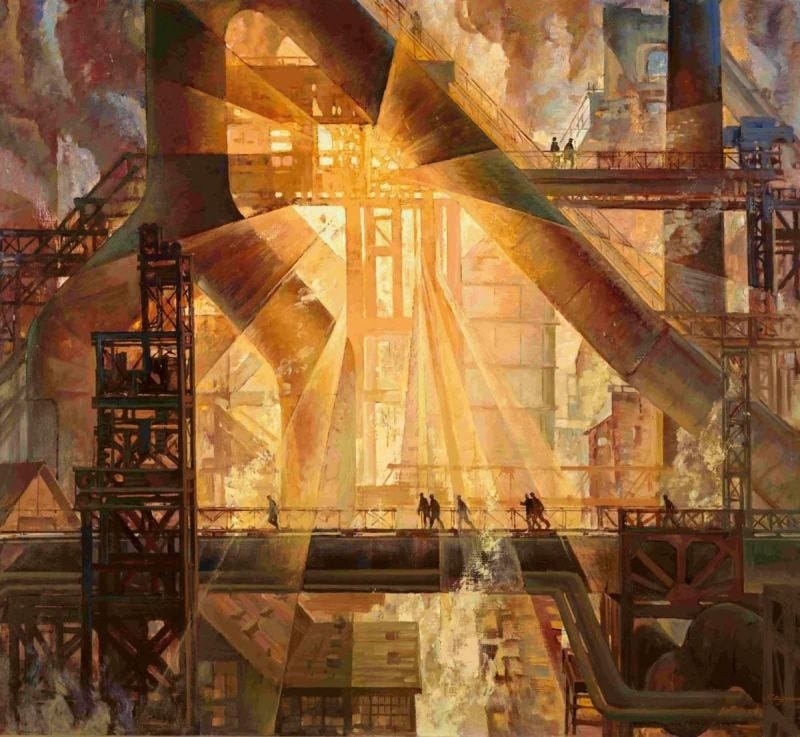
An oil on canvas painting created in 1979 by Evgeny Vasilyevich Sedukhin (1930–2023), held by the State Art Museum in Yekaterinburg, Russia. It's a Soviet-era socialist realism work depicting industrial/factory labour, associated with the Nizhny Tagil Iron and Steel Works. The painting captures a breathtaking interior view of a steel mill, dominated by a brilliant, glowing orb of fire resembling a contained sun. A nod to the elemental power of fire conquered by heavy industry. Sedukhin avoids making the machines cold or detached; instead, he applies the soft, expressive techniques used in landscape paintings to create an almost dreamlike, awe-inspiring atmosphere. Propaganda vibes. But a wonderful piece of art.
No posts
Comments
Nothing yet. Say the first thing.
Sign in to join the conversation.