
On 1 Jan 2026 at 01:26, during New Year celebrations, a fire broke out at Le Constellation bar in the ski-resort town of Crans-Montana, Switzerland. Forty-one people tragically died in the fire.

Many of them teenagers. Some initial blame was attributed to the fact that young people are preoccupied with filming everything. Nothing could be further from the truth. The Station Nightclub fire (USA) occurred in 2003. There were no smartphones or Instagram. Yet, 100 people still died because they stood watching the flames, assuming it was part of the show. They did not die because of stalling to take images. This isn’t stupidity. It’s biology, physics, and a catastrophic design failure. What actually happened: 1. When music continues, and staff don’t panic, the brain suppresses the fight-or-flight response. This is normalcy bias. People freeze to reconcile conflicting cues, not to film. Many were already recording and likely drunk. 2. Fire codes assume this hesitation. Buildings are designed with pre-movement time in mind. Sprinklers and detection exist to buy those minutes. 3. That buffer vanished because of the ceiling material. Polyurethane foam reaches flashover in under 90 seconds at around 1,100°F. It behaves like solid fuel. The room effectively exploded. 4. Exit widths are calculated on flow rate versus fire growth. With foam fires, available safe egress time collapses to near zero. Even an instant reaction wouldn’t have cleared the exits before the crowd choke occurred. 5. In normal fires, you expect staff or sprinklers to control it. You don’t evacuate a restaurant because of a small pan fire. No reasonable person would expect instantaneous flashover unless they knew the building’s design. They didn’t die because of Instagram. They died because the fire moved faster than human bodies can move through a door, and because the building gave them no chance.
This is the amount of oil Kuwait produces every second. It is not a time-lapse. It is real-time. Thirty-one barrels. Every single second (a barrel contains 159 litres).
That adds up to over 2.6 million barrels per day, ranking Kuwait among the world's top oil producers. This exhibit at the Kuwait Oil Museum effectively illustrates the scale of this volume, with a simple and powerful visual. It makes the scale of energy production tangible. But behind that barrel is decades of engineering. Water injection, gas lift, flow assurance, well integrity, etc. The systems that sustain production through technical challenges and political shocks. Just look at what is happening in the world, and yet oil continues to flow. Price might fluctuate, but the flow does not stop. Kuwait’s reservoirs are relatively shallow and accessible. But producing at this speed still requires complex infrastructure. Pipelines, separators, metering stations, tank farms, and export terminals must operate without failure. Engineers built this. Engineers maintain it. Making virtually every conceivable modern convenience, luxury and basic necessity possible.
Since the 1960s, Singapore has reclaimed approximately 170 square kilometres from the ocean—a 25% increase for the small city state!
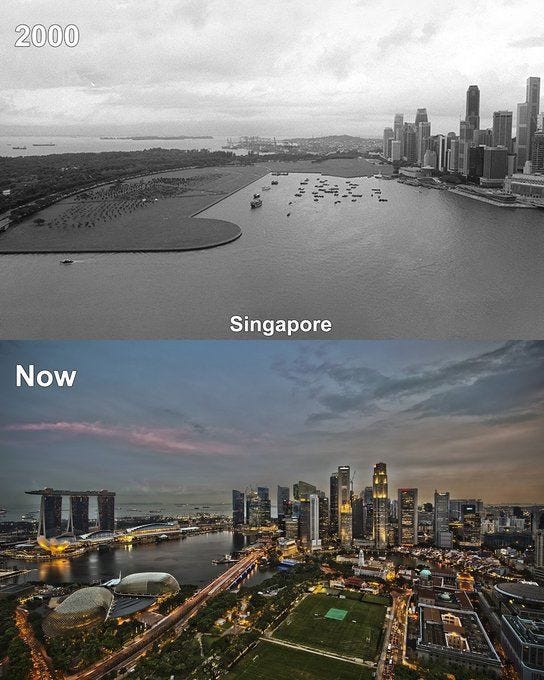
Most of what that country does amazes me. It's to support its rapid urbanisation and population growth, expanding its land area from 581.5 km² in the 1960s to about 750 km² by 2023. They did this mostly through hydraulic reclamation, using sand as the main fill material. Dredgers extracted sand from the seabed or imported it from neighbouring countries, while large pipelines or barges transported it to designated coastal areas. Bulldozers and compactors then levelled and stabilised the sand, creating solid land. Engineering challenges included managing tidal currents and ensuring seabed stability. Singapore employed advanced geotechnical surveys and soil improvement techniques, such as vertical drains and preloading, to consolidate soft marine clay. Constructed with concrete and rock, breakwaters and seawalls protected reclamation sites from wave erosion. There must have been so many marine and civil engineers who cut their teeth on projects over there. Since 2016, facing a global sand shortage (yes, the world is running out of sand!), Singapore has adopted the polder method, inspired by the Netherlands. This involves encircling areas with dykes, pumping out seawater, and draining the land to minimise sand use. Like the Dutch used to do for centuries (with windmills as the driving force) These innovative, multidisciplinary approaches—combining civil engineering, coastal management, and environmental science—enabled Singapore to reclaim land sustainably while addressing rising sea levels and ecological concerns. Almost everything that little country does is amazing. I have an endless list of topics to write on with them. By the way! I am there at the end of July, so if you are around and want to meet, then send me a DM.
No posts
Comments
Nothing yet. Say the first thing.
Sign in to join the conversation.