
When I was six years old, my father died in the middle of the night of a heart arrhythmia. I have very few memories of my childhood, a defense mechanism no doubt, but two moments have always connected me to that time.
The first memory is real, yet flickering, relived through the sensation of place. My father was a gardener and always planted sunflowers along the back porch. I remember them, so tall and top-heavy that they dipped in the wind, almost as if bowing to an unseen audience. I remember the way they blocked out the sun when you looked up at them, the way they seemed to nod hello. I remember how hard and fibrous the stalks felt beneath my fingertips. I remember standing underneath them holding my lunchbox, to take a picture before the first day of kindergarten.
The second memory is not real, but something I invented for myself sometime in my youth, as a way to stay present in my grief. I’ve articulated this “memory” in many forms over the years, but most succinctly in a short story I wrote in my late 20s.
The day he died I sat on the front steps of our home in Aurora, Illinois, the side of my face pressed to the concrete landing. It was cold and hard and dimpled; the hollow chill of the concrete drifted into my ear, swirling around in my head before sinking deep into my chest. It was dusk and quiet in our suburban neighborhood, the air drowsy with the smell of freshly cut grass.
I listened closely, closing my eyes as I pressed my face harder into the echoing emptiness of the stone beneath me.
I quietly whispered, ‘breath, daddy, breath’.
I waited.
An overwhelming ache was growing inside my chest as I held my own breath, yearning to hear anything instead of the ringing silence.
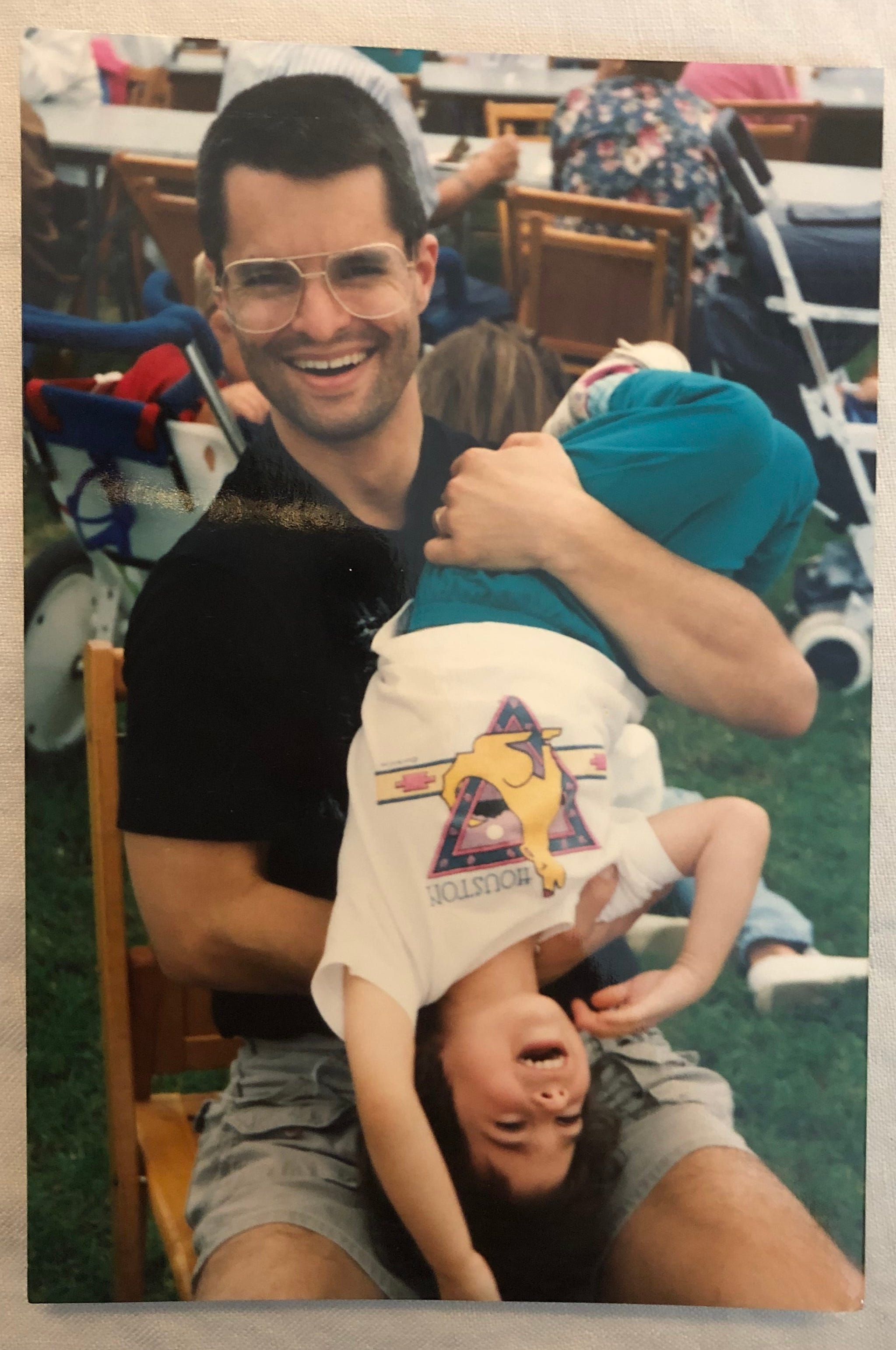
Growing up, I searched for him. I talked to him as I waded into the ocean, imagining him as the waves, his presence the ebb and flow as the water lapped at my feet. He was every cardinal and hummingbird that paused for a moment, as if stopping to make their presence known. He was the mountains, the horizon line, the rain during a sky-lit sun shower. Sometimes I would watch the patterns tall grasses made as they danced in the wind, on sand dunes and prairies, and I would take a deep breath to acknowledge him. hi, daddy. I miss you.
Sometimes, even as an adult, I would press my face to the earth and listen for him. I would breathe slowly, stilling myself, hoping that if I was quiet enough, I could trade my breath for his.
✻
While pursuing my undergrad at The School of the Art Institute of Chicago, I was simultaneously discovering myself as an individual while creating my artistic identity. As my sense of self began to form, so did my yearning for place. How could I memorialize my father as a way to heal? How could I root myself, or allow my hollowness to seep out in order to find peace?
I shaved my head and buried my hair. It didn’t ground me.
I created performance art. I attempted ritual. I folded his flannel shirt to the sound of his voice, taken from an old home video. I ate sunflower seeds. I recited poetry. It didn’t mend me.
One night I was articulating this all to a good friend of mine, Han, and they asked me about the house I lived in when my father died. My family moved back home to New Jersey after he passed away (we had only been in Illinois for his work) and I hadn’t been back since. It was in a town called Aurora, part of a suburban community on a dead-end street. I told them how I was jarred awake in the middle of the night, opening my eyes to flashing lights of red and white creating rhythmic patterns on my bedroom wall. I told them about the feeling of concrete on my face. I told them about the silence.
Han and I stayed up until 3am systematically searching Google Maps until we found my old house. I now had a tangible place, but I was still untethered.
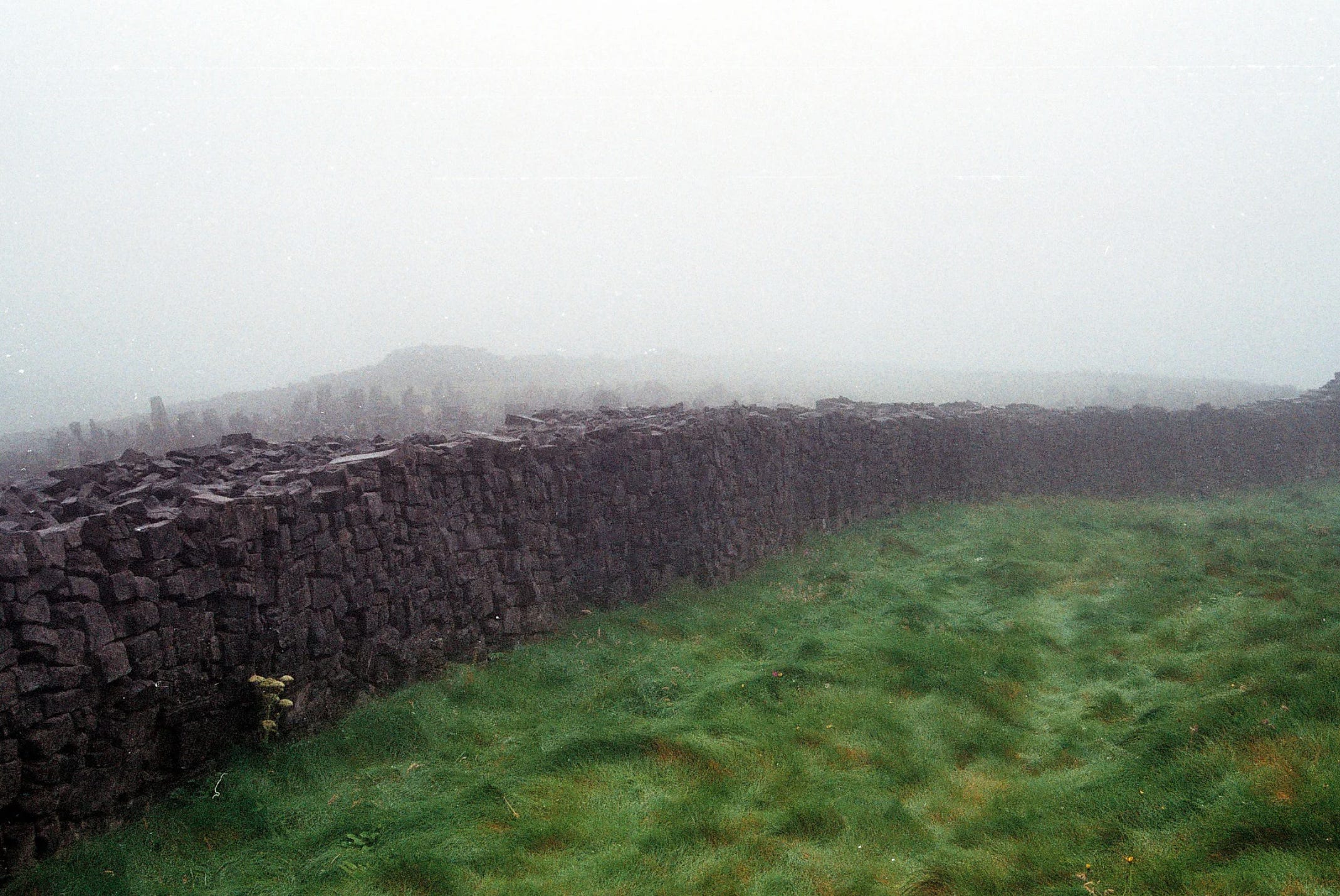
In the summer of 2012, between my junior and senior year of undergrad, I traveled to Ireland. I was there to attend an artist residency as part of my study at SAIC, and we were given studio space at The Burren College of Art. The college didn’t have a loom for me to use, so instead I painted, wrote poetry, explored castles, and took long walks through cow pastures.
It was there that I talked to the earth — and it talked back. It was in Ireland that I began to unravel the symbolism of landscape and my memorial to place.
I wrote in my journal,
Ballyvaughan, Ireland, is a sacred ground. Hallowed are the green, unending plains of the earth in contrast with the meandering lines created by man-made stone fences, and the flat, textured, moss-covered boulders captured by thick, overgrown wildflowers.
Standing still, the chill of the wind whispers, singing softly to the earth.
In the stillness, the moments between the wind and the sea, the land sighs, capturing body and soul — grounding presence into earth. These moments of awe-inspiring religion create memories rooted in place, and a profound sanctity of what it means to be a maker, and to be made.
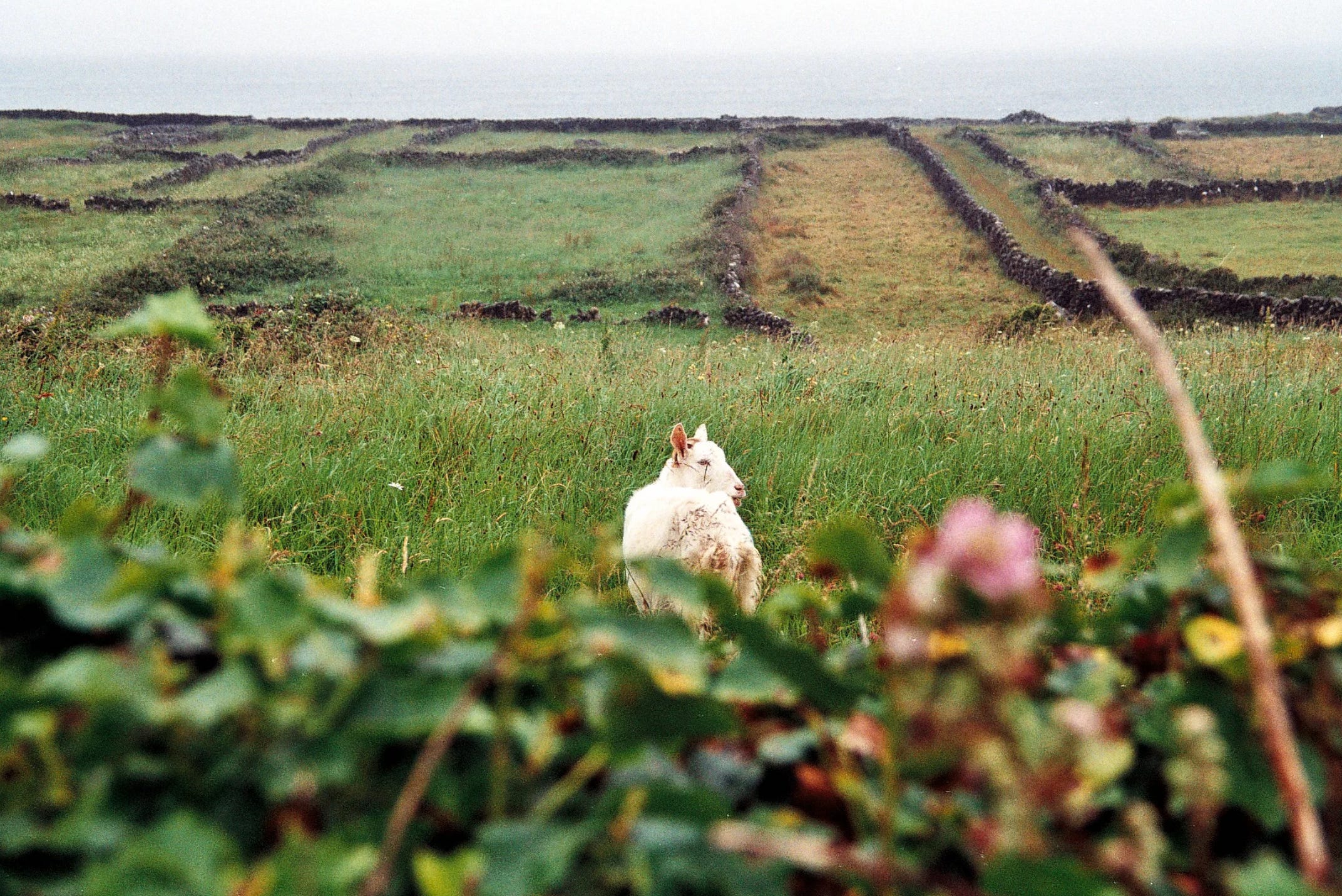
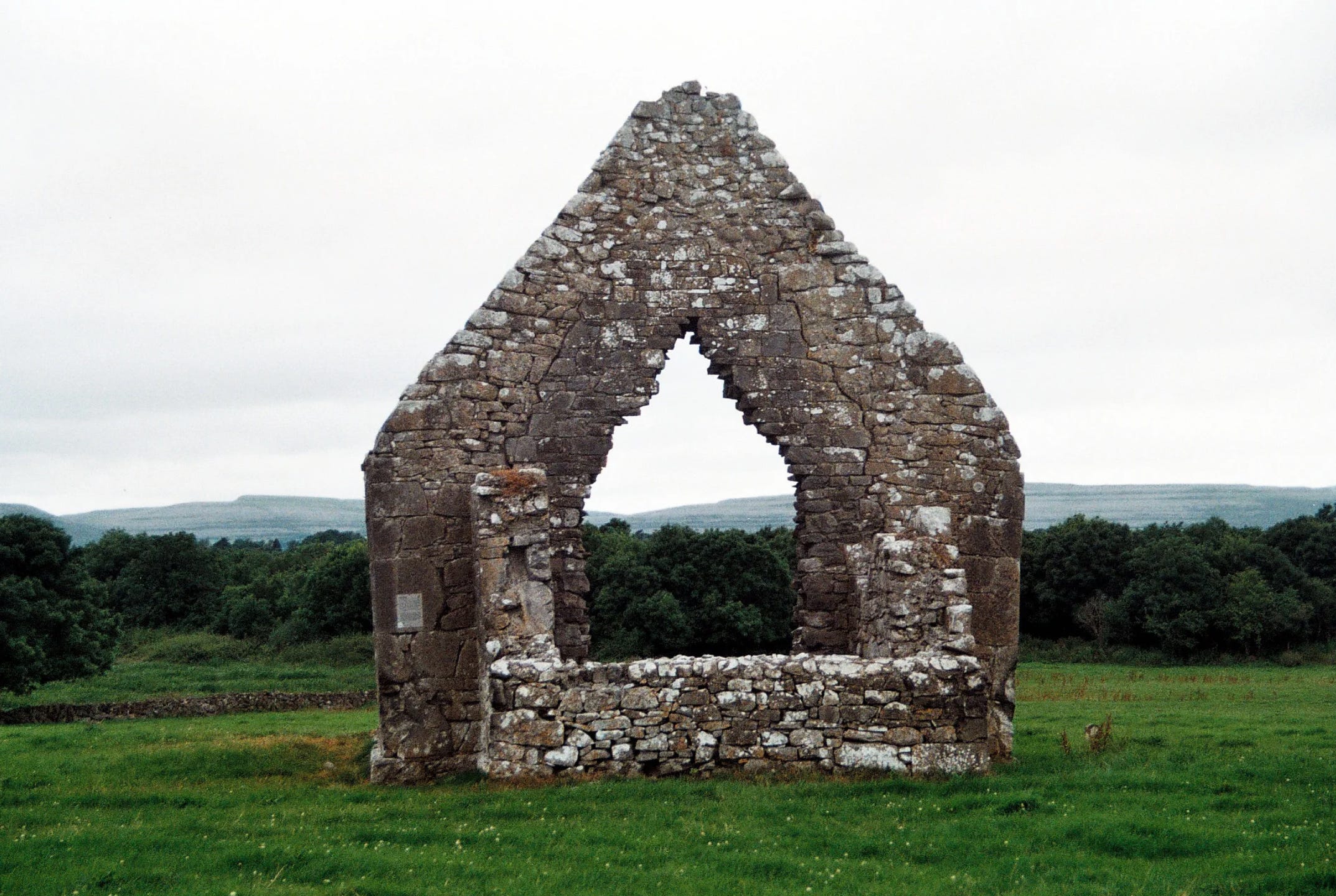
Stone dwellings define the visual landscape of Southern Ireland — many are fences used to divide land, while others remain as remnants, acting as a tactile memory of structures that once stood. I found these stone fences fascinating, not only for their presence but also for how they divided the land. As I noted on the back of a Polaroid I had taken, the landscape was a lawless grid.
Many years later, when I was writing my thesis for graduate school, I came across the article “Classifications of Sacred Space: A New Understanding of Mass Rock Sites in Ireland” by Hilary J. Bishop. Bishop says,
“Irish folklore continues to emphasize the sacredness of stone as well as the idea that stone is a container of supernatural power. It is thought that the erection of standing stones by pre-historic communities served as a way of marking or ‘socializing’ the environment but such stones would also have held a religious significance of their own and would have increased the sacredness of such sites. In Ireland, there was a common custom of swearing on stones and a belief that stones could move about and speak oracles on certain occasions” (Bishop 839).
I began to imagine how I could capture the feeling of standing in the Irish landscape, as the land came to life around me. I could create a memorial to honor place and the breath of my father. But how could I extend the loom into these spaces? How could I create an artwork that would allow the viewer to access a place so far away?
The division of land, connected to the grid (in landscape and in weaving), religious space (sacred ground), and re-creating “lost” memories all started to converge in my mind as I returned to Chicago. I wrote on the plane,
Now, when I unlock the fragmented part of my soul, the gateway deep-rooted inside of my chest, small whispers of memory float out — like a melody of longing, the song of my missing father. It is here that I create my memorial, my sacred space.
Continued in part 2.
Comments
Nothing yet. Say the first thing.
Sign in to join the conversation.