

Happy August, Memoir Nation! As is our custom, we bring you our favorite guests of the past year, partnered by theme. This week we chose Kwame Alexander and E. Jean Carroll, both of whom have seen major personal victories in the months since we originally interviewed them. Kwame Alexander launched his own imprint, Kwame Alexander Books, and E. Jean Carroll finally got her settlement money from Trump. These two guests are exemplary of how to face the hard stuff and keep going—all the way to the top. As we say in the show opening, it’s as if they’re interviews are in conversation with one another—and neither one fails to inspire. We’re wishing you good summer writing and good summer reading, and we hope you enjoy our Year 8 “best-of” series.
Kwame Alexander is an Emmy® Award-winning producer of The Crossover, his Newbery Medal-winning novel turned Disney+ TV series, the creator of the new animated PBS special Acoustic Rooster’s Barnyard Band, and the new head of Kwame Alexander Books, an imprint of Sourcebooks. His mission is to change the world—one word at a time.
E. Jean Carroll is a journalist and longtime advice columnist best known for her column “Ask E. Jean” in Elle, which ran for over twenty-five years. She is the author of Not My Type: One Woman vs. a President, about the two sexual abuse cases she won against Trump, twice, and for which she has subsequently received a $5.6 million payout. Her high-profile legal victories against Donald Trump have elevated her as a symbol of resilience and truth-telling.
Grant: Hello writers, memoirists, positivists, optimists, resilence-ists, I’m Grant Faulkner, and I’m feeling very uplifted today, because we’re doing a very special episode that is dear to my heart for a number of reasons.
Today we’re doing another episode as part of our end-of-season mash-up series—which means we’re taking two of our favorite episodes and weaving them together, because when we looked at these two conversations side by side, we realized they were in conversation with each other in ways we didn’t fully anticipate when we recorded them separately.
I’m always amazed by how some of our episodes serendipitously speak to each other, as if we planned them to go together, and today we have two writers, Kwame Alexander and E. Jean Carroll, who have inspired thousands, maybe millions of people, by the way they have handled adversity and not only followed their yes, but embodied it, lived it, spread it. Brooke, you were the one who noticed the common theme of this pairing.
Brooke: I have to say—this pairing came together so organically, and I think it’s because at their core, both Kwame and E. Jean are talking about the same thing: what it costs to tell the truth, and what it gives you back.
Kwame is a Newbery Medal-winning, Emmy® Award-winning, #1 New York Times bestselling author of forty-five books and counting—and I want to pause on that number—forty-five books—a person who has become a force of nature in the literary world, but who first spent twenty-six years as a working writer before he became what he calls an “overnight success story.” And then we have E. Jean Carroll, journalist, author, and the woman who took on one of the most powerful men in the world in a court of law and won—twice. Despite Trump’s legal machinations, intimidations, and outright weaselry, the Supreme Court recently upheld one of those judgments and ordered Trump to pay. I love every single headline that says: “Judge Orders $5 Million Trump Judgment Be Released to E. Jean Carroll.” I just really really really hope someone forces him to give her the money, because you know they’re going to have to do it by court order.
Grant: I know, we’ll celebrate her once she has it—but in the meantime, I think she’s enjoying sticking it to him as much as she will the actual cash. You know, it’s easy to applaud these two for saying yes, and that sounds easy to do, but I think we have to really pause and think about what it means to say yes day after day, year after year, when you’re hearing a lot of no’s.
These are two people who said yes to something enormous, but in both cases, that yes came at a cost, as you mentioned. It required showing up again and again in the face of rejection and doubt in Kwame’s case and in E. Jean’s case, real danger—a danger I still worry about given the way we are living in a type of Civil War. But what strikes me listening back to these conversations is how different their versions of yes look. Kwame’s yes is exuberant, motivational, and forward-leaning. E. Jean’s yes has this almost amused quality—like she’s daring the world to stop her and finding it slightly funny that anyone would try. But they also share a fundamental exuberance and self-confidence as E. Jean communicates when asked how she is. She always answers fabulous. She left me wanting to be E. Jean, and I think of her often, fearlessly living in her remote house with a shotgun by her bed. Don’t mess with E. Jean, folks.
Brooke: That’s such a perfect observation. And both of them, I think, have a relationship to failure that most of us don’t. Kwame was rejected twenty-three times for The Crossover—which then went on to win the Newbery and become a series on Disney+. But then on the very day he found out he’d been nominated for two Emmys for the Disney+ adaptation of that book, he got a call from a Disney executive—and you’d think it was a congratulatory call, but no. The executive called to tell him the show was being cancelled. On the same day. That’s the story of the creative life, though, isn’t it? No matter what success we have, somebody’s no is just around the corner.
And I just saw Kwame in June, and his latest win is that he has his very own imprint, part of Sourcebooks, and when I marveled about this to one of my friends who was standing there in the crowd with me, she was like: He’s been doing this so long. He’s earned this. And of course, right? He has just stayed the course, and never given up no matter what—and it’s a true inspiration, and so nice to see him honored for all his hard work. I love how undeterred he’s been my rejection over all these years.
I know you have thought plenty about this, Grant, because you’ve worked on a book about rejection—which was rejected, only to now see a second life, fortunately.
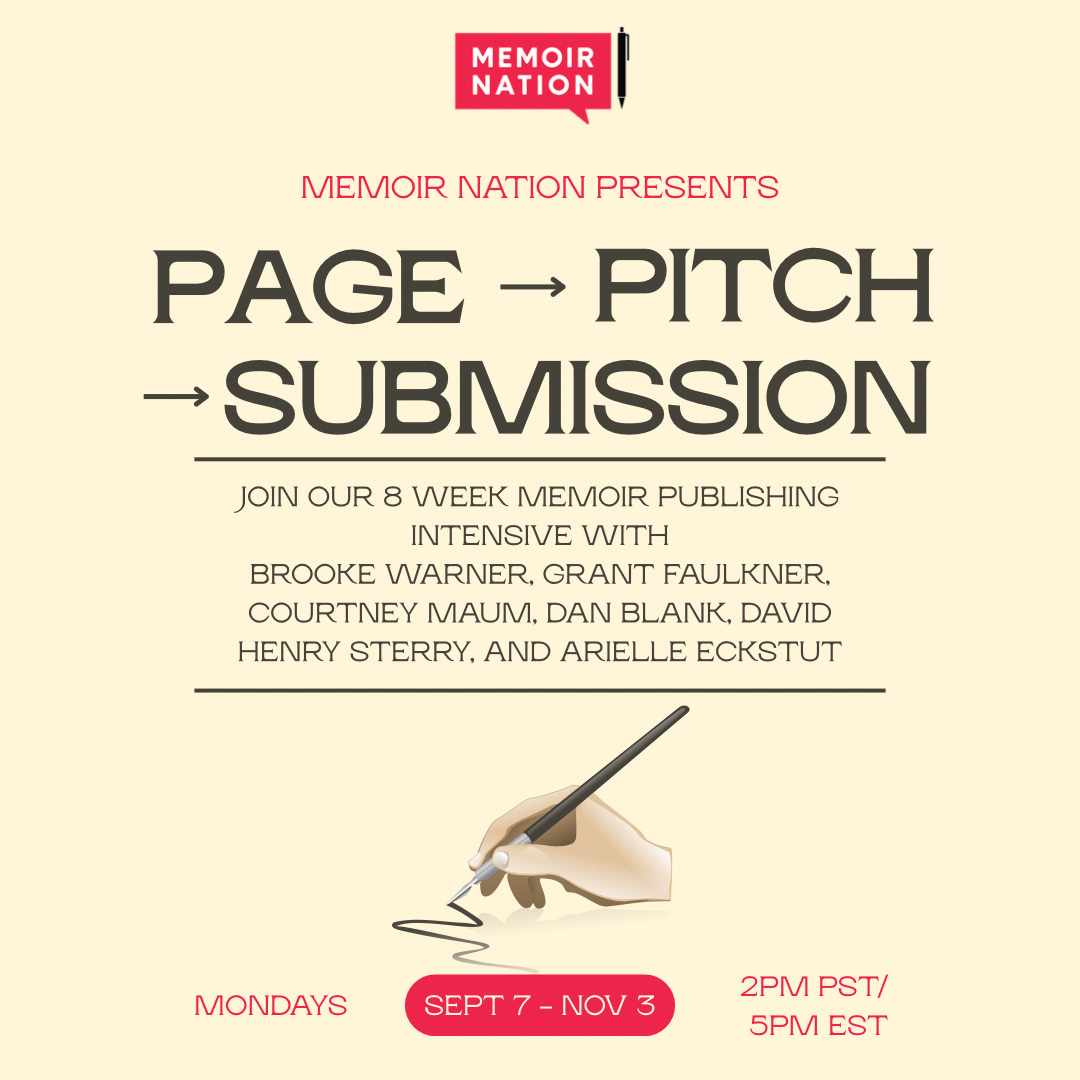
Grant: I happen to be a specialist, an expert in rejection, Brooke, as all authors are. I always say that to be a writer is to be rejected. That’s why we’re going to have a special session on rejection in our publishing course that is coming up in September. It’s good to develop a rejection mindset so that you can not only weather rejections, but find a way to use them to your advantage. So listeners, if you’re not picking up on this, that’s a plug for you to check out our course on memoirnation.com, because it’s going to be special.
My rejection story is ordinary, though, whereas E. Jean carried her story for nearly thirty years before she told it publicly. It’s obviously a different kind of fear of rejection when rape is involved, and the rejections, whether legal, personal, or familial, are genuinely harrowing, and that fear of rejection has silenced so many. But E. Jean knew what Donald Trump had done to her in that Bergdorf Goodman dressing room in 1996, and she wasn’t going to be silenced, even though she had to take on the most powerful person in the country. The decision to go public—and then to go to trial—and then to write the memoir Not My Type—that’s not one of the biggest yeses I’ve ever heard of. That’s hundreds of yeses, each one harder than the last.
Brooke: What I love about the way she wrote that book—and what came through so clearly in our conversation—is that she refuses to be a victim on the page. She’s funny. She’s snarky. She’s almost breezy in parts. And I found that incredibly moving, because underneath that breezy quality is the acknowledgment that she will live the rest of her life looking over her shoulder. She said she never had sex again after what Trump did to her. She lost that capacity for trust and intimacy permanently. And yet she’s not asking for your pity. She’s asking you to pay attention.
That refusal to perform victimhood while still being completely honest about the damage—that’s a very particular kind of memoir courage. And it connects, I think, to something Kwame does in Why Fathers Cry at Night, which is his own memoir—told in prose, poems, letters, and recipes. He writes about the end of his marriage, a complicated relationship with his father, tensions with his daughters—enormous pain—but in a form that holds that pain inside something larger and more generous.
Grant: The collage form of his memoir is actually one of the things I wanted to get into with him, because it’s a formal yes—a decision to say that my story doesn’t fit into a straight line, so I’m not going to force it into one. And what Kwame does, both in his poetry-driven novels for young people and in his memoir, is trust that the unconventional form can carry something true. Publishers told him there was no market for a novel in verse for boys about basketball. He proved them wrong in the most spectacular way possible.
Brooke: The thread that I keep coming back to between these two guests is what it means to claim your story when someone more powerful than you has tried to take it from you. Trump tried to take E. Jean’s story by calling her a liar, by saying she wasn’t his type, by weaponizing his followers against her. And what she did—in the courtroom and on the page—was take it back. She made the title of the book his insult. She put her stylish, smiling face on the cover. She said: this is mine, and you don’t get to define it.
And Kwame did something similar when he talked about being a twenty-six-year overnight success. He was claiming the whole arc—not just the Newbery, not just the Emmy, but the twenty-six years of grinding and rejection and doubt and working at it. He told us he woke up every day saying yes to himself as a writer, even when the external world wasn’t saying yes back. And he quotes Maya Angelou in the book: “You may encounter many defeats, but you must not be defeated. In fact, it may be necessary to encounter the defeats so you can know who you are, what you can rise from, how you can still come out of it.”
Grant: The necessity of the defeats. I love that reframe. Not that defeat is fine, not that it doesn’t hurt—but that it’s doing something. It’s teaching you something about yourself that you couldn’t learn any other way.
I think that’s where both of these stories intersect most powerfully for us as memoir writers. Because memoir, at its core, is the act of going back into the defeats and finding out who you are in them. Both of them are essentially saying: my story matters, and that’s our mantra. Your story matters. Which is the most important yes of all.
Brooke: On that note—let’s get into the conversation with Kwame and E. Jean.
Subscribe, listen online, or download
Memoir Nation is a hub and a community for writers, legacy-builders, published authors, and memoir enthusiasts.
Whether you’ve lived twenty years or eighty years, you’ve lived a life rich with stories that are calling out to be told.
So many people say, “I’m going to write my story someday,” but “someday” tends to always be off in the distance. Memoir Nation is here to help you start writing your story today.
Memoir Nation provides the inspiration, guidance, structure, and support to equip you creatively, emotionally, and psychologically to write your life story.
Visit the Community - It's Free!
Thanks for sharing with an author or writer in your life . . . ⤵

No posts
Comments
Nothing yet. Say the first thing.
Sign in to join the conversation.