
To state the obvious, where there are winners, there are also losers. It was ever thus - it remains a hard lesson because we try to tell our children that it’s about taking part, but they see winners get rewarded all the time (for best behaviour, in sports, art competitions and so on).
It was a hard lesson this week to explain to S that she didn’t make it for an audition she went for, as she took it to mean they didn’t like her performance. I had to explain that we don’t quite know what they were looking for and that in life sometimes opportunities work out, sometimes they don’t… It’s never personal, is what I was trying to get at.
It was another lesson that as parents we should be careful to praise effort rather than outcome, because the latter we cannot control.
To rewind a bit. When I wrote Breadwinners the first draft was about 30,000 words too long. As any writer will tell you, the more you dive into a subject the more it starts to feel important to include every tangentially interesting side-note.
Luckily my editor was good at steering me back to the topic at hand, and readers will thank me that I cut a lot of it. Many were short sentences here and there but when I cut bigger chunks I carefully saved the cuts in a separate folder, believing I would come back to them for articles or other ideas. I’m of the mindset that writing is never wasted, writing is thinking. The process itself helps define the end point.
Anyhow, I have barely come back to that mammoth document and therefore completely forgot about one fascinating study, but it came to mind recently when I was thinking again about how we define success and how it can be quite damaging on a societal level how much brains are primed to want to win, especially when many of us teach the opposite to our children, because we truly believe that we are all equal, then they find out the hard way that many are not treated equally, or given the same opportunities.
Winning, of course, has evolutionary benefits*, but today we’re not running the fastest simply to survive, today we show off our successes in part because we can get addicted to the hedonic treadmill and it can seek power-hungry individuals to look to outcompete each other regularly. We are primed from childhood to understand that to be the best gets us rewards, because that is how our society is structured even if we try to push against it. A gold medal here, a “star of the week” there. The kids are watching, learning.
Or put more primally, our dopamine-obsessed brains get rewarded from winning, which (checks notes) can make imbalances of power dominate every aspect of modern society, especially when that power is left unchecked, the winners continue to dominate.
But bringing it back to the start, where there are winners, there are also losers and because meritocracy is a myth, it’s never a level playing field.
So with that in mind, our obsession with winning can have disastrous effects on the losers. Researchers turned to cocaine-taking monkeys to showcase this effect, an excerpt which rightly so was cut from the book but has some alarming implications.
*(The truth is that at times, a bit of competition is healthy, but so is cooperation. Cooperation, many researchers argue, shaped the world more powerfully than winning ever did. There’s probably a place for both…)
—
Those who have a higher status and higher levels of social support have been shown to have higher levels of dopamine receptors in the brain, meaning they literally feel more rewards from everyday life events.
Or put another way, they are more naturally high which can then become self-perpetuating. These individuals would be more motivated to continue feeling this way, which could further their social status even more.
Cocaine-taking moneys
This can have real world consequences. If daily life is a struggle, you never get a break, and ‘winning’ is unlikely, researchers say that those individuals are more at risk from seeking highs in other places, including from alcohol or drugs. How did they come to this somewhat controversial conclusion? It involved a study of macaques and cocaine.
Ethics aside, researchers did have an important goal in mind – they do this type of work to help understand what contributes to addictive tendencies, precisely so they can better identify preventative strategies.
In one experiment, groups of monkeys were placed together for three months to see which hierarchies would develop - this particular species is known for being extremely hierarchical.
After three months together, hierarchies had formed and those lowest on the social hierarchy had lower dopamine activity in the reward network of the brain (When they were housed apart the levels of dopamine in the brain looked roughly the same - i.e. before inequality took hold…)
What did the researchers do next? Well, they offered them cocaine. When given a choice to self-administer saline solution or cocaine, the subordinate monkeys were more likely to choose cocaine. In a follow-up they were more likely to pick cocaine over food pellets.
The conclusion - being at the bottom of a group is so damaging it seeks us to find highs in other places. It’s not a perfect experiment and we should be wary of drawing direct comparisons to humans.
But it certainly showed that the socially dominant animals were less likely to seek rewards elsewhere. Being at the top was a reward in itself.
You might also like:
—
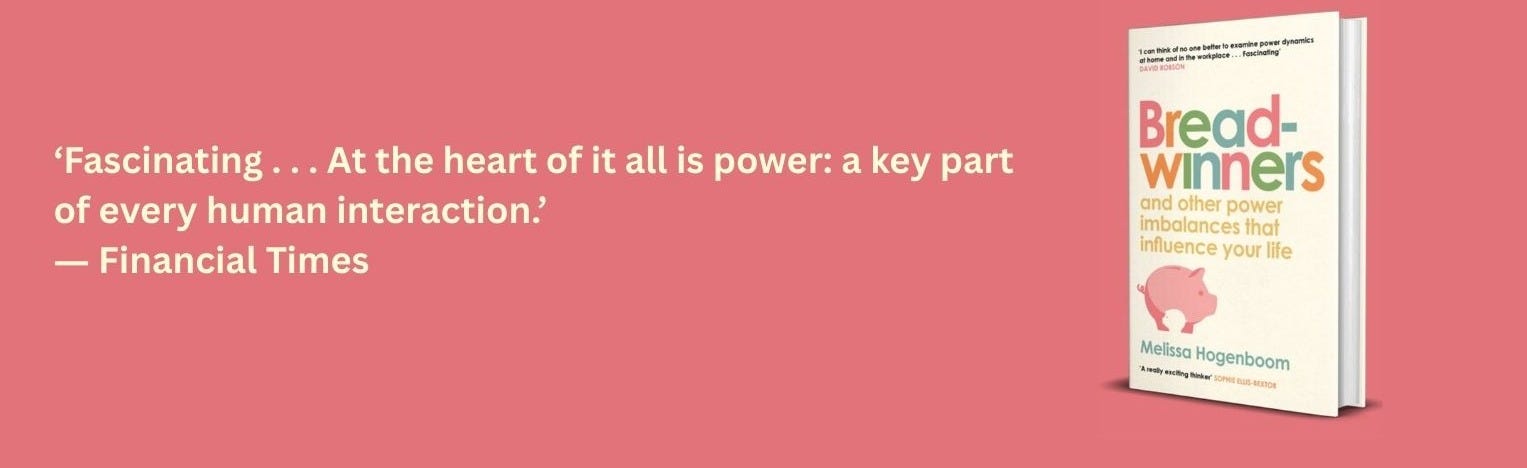
Breadwinners is packed with research, real-life stories, and practical advice for navigating the power dynamics at play in our lives. Buy it for a friend, or consider leaving a review or rating here (you don’t need to have bought it from there to do so).
No posts
Comments
Nothing yet. Say the first thing.
Sign in to join the conversation.