
I knew about the Muslim Brotherhood’s “100-year plan,” but I realized I didn’t truly know what was in it. What did the plan entail? Where did it begin? Where was it supposed to end? What were the steps in between?
I’m on a mission as a history activist to document Jewish history before it’s rewritten, distorted, or erased. Every paid subscription helps fund the research behind these essays and enables me to continue this work full-time. For $75 a year (just 21¢ a day), you’re doing more than supporting a writer. You’re helping preserve the Jewish story.
So, I decided to go in for a fun day and read about it. Like, all of it.
I figured if I didn’t know the whole deal, plenty of other people probably didn’t either.
Sharing is caring, is what I always say.
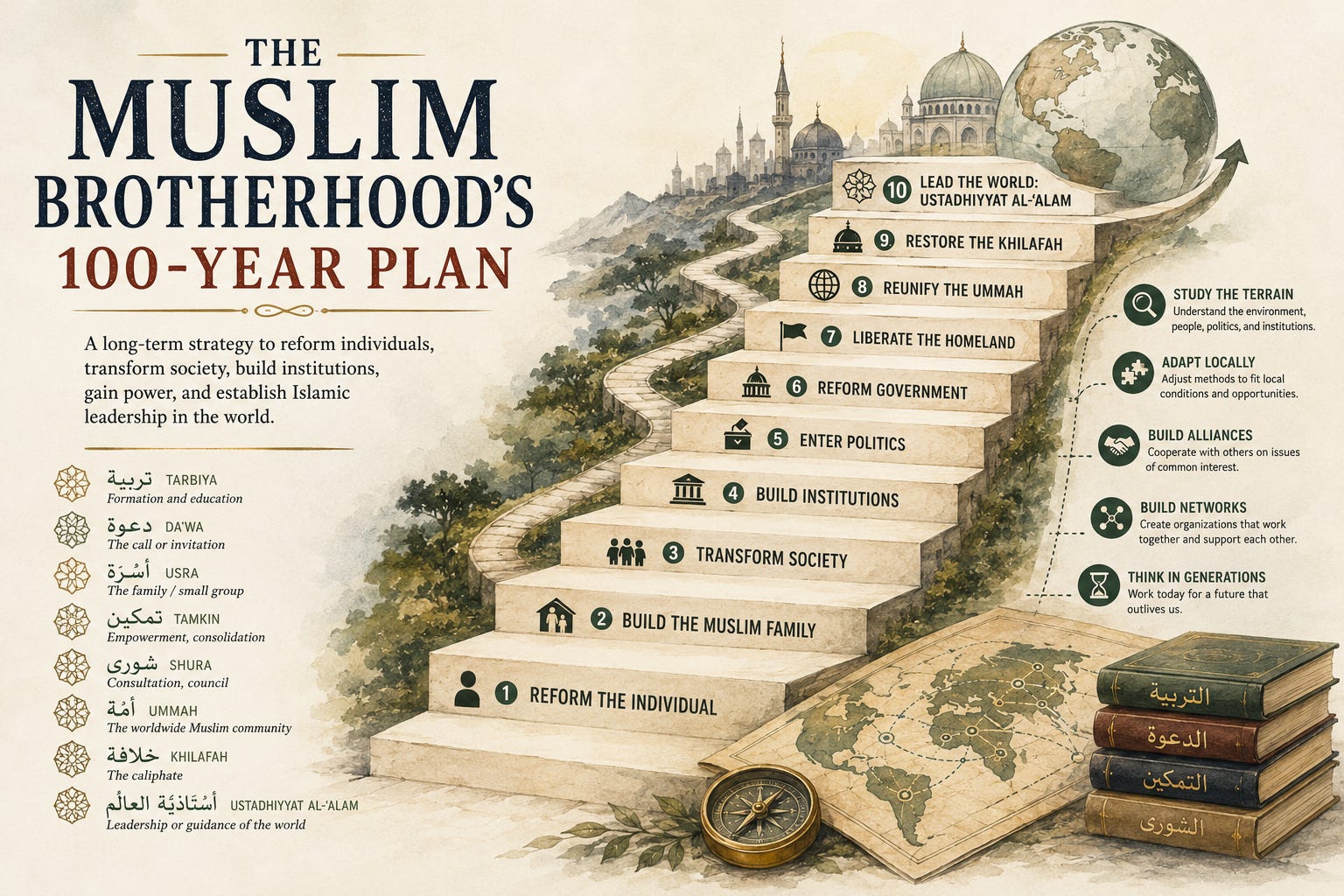
There isn’t one Brotherhood document conveniently titled The 100-Year Plan. The program emerges across strategy documents produced over decades. Hassan al-Banna founded the Muslim Brotherhood (the Ikhwan) in Egypt in 1928, designing a progression that begins with the individual and scales to unity across the Muslim world, restoration of the caliphate, and eventually ustadhiyyat al-’alam—worldwide Islamic mastery.
Later strategy documents establish the operating mechanics: study the environment, develop operatives, build institutions, create networks, participate politically, co-opt other movements, accumulate influence, and adapt to local terrain.
Put together, the progression operates in stages:
Reform the individual.
Build the Muslim family.
Transform society.
Build durable institutions.
Enter the political system.
Reform government according to Islamic principles.
Free Muslim lands from foreign influence.
Reunify the Muslim world politically.
Restore the khilafah (caliphate) under Sharia.
Extend Islamic leadership globally.
The foundation rests on a single person.
Al-Banna’s progression demands the total formation of the individual—religiously, morally, intellectually, and physically. The core mechanism is Tarbiya (formation or upbringing). This process instills Aqida (unshakeable creed). The individual learns the ideology, practices strict discipline, and prepares to serve the larger mission. Before a movement commands a society, it requires disciplined operatives trained to carry the project forward.
The ideology next colonizes the home.
The formed individual establishes a household governed by Islamic principles, ensuring the worldview becomes generational. The Brotherhood calls this the Usra (family). This functions biologically through reproduction and organizationally through cell groups. The usra is the small-group structure used for education and absolute organizational cohesion. Within these cells, members give Bay’a (a binding oath of allegiance) to the leadership, ultimately answering to the Murshid (Supreme Guide). This cellular structure guarantees the movement survives repression, exile, and the passage of decades.
The circle expands to the public square.
Al-Banna demanded the total reform of society through Da’wa (the call or invitation to Islam). Brotherhood ideology, heavily shaped by later figures like Sayyid Qutb, views secularized society as residing in Jahiliyya (a state of pre-Islamic ignorance and moral corruption). Da’wa cures this. Mosques, charities, schools, and youth organizations operate as engines to eradicate jahiliyya and mainstream the Brotherhood’s principles.
Ideas require architecture to survive.
The Brotherhood builds schools, charities, religious organizations, professional associations, and social-service networks around its religious mission. The 1982 strategy document Towards a Worldwide Strategy for Islamic Policy (commonly called The Project) dictates “permanent education and institutional action,” international coordination, and infiltrating local centers of power. Institutions outlive individual organizers. People retire; organizations recruit replacements.
Social organization inevitably weaponizes into political organization.
Brotherhood movements participate in elections, political parties, professional associations, and parliamentary politics. Al-Banna accepted constitutional political struggle as an avenue for advancing the mission. Elections create representation. Representation yields access. Political organizations develop voting blocs, coalitions expand reach, and government appointments place operatives directly adjacent to policymaking.
Another Arabic concept explains the tipping point.
Tamkin means empowerment, enablement, or consolidation. In Islamist political thought, it refers to reaching a critical mass at which the movement has accumulated enough strength and authority to fully impose its program. Education develops operatives. Da’wa expands the social base. Institutions create permanence. Political participation secures access. Over time, these elements synthesize into tamkin.
Government enters the crosshairs directly.
The movement pivots from reforming individuals toward islah al-hukuma—reforming the government to mandate Islamic law. Britain’s Muslim Brotherhood Review traced this program through the progressive Islamization of society toward political transformation. At this stage, Islamic principles supersede secular political authority and law.
The struggle expands beyond domestic borders.
Al-Banna demanded Muslim lands be purged of foreign domination. Western cultural and intellectual influence are viewed as existential threats. The objective extends beyond removing foreign political control; society itself must be violently or systematically reoriented around the ideology.
The nation-state is a temporary construct in al-Banna’s program.
The next stage requires political unity among Muslim societies, bringing in the Ummah (the worldwide community of Muslims). Brotherhood ideology places this religious identity above the borders dividing individual states. The project scales from one Muslim to the entire Muslim world.
Following unification comes the Khilafah (the caliphate).
Britain’s Muslim Brotherhood Review concluded that the foundational texts require progressive Islamization followed by absolute political unification under Sharia law. A movement founded in Egypt has a political horizon that extends far beyond the Middle East.
The caliphate is a stepping stone.
Al-Banna utilized the phrase Ustadhiyyat al-’Alam—the guidance, leadership, or mastership of the world. The progression travels through the Muslim individual, family, society, government, political unity, and caliphate. The final horizon demands global supremacy.
Study the environment. Understand the political system. Identify vulnerabilities. A movement operating in Egypt behaves differently than one operating in Britain or America. Laws, political cultures, and public attitudes differ. Tactics adapt to the terrain.
Flexibility protects a transnational movement.
Local organizations respond to their immediate environments while international relationships provide shared direction. Names change. Structures morph. Priorities shift. The movement adopts whatever camouflage is necessary to pursue overlapping goals.
The 1982 strategy demands cooperation with outside movements.
Civil rights organizations, anti-war groups, student movements, labor unions, and political parties are co-opted around causes where interests intersect. Coalitions multiply manpower, funding, political access, and communications reach. A fringe organization suddenly directs a movement representing millions.
The documents reach America.
In 1991, Mohamed Akram prepared An Explanatory Memorandum on the General Strategic Goal for the Group in North America for the Brotherhood’s Shura (consultative council). The memorandum outlines a long-term plan: establish a stable Islamic movement led by the Muslim Brotherhood, expand the observant base, present Islam as a “civilization alternative,” and support the global Islamic state.
The memorandum describes Brotherhood work in America as a “Civilization-Jihadist Process.” Members must understand their work as a “grand jihad” aimed at eliminating and destroying Western civilization from within, enabling God’s religion to claim victory.
The 1991 memorandum catalogs “our organizations and the organizations of our friends.”
The list permeates every sector: religious, student, professional, educational, research, financial, and community organizations. Different institutions perform isolated functions while contributing to a massive, interconnected ecosystem. The network easily survives the destruction of any single node.
The ideological progression and operating strategy fuse into a unified machine:
Tarbiya → Individual → Usra → Da’wa → Society → Institutions → Political participation → Tamkin → Government → Ummah → Khilafah → Ustadhiyyat al-’Alam
This strategy weaponizes time. The Brotherhood was founded in 1928. Its hundredth anniversary arrives in 2028.
Nearly a century after al-Banna outlined this progression, the United States is home to a sprawling Islamic institutional ecosystem. Parts of its history lead directly into organizations named in internal Brotherhood documents.
Mosques and Islamic centers control religious infrastructure, providing community formation and da’wa. The North American Islamic Trust, named in the 1991 memorandum, handles real estate and financial holdings.
Youth infrastructure ensures continuity. Children move through camps and leadership programs, eventually entering universities. The Muslim Students Association (MSA), founded in 1963 and heavily referenced in Brotherhood material, dominates campus infrastructure. Graduates infiltrate law, medicine, academia, media, and government.
Intellectual infrastructure produces the arguments. The International Institute of Islamic Thought (identified in the 1991 memo) translates religious ideology into academic and policy frameworks.
Charitable infrastructure funnels the capital. The Holy Land Foundation trial exposed this network, proving the charity provided millions to Hamas through zakat committees.
Civic and political infrastructure secures the power. Organizations like CAIR, CAIR Action, Emgage, and JETPAC lobby legislatures, mobilize voters, develop candidates, and dictate policy. CAIR’s founding history intersects heavily with the Palestine Committee evidence from the Holy Land Foundation case.
Legal infrastructure forces compliance. Civil rights organizations challenge government policies, rewrite immigration laws, and paralyze national security surveillance through the courts. Media infrastructure shapes the narrative, pushing coordinated messaging through press offices, social media, and compliant journalists within hours.
Eventually, the progression captures the state. Muslim advocacy organizations lobby executive agencies while operatives serve throughout federal, state, and local governments. Massachusetts established a permanent Commission on the Status of People Who Practice Islam, embedding religious identity directly into state policymaking.
The Muslim Brotherhood turns 100 in 2028. Its greatest strategic advantage is grasping a reality most political movements lack the discipline to accept…
A movement built around an election can lose in November, but a movement built around generations can afford to wait.
I’m on a mission as a history activist to document Jewish history before it’s rewritten, distorted, or erased. Every paid subscription helps fund the research behind these essays and enables me to continue this work full-time. For $75 a year (just 21¢ a day), you’re doing more than supporting a writer. You’re helping preserve the Jewish story.
References
UK Government: Muslim Brotherhood Review, Main Findings Official findings from the Prime Minister’s commissioned internal review of the Muslim Brotherhood. Direct PDF Link (gov.uk)
U.S. Department of Justice: Federal Judge Hands Downs Sentences in Holy Land Foundation Case Official DOJ press release and case summary detailing the convictions and the network’s operations. Direct Link (justice.gov)
1991: An Explanatory Memorandum on the General Strategic Goal for the Group in North America The internal Brotherhood memorandum written by Mohamed Akram, declassified as U.S. Government Exhibit GX003-0085. Direct PDF Link (Investigative Project Archives)
1982: Towards a Worldwide Strategy for Islamic Policy (”The Project”) The internal 12-point strategy document recovered during a 2001 raid in Switzerland. Direct PDF Link (Investigative Project Archives)
Academic Examination: The Concept of Ustāḏiyyat al-ʿĀlam in the Doctrine of the Muslim Brotherhood A peer-reviewed academic breakdown of Hassan al-Banna’s mastership of the world and the stages of the Brotherhood program. Direct Link (MDPI Open Access Journal)
No posts
Comments
Nothing yet. Say the first thing.
Sign in to join the conversation.