
I am drawn to “uglystocks” because struggling companies force their execs fat cats into taking action or they are fired and replaced by competent operators.
Most corporate leaders are Ivy League-educated climbers formatted to Wall Street’s metrics. The asymmetry lies in delineating technocrats and careerists climbers from real leaders-entrepreneurs trying to work out solutions to salvage and revive their companies.
The failure rate of turn around tends to be high but occasionally, a strong exec and a team of visionary officers successfully revive their struggling companies and sets them on a path to profitability, which benefits shareholders.
Struggling companies are thus a unique investment niche because they operate as closely as possible to pure capitalist active management, unlike “growth” investing, which is often driven by momentum and popular trends, therefore rewards unimaginative corporate opportunists.
FMC Corporation is the quintessential “uglystock.” 20% of its tradable float is held by shorts. And that trade has been right on the money. Shorts have eaten “good.”
The stock is down 70% Y/Y after reporting a net loss of $2.5 billion on $3.4 billion in revenue in 2025. The company was booted from the S&P 500, slashed its dividend by 86%, and carries roughly $4.5 billion of debt in its balance sheet. FMC Company is stumbling around like an emaciated half-dead corpse waiting to wither away after a decade of miscalculated short-term Wall Street-friendly missteps.
The stock is currently trading below its Global Financial Crisis lows. Adjusted to inflation, it is likely selling at an all-time low.
At first glance, it is nearly impossible to identify a clear catalyst that justifies a contrarian buy outside of pure technical-analysis gymnastics. Even for an “Uglystock” lover like me, the situation looks a lot like a gamble into the void.
Nevertheless, everything isn’t completely gloomy. In fact, there is an interesting valuation catalyst that can transform this seemingly “ sick” stock into an interesting M&A trade opportunity: it is the human factor; more specifically, the leadership asymmetry. . .
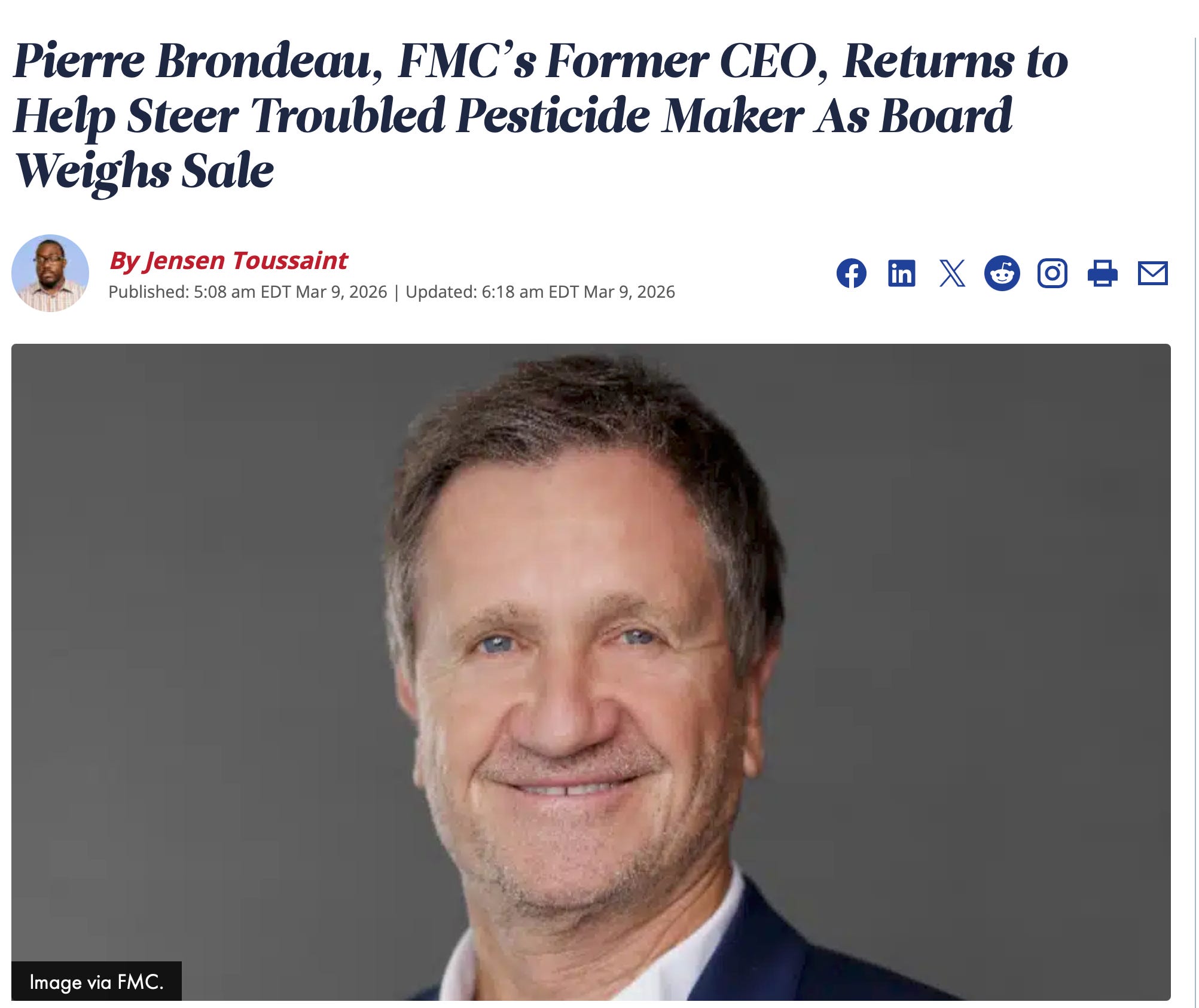
When Pierre Brondeau first joined FMC Corporation in 2010, the company was a sprawling hodgepodge spanning agricultural chemicals, lithium, soda ash, peroxygens, phosphorus chemicals, and health and nutrition ingredients.
Brondeau is a classically French-trained engineer turned Wall Street portfolio builder. Unlike lifetime managers who defend legacy operations, he views chemical assets as trading chips to be optimized, combined, and even liquidated.
During his first tenure, he executed a multi-billion-dollar portfolio overhaul. He orchestrated the divestiture of FMC’s soda ash and health segments, acquired Danish chemical maker Cheminova, and completed a major asset swap with Dow/DuPont to inherit their massive crop protection portfolio. He delivered a historic 325% total return to shareholders across his first tenured stretch.
FMC became the world’s fifth largest crop protection company with a balanced global footprint and a portfolio of patented, high-margin technology. Wall Street cheered, and Brondeau retired in 2020, giving way to his protegee Marc Douglas to take over the reins of the company.
FMC Corporation stock has dropped from its 2022 highs above $140 per share to recent new lows at $11 per share. This collapse was driven by the lingering effects of post COVID crop protection destocking, debt accumulation, and most importantly, generic competition on its key diamide patents.
The global pesticide industry has shifted from being dominated by patented products and legacy multinationals to being led by generic producers in India and China. This “generics revolution” has led to increased pesticide use, particularly in lower-income countries, and has blurred the lines between R&D and generics firms.
Agrochemical patent expirations are driving a multi-billion-dollar shift toward generics, with Asian manufacturers in China and India leading global production. FMC’s core cash cows, Rynaxypyr and Cyazypyr, have faced increasing patent expirations and aggressive post-patent generic competition in key markets such as India and Latin America, eroding the company’s margins.
Global leaders in generic agrochemicals and off-patent crop protection include UPL Limited, ADAMA Ltd., and Nufarm Limited. All these companies are known for providing cost-effective, large-scale agricultural solutions. These firms have cornered the markets once dominated by Western pesticide companies like FMC -1.60%↓, which is among the most fragile and weakest market leaders.
Christian Pereira, of Campo de Visao Internacional, wrote an in-depth analysis describing the driving factors behind the FMC Corporation difficulties:
the patent cliff, specifically the expiration of Rynaxypyr patents, and the acceleration of Chinese generics have eroded the company’s hold over its market.
Pereira paints an interesting picture of a company that failed to anticipate the lingering effects of its patent expiration, contending with short-term, Wall Street-friendly financial reporting rather than investing in structural acquisitions for the future. His article sheds new light on an industry-wide “neglect” that has come home to roost, negatively affecting heavily indebted and poorly capitalized companies such as FMC 0.00%↑ .
At the November 2023 investor Day, FMC projected revenue of $5.5-6 billion for 2026 and $11 billion for 2033. The reality has been quite brutal; aggressive Chinese generic entry has shrunk the company’s market share much faster than anticipated.
Whilst the company headquarters focused on assuaging investors’ concerns with press releases, Chinese and Indian generics developed manufacturing capabilities faster. And the market quickly accepted quality generics.
2025 was one of the worst years in the company’s modern history:
Q4 2024 earnings missed expectations. Full-year revenue guidance of $4.15-4.35 billion disappointed against a $4.40 billion consensus. The stock began its descent.
In March 2025, FMC was removed from the S&P 500 index entirely and demoted to the S&P small-cap index. A humiliating fall for a company that was once a mid-cap stalwart.
The Q3 2025 report was a disaster. Revenue of $542 million was down 49% versus Q3 2024. The company reported GAAP net loss of $569M. Free cash flow guidance was slashed to -$200M. The quarterly dividend was cut 86% to preserve cash for debt reduction.
FMC recorded a $1.36 billion goodwill impairment, writing off its entire goodwill balance. The company posted a full-year net loss of approximately $2.2 billion, a significant swing from a $ 3.21-per-share profit in FY 2024.
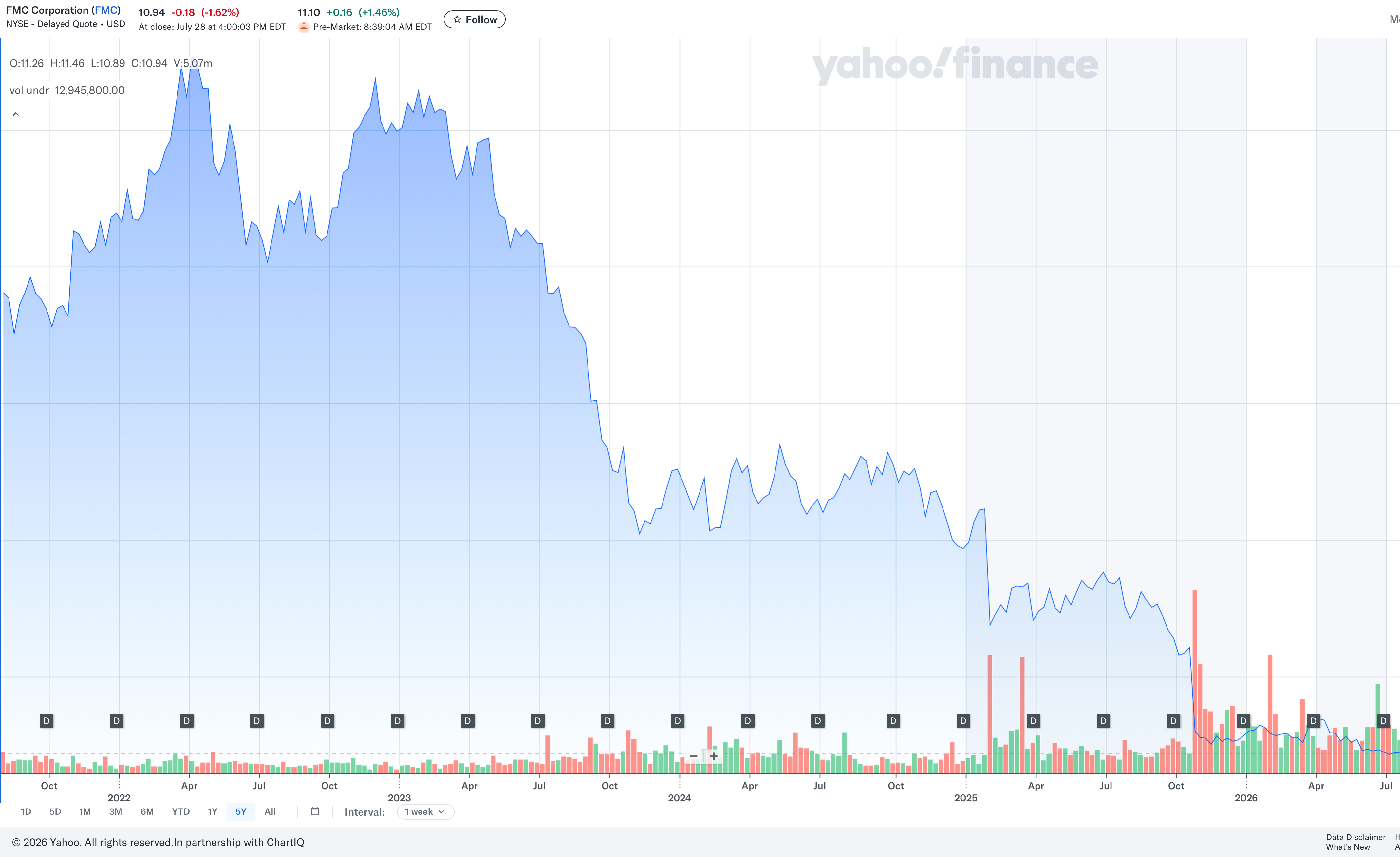
Fmc stock is down -85% in 5 years
FMC looks like a company frozen in the middle of the road like a deer caught in the headlights. Chinese and Indian generic manufacturers have squeezed its margins by aggressively flooding the market with cheap off-patent alternatives to its flagship insecticide, Rynaxypyr (chlorantraniliprole). Generics now account for a large majority of the global crop protection market by value estimates. Estimates range from 70% to as high as 93% depending on the source and definition.
This massive supply surge collapsed global active ingredient prices and compressed FMC’s revenues, forcing the chemical producer into severe financial restructuring.
The company is therefore stuck in a survival conundrum after exhausting its capital armory. The B word, aka Bankruptcy has been mentioned quite often. The company’s capital structure and negative cash flow give skeptics reasons to doubt the 148-year-old company's ability to survive what amounts to its most severe existential crisis.
I believe Brondeau’s return at the helm ought to be cheered by investors and seen as a valuable catalyst for contrarian rerating. The merger or sale of the company is back on the table. Pierre Brondeau is reputed for his ability to remove operational bottlenecks, deleverage balance sheets, and clean up enough for a valuation repricing. And he has moved quite swiftly:
In May 2026, FMC priced a $1.2 billion offering of 8% senior secured notes due in 2031. Proceeds were earmarked to retire the company’s 3.2% note due in October 2026, repay debt, and for other general corporate purposes. This was a junk-rate coupon, but it bought time and pushed out maturities.
In June 2026, FMC announced a $400M minority equity investment from Belgium’s Tessenderlo Group, for a 20% stake. In parallel, the company agreed to sell its India commercial business to Crystal Crop Protection for $252M with all proceeds allocated to debt reduction.
The company also amended its revolving credit facility to include covenant relief, rescheduled a $200M prepayment under a strategic supply agreement with Corteva, and signed a $114M sale-and-leaseback of its Newark, Delaware property.
All combined, these actions represent a credible path to reducing debt by up to $1 billion. This might not solve the company’s problems entirely, but it marks a significant positive step forward to push bankruptcy off the table and give Brondeau enough leeway and room to operate.
He was the architect of FMC 0.00%↑ previous transformation. There is no better candidate to clean up the current mess and potentially get a decent takeover bid.
The asymmetry is clear: the market is pricing FMC as an extreme distress case. But with Pierre Brondeau back at the helm, I believe the bankruptcy risks are overblown and the upside multi-baggers completely ignored by general consensus.
FMC trades at a P/B of 0.8x, below book value, and at an EV/EBITDA that is roughly 1/2 of the industry average. The combination of dividend cuts, debt load, generic competition, the patent cliff, and negative cash flow has led many analysts to rate the company at a high probability of bankruptcy.
But the market is underweighting Brondeau’s recent actions and ignoring the aggressive transformation. The facts are clear: the agrochemical industry will be forced to consolidate to compete with Asian generics.
The Tessenderlo investment and the company’s bond refinancing have bought 2-3 years of runway. The India subs sale and other asset divestitures are generating real cash for deleveraging.
A strategic buyer, likely a larger Agrochemical firm interested in FMC’s patent portfolio—including Rynaxypyr, CYazypyr, and the diamide platform—along with manufacturing capabilities and Latin American distribution, might purchase the company at a distressed price of $25 to $35 per share. Well below its replacement cost. Private equity is also an option if the debt can be further reduced and the cash flow profile stabilized.
The market consensus overlooks that the downside is already priced in, while the upside is priced at near-zero probability. The optionality lies in exploiting this valuation mispricing.
At 8.1x, FMC trades below its peers’ EV/EBITDA average of 12x. The agrochemical and fertilizer sector saw M&A multiples averaging 14-18x for high-growth and strategically critical assets. For a distressed but valuable entity such as FMC, a buyer should nominally bid up to 12x EBITDA. With Pierre Brondeau's premium included, investors can be confident in an experienced operator who knows exactly what his assets are worth and in an exec with deep relationships across the agrochemical industry who can facilitate a smooth transition.
Most investors and analysts have not fully priced in Pierre Brondeau's “unique premium”. Without him, the company would lack a clear restructuring plan, potentially setting the stage for bankruptcy within 12-18 months. Brondeau's presence alone represents a huge margin of credibility that has yet to be priced in.
FMC Corporation is facing its worst existential crisis. The market consensus has completely abandoned any hope for its future, with many experts comparing its current situation to the fate of drug manufacturers’ patent-expiration crisis in 2016.
The rehiring of Pierre Brondeau represents a premium hedge against the loud bankruptcy noise. That alone constitutes a baseline that the company stock price misses. Brondeau’s restructuring expertise and ongoing, swift debt-reduction push are equally mispriced and ignored in analysts’ reports.
To be fair, FMC is not a clear-cut contrarian discount selling below cash flow or Net Asset. FMC is a seriously distressed entity trying to clean up decades of capital misallocation and debt accumulation for a profitable sum-of-the-parts sale to a deep-pocketed competitor.
Consequently, I will not directly hold the equity itself but mitigate the stock's current risk profile by buying its deeply discounted out-of-the-money call option expiring in 2028.
Why? Because Brondeau is 68 years old, and FMC’s own proxy disclosures show the board explicitly wrestling with succession terms tied to his tenure. Age and energy are non-negligible factors given the scale of energy and effort required to turn what amounts to a sinking ship.
Is Pierre Brondeau the last CEO of an independent FMC Corporation? Much of the proxies language points to that. For a contrarian, risk-tolerant hedger, 2 years of optionality margins of error is a safe bet against extreme uncertainty while maintaining a premium discount in case the turnaround or sale pans out.
Not investment advice. Always consult a trusted investment advisor before buying or selling financial securities. Wall Street is not your Friend.
Comments
Nothing yet. Say the first thing.
Sign in to join the conversation.