
You may have received an earlier version of this issue in error. This is the complete piece, with the full toolkit included. Apologies for the double email.
You post something useful. It gets a handful of likes. A prospect asks what you charge before they’ve asked what you actually do. Somewhere else, a competitor undercuts you by fifteen per cent and wins the pitch anyway.
Or perhaps you’re earlier in the journey than that.
You’re in a demanding senior role, you know you want to build something of your own, and the only thing stopping you is the terrifying blankness of month one: no pipeline, no reputation beyond your firm’s name, no idea where the first client comes from.
Both problems have the same root. Most professionals who go independent get the order of operations backwards. They design the service, build the website, price the packages, and only then go looking for clients, discovering too late that attention takes the longest to build and should have come first.
The professionals who transition smoothly solve the audience problem while they still have a salary, so that by the time they need clients, the pipeline already exists.
This issue is about that build: the mechanism that takes you from interchangeable to only option, and the twelve-month sequence that gets you there without waiting for a slow news week or a lucky referral.
Most advice to senior professionals on building a presence stops at frequency. Post more. Show up weekly. Stay top of mind. That advice isn’t wrong, but it treats the symptom, not the cause.
The actual problem is a supply-and-demand one. When a client is choosing between several advisers, consultants or wealth managers who all describe themselves in roughly the same terms, competence stops being the differentiator. There’s nothing for the client to compare except price and availability so price becomes the deciding factor, and the professional with the deepest expertise loses to whoever quoted the lowest fee.
The problem sits in positioning, not skill. Adding more content to a crowded, undifferentiated position just increases the noise without changing the comparison the client is making.
When every adviser describes themselves in roughly the same terms, expertise stops being visible, so clients compare the only thing left: price. Specificity fixes the first half of that.
Serve one clearly named audience with one clearly named problem and, in the client's mind, the field shrinks from forty options to one or two, which is what moves pricing power across the table.
Trust fixes the second half, and it's built through repeated, low-pressure contact over months rather than one well-timed pitch.
That's the trust ladder: narrow the positioning until you're the obvious choice, then build familiarity for roughly a year, so that when a client needs you, your price is a formality rather than a negotiation.
1. Narrow the positioning first. Before any content strategy, write a single sentence that says exactly who you help and with what, specific enough that a prospect reading it either says “that’s me” or moves on. Not “consultant” or “adviser,” but the outcome and the audience named together. This sentence goes in your headline and the opening line of your profile summary. If you haven’t already worked through the Headline and About section guides (see below in this article), do that first, since they cover the exact wording template this step relies on.
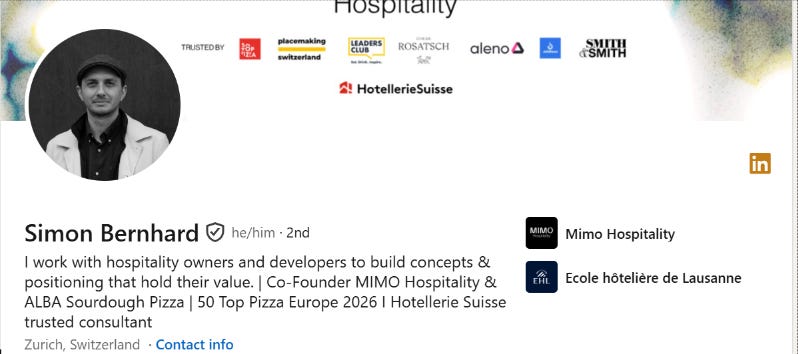
Simon’s profile is an excellent example of this done well.
2. Build relationships on a steady weekly cadence. Pick a realistic, sustainable number of ideal clients to connect with each week, and add a short, genuinely relevant note when you do. Consistency over the full year matters more than volume, so that by the time you’re ready to sell anything, a meaningful number of the right people already recognise your name. Keep the note free of any pitch. You’re building familiarity, not opening a sales conversation.
The practical way to find these people is LinkedIn’s Sales Navigator (I am not affiliated - a useful tool that I use with all our clients), which is a paid tool but the only reliable way to build a genuinely targeted list. Filter by industry, company headcount, geography and job title until the results match your positioning sentence, then save that list and work through it steadily each week. Expect to spend an hour or two refining the filters before the list feels right. A smaller, accurate list beats a large, loose one, because every connection you add should be someone your positioning sentence was written for.
3. Publish three types of content on rotation. Problem-solving content that names a specific, recognisable mistake your audience makes and how to fix it. Thought leadership that takes a considered position on something happening in your sector. And enough of your own perspective and personality that readers start to feel they know you, not just your job title. If you’re in a regulated sector, check anything client-facing against your compliance requirements before it goes out, particularly problem-solving content that could be read as advice.
4. Create one genuinely useful resource. A checklist, a short diagnostic, or a template that solves a real, narrow problem for your specific audience. This is what earns an email address. Send people to a simple landing page rather than asking them to message you directly, and be transparent about what happens to their data and how they can opt out, particularly if you’re contacting people based anywhere in Europe.
5. Start a short, regular note rather than a formal newsletter. People commit more easily to something that sounds low-effort than something that sounds like a subscription. A few short, useful lines sent regularly will get better engagement than an occasional long newsletter, and it keeps you present in a way that feels helpful rather than promotional.
6. Be useful in direct messages before you’re ever selling. Ask about the problem someone’s actually facing. If it isn’t something you solve, refer them to someone who can. This does more for your reputation than any post, because referrals are remembered and repaid.
7. Make your move visible when you’re ready. When you do launch, change role, or open availability, say so clearly and once, rather than hinting at it across several posts. By this point, if the previous eleven months have been done properly, you’re not introducing yourself to a cold audience. You’re confirming availability to people who already trust you.
One mechanic worth knowing: when you add a new “Experience”on your profile, LinkedIn generates a “new position” notification that reaches far more of your network than an ordinary post. Use this once, for the genuine moment you launch or open availability, and let the announcement post carry the detail. Some people trigger this notification repeatedly with cosmetic title changes to harvest attention. Resist that. Your audience notices, and the credibility you’ve spent a year building is worth more than one week of reach. Sparingly though it is an excellent way to get 1 message out to many in one go.
A note for readers building this while still employed. Have the conversation with your firm early rather than hoping nobody notices. Most employers will accept a personal brand that reflects well on the firm, and some will welcome it. If enquiries arrive before you’re ready to leave, pass them to the firm. It costs you nothing, since the relationships you’re building remain yours, and it means you leave on good terms with your reputation intact. Check your employment contract for restrictions on outside work and non-solicitation clauses before you start, and take proper advice if anything is unclear.
Take a compliance consultant who spent a year repositioning from “I help firms with regulatory compliance” to “I help mid-sized wealth management firms prepare for their first Financial Conduct Authority (FCA) thematic review.” The narrower version felt uncomfortably small when she first wrote it.
Within the year, by consistently publishing short, specific content about thematic review preparation and building a modest list of firm principals through a preparation checklist, she stopped being one of several compliance consultants a firm might call and became the person a firm’s general counsel mentioned by name when the topic came up internally. Her day rate didn’t need to be defended. It was simply what it cost to work with her.
The objection that usually surfaces here is the fear of running out of clients. In practice, a well-chosen niche contains far more potential clients than one person can serve. When you do eventually reach the edges of it, you expand sideways into an adjacent niche rather than broadening out into everyone. A consultant who owns wealth management firms can move to private banks. One who owns legal practices can move to accountancy firms. The expertise transfers, the reputation travels with you, and you arrive in the new niche as a specialist rather than starting again as a generalist.
The most common mistake is copying the content style of someone successful in a completely different niche, rather than borrowing the underlying strategy. What works for a personal-brand growth expert with a broad audience will not convert for a specialist adviser, because their goals are different. One is optimising for reach. You’re optimising for a small number of the right people recognising your name.
The second mistake is confusing impressions with leads. A post can perform well and generate nothing, or perform modestly and bring in exactly the right enquiry. Track who’s actually engaging and whether they match your positioning, not the vanity numbers.
The third is trying to build every system, from pricing structures to fully built-out service pages, before a single relationship exists. The leads problem has to be solved first. Everything else can be built once there’s demand to build it for.
Templates for each stage of the build. Adapt the bracketed sections to your own sector and swap the tone to match your voice, but the structure behind each one is doing the actual work.
The positioning sentence
I’m not going to repeat the formula here, since I covered it thoroughly in
and
Use those two for the exact wording template and worked examples. What this issue adds is the reasoning for why that sentence matters economically, and the twelve-month build that makes it pay off.
The connection note
Hi [name], saw you’re [specific detail from their profile or a recent post]. I work with [your specific niche] on [specific problem], so thought it made sense to connect.
Keep it under thirty words. No pitch, no link, no “let me know if I can help.” The note only needs to justify the connection.
The three content pillar prompts
Problem-solving: Three mistakes [your specific client type] make with [your area], and what to do instead.
Thought leadership: [Recent development in your sector] means [specific implication for your client type]. Here’s what I’d be doing differently.
Personal perspective: A short, honest line about how you work, what you got wrong once, or what you actually think about a trend in your field. This one doesn’t have a template. It just needs to sound like you.
The lead magnet landing page opener
This is a resource for [specific client type] who need to [specific outcome] without [the thing they’re afraid of or trying to avoid].
Example: For finance directors who need to prepare for an FCA thematic review without pulling their team off client work for a month.
The lead magnet creation prompt
You’re not a marketer so this is
THE BIG ONE! Copy everything in the block below into Claude or another AI assistant and it will research your sector, surface the pain points, and build the full resource with you.
The DM referral script
That’s not something I work on directly, but I know someone who does. Want me to make an introduction?
Use this whenever a conversation surfaces a problem outside your niche. It costs nothing and it’s remembered longer than most pitches.
The launch announcement
I’m now taking on [specific number, if you want to create urgency] new clients for [specific service], starting [month]. If that’s relevant to you or someone you know, reply here or send me a message.
One post. One email to your list. Said once, not teased across several weeks.
Weekly: a consistent number of relevant new connections, each with a short, specific note. Two to three pieces of content, rotating between problem-solving, thought leadership and personal perspective. A handful of genuinely helpful direct messages, with no pitch attached.
Monthly: one short, useful note sent to your growing list. A review of which content and which connections are actually leading to conversations, so you can do more of what’s working.
At month twelve, or whenever the moment is right: one clear, single announcement of your availability, sent to the list and posted once, rather than teased across several weeks.
The uncomfortable part of this isn’t the twelve months. It’s narrowing the positioning enough to feel, at first, like you’re turning business away. That discomfort is usually the sign you’ve gone specific enough to matter.
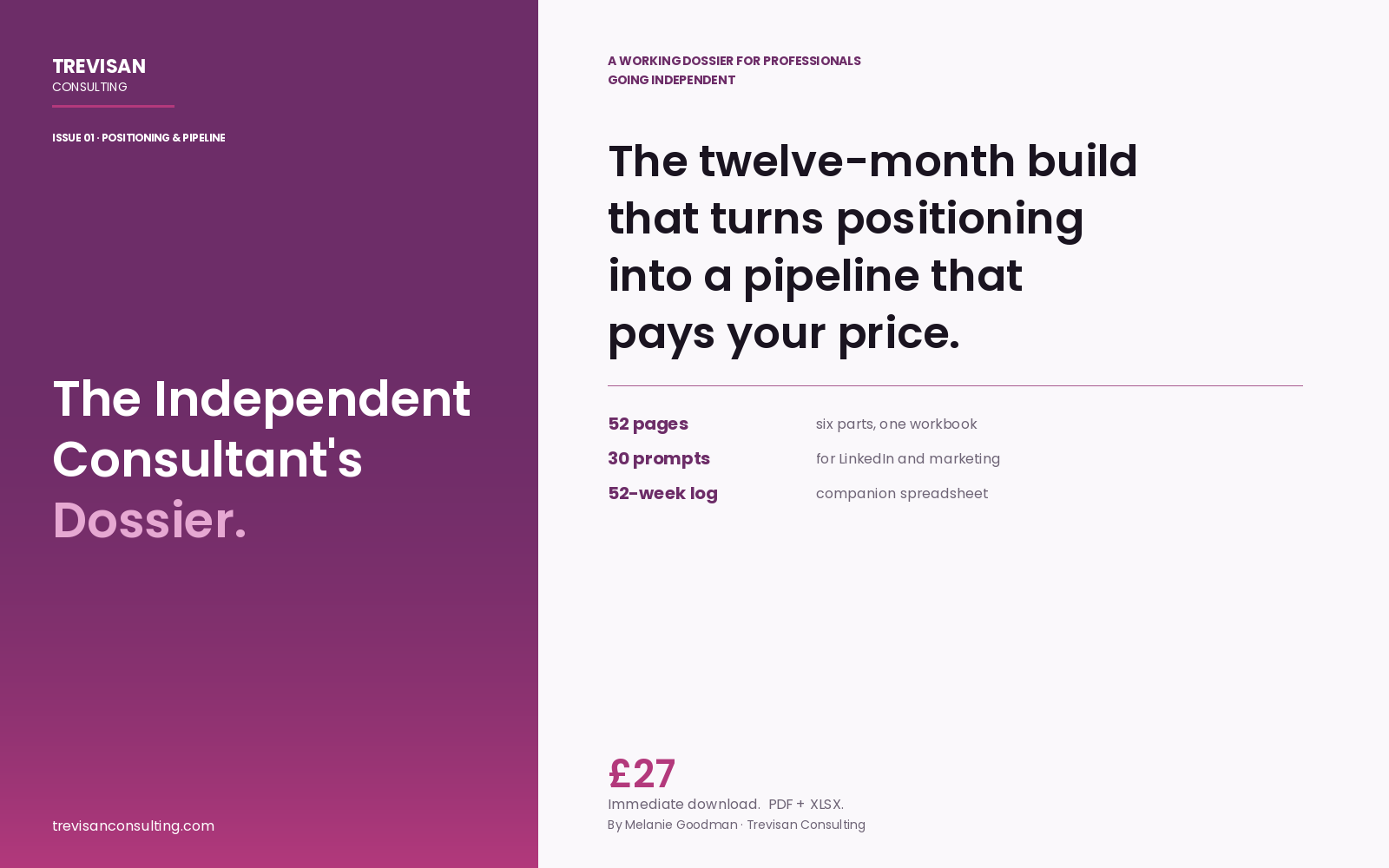
If you want the working version of this build, I've turned the whole sequence into The Independent Consultant's Dossier: a 52-page workbook with one page per month, the full positioning worksheets, the target list method, a weekly log and 30 fully-written expert AI prompts for LinkedIn and marketing, ready to paste into Claude, ChatGPT, Perplexity or Gemini.
It's £27 and it exists for exactly the reader this issue was written for.
What’s the sentence you’d write if you had to describe exactly who you help and with what, in a way specific enough that half the room would say “that’s not me”?
Reply and tell me. I’d genuinely like to know what you land on (or DM me if you’re feeling shy🫣)
This issue draws on general market positioning and trust-economics principles rather than a single case study. The worked example above is an illustrative composite, not a real client, in keeping with client confidentiality.
Comments
Nothing yet. Say the first thing.
Sign in to join the conversation.