
Almost everything you have read about LinkedIn newsletters is wrong. The lists are out of date, the maths is optimistic, and the biggest publishers are not who you think they are. Here is what the top of the leaderboard actually looks like in August 2026, and what it means if you are trying to build one.
What you will learn
How to check a newsletter’s real subscriber count in ten seconds.
Who actually dominates LinkedIn newsletters in 2026.
What percentage of subscribers LinkedIn actually emails.
Which cadence works and which ruins growth.
The title formula the top 58 newsletters use.
The one LinkedIn mechanic that quietly drives most of your subscriber growth.
The seven mechanics LinkedIn Help does not tell you.
The three decisions to make before you open the create flow.
How to protect yourself from platform risk.
I started this by fact-checking a stat I kept seeing quoted. Someone would drop into a comment thread and say “there are 184,000 newsletters on LinkedIn and only 30% publish monthly”, or “98% of the top newsletters are owned by individuals”. I went to check. Neither is true today and the leaderboard that supposedly proves it is 18 to 30 months out of date.
I did the work properly:
I opened the biggest circulating lists, checked every one against the live LinkedIn newsletter and edition pages where the current subscriber count is visible (like this one for In the Loop), and reordered the leaderboard on the numbers I could see with my own eyes on 19 August 2026. Then I pulled the analytics on my own LinkedIn newsletter, The Link Tank, to see what the numbers actually do at a normal scale. That last part turned out to matter more than any of the lists.
This piece is what I learned. Ten findings, one leaderboard, and a short set of decisions to make before you press Create newsletter.
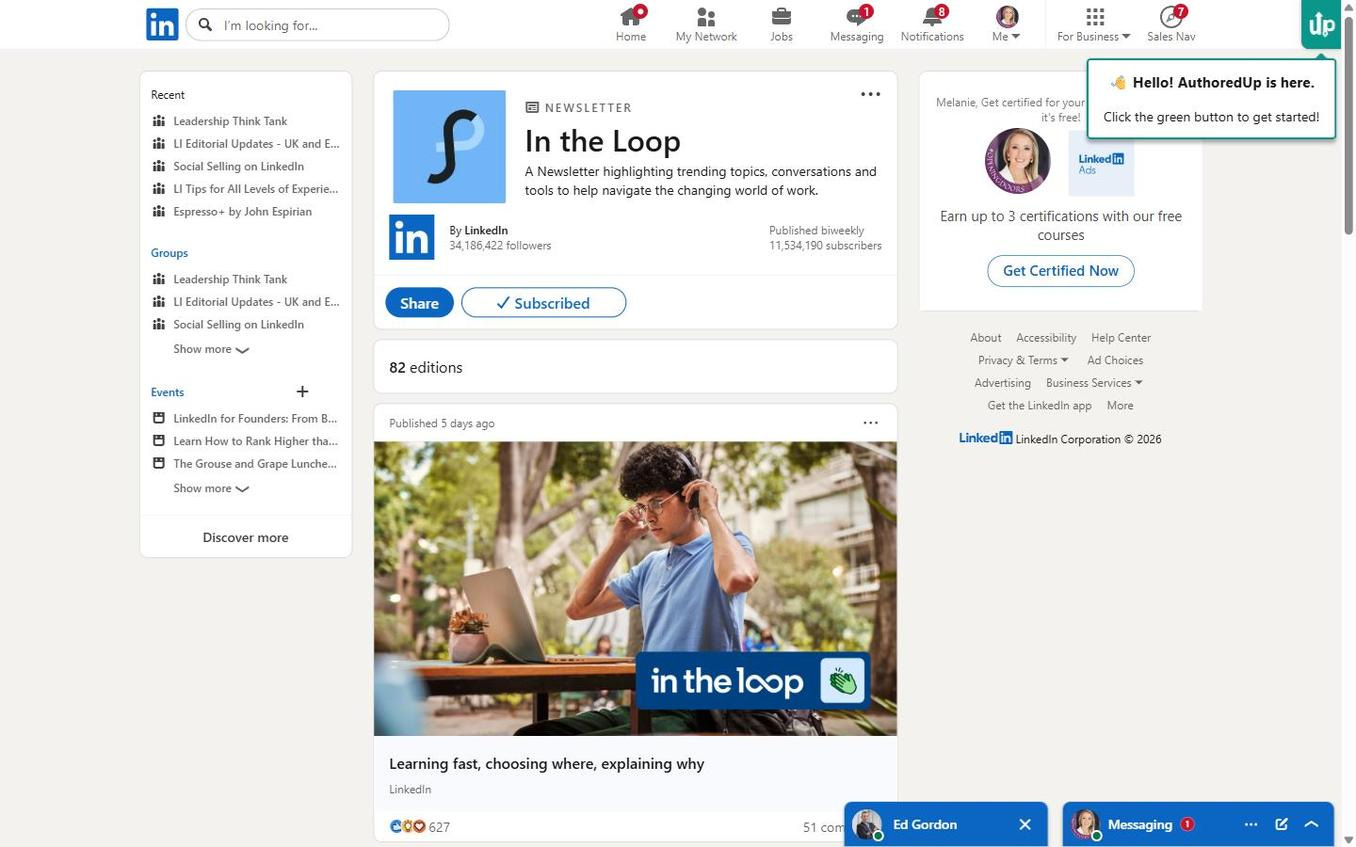
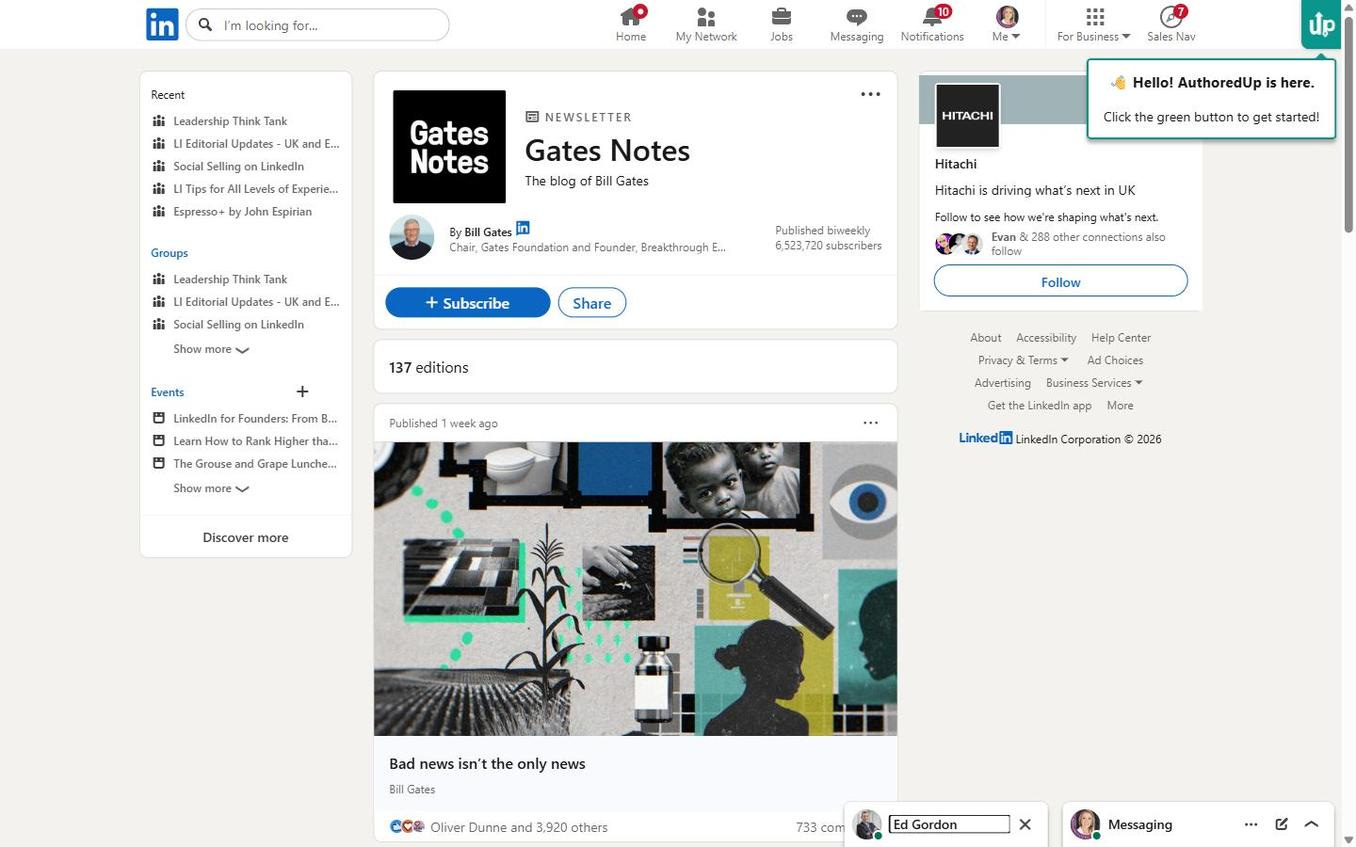
The list you are most likely to have seen is Tomislav Horvat’s LinkedIn Newsletter Statistics, republished endlessly on other blogs. It puts In the Loop at 7.4 million subscribers and Gates Notes at 2.3 million. When I opened those two pages this morning, In the Loop showed 11,534,190 and Gates Notes showed 6,523,720. The reality is somewhere between two and three times larger than the numbers being cited.
The Reletter top-50 LinkedIn chart is fresher, but its methodology mixes creator newsletters with company Pages inconsistently, and its snapshot dates lag by months. If you cite either without checking the live pages, you are quoting the past.
What to do instead: open the newsletter page directly, look for the “N subscribers” line at the top, and use that. It is the only number LinkedIn shows publicly and the only one that updates in real time.
Here is the leaderboard as of this morning. I checked every entry on its live LinkedIn page. Owner type is my classification: I have counted media brands (HBR, Forbes, TED, Economist, WSJ) separately from operating companies (Microsoft, Google, IBM), because they behave differently.
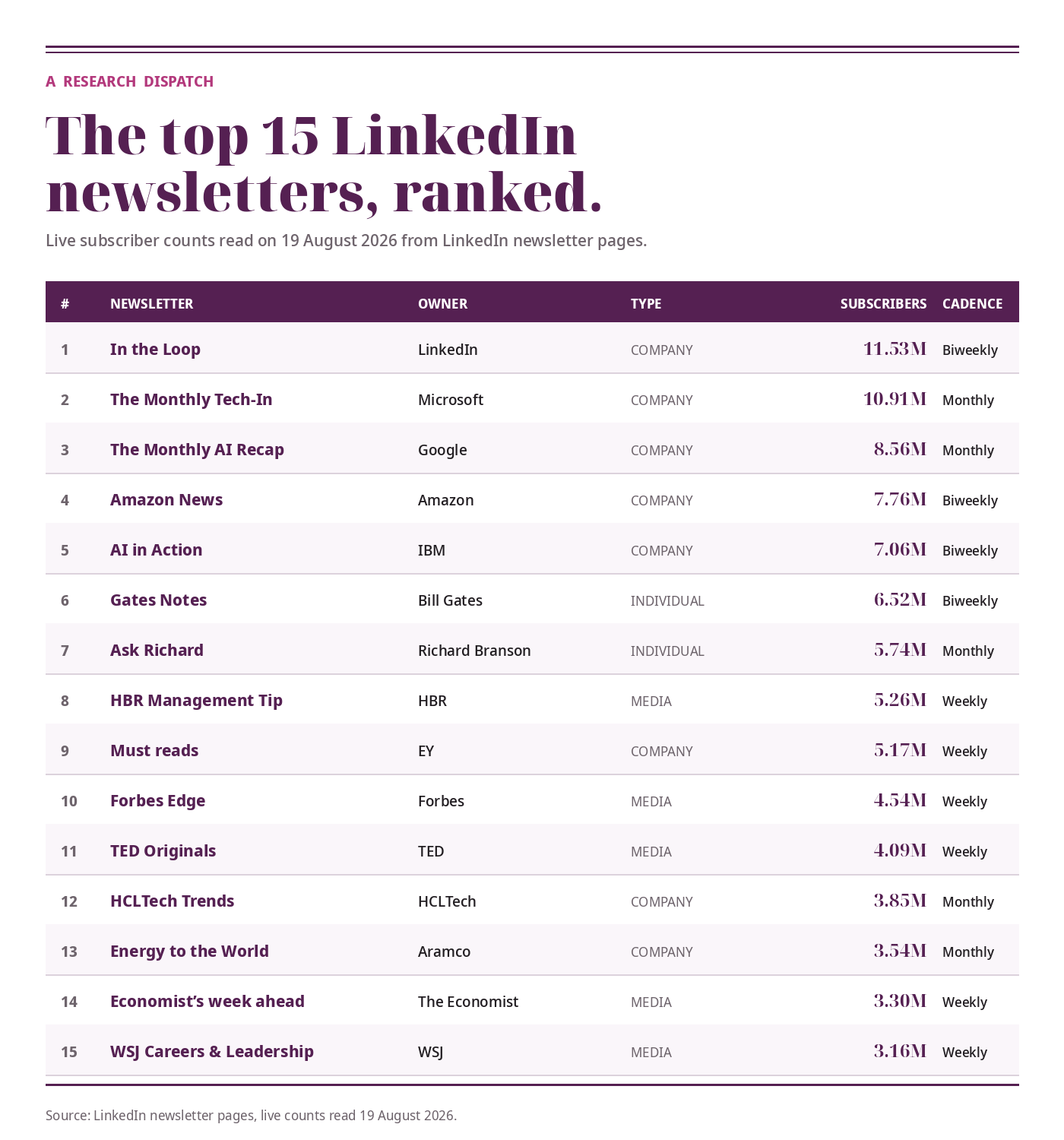
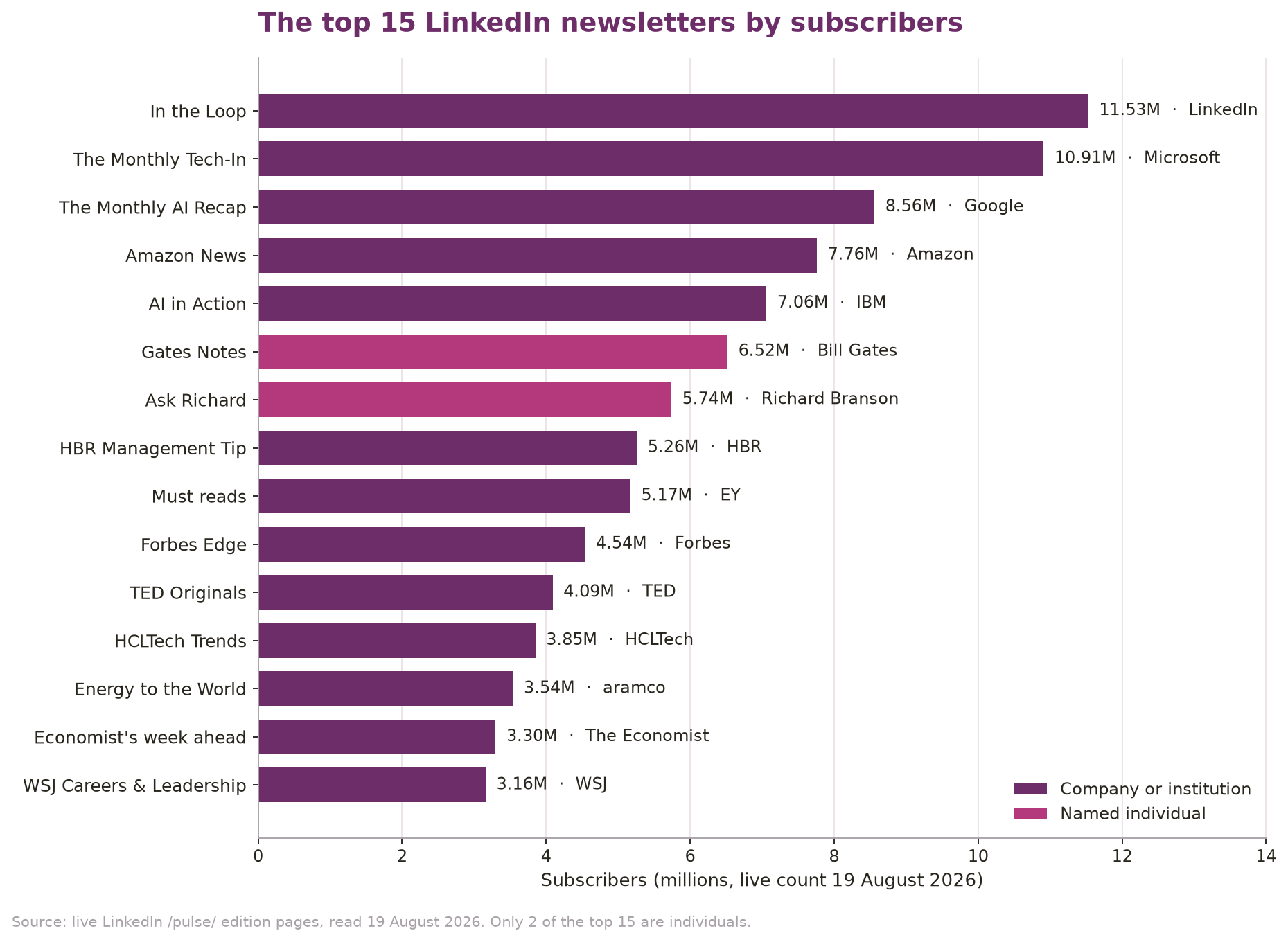
I have seen the claim “489 of the top 500 LinkedIn newsletters are owned by individuals” quoted as if it were physics🤪 It is not true at the top of the list.
Of the 15 newsletters above, 11 belong to companies or media brands and 4 to individuals (Bill Gates, Richard Branson, and two named columnists further down). Widen to the top 50 and the corporate share stays above 70%.
There is one obvious reason: these are the accounts with existing audiences to convert. LinkedIn News alone has 34.1 million followers behind In the Loop, and the newsletter converts a fraction of them to subscribers. An individual creator has to earn every subscriber from scratch.
This is the finding that changes how you should think about the whole product. LinkedIn Help says publishing an edition sends “a notification and an email to your subscribers”. Most creators read that as “everyone gets emailed”. The evidence says otherwise.
When Gina Riley checked her own analytics, she found only around 35% of her subscribers had been emailed for a given edition (3,300 to 3,600 email sends per issue). LinkedIn support reportedly told her that sends are filtered by relevance. Nobody outside LinkedIn knows the exact rules, and other practitioners cite very different numbers, which is exactly the point: this is opaque.
My own numbers say the same thing at a different scale. Here is the analytics screen for one recent edition of my newsletter, The Link Tank:
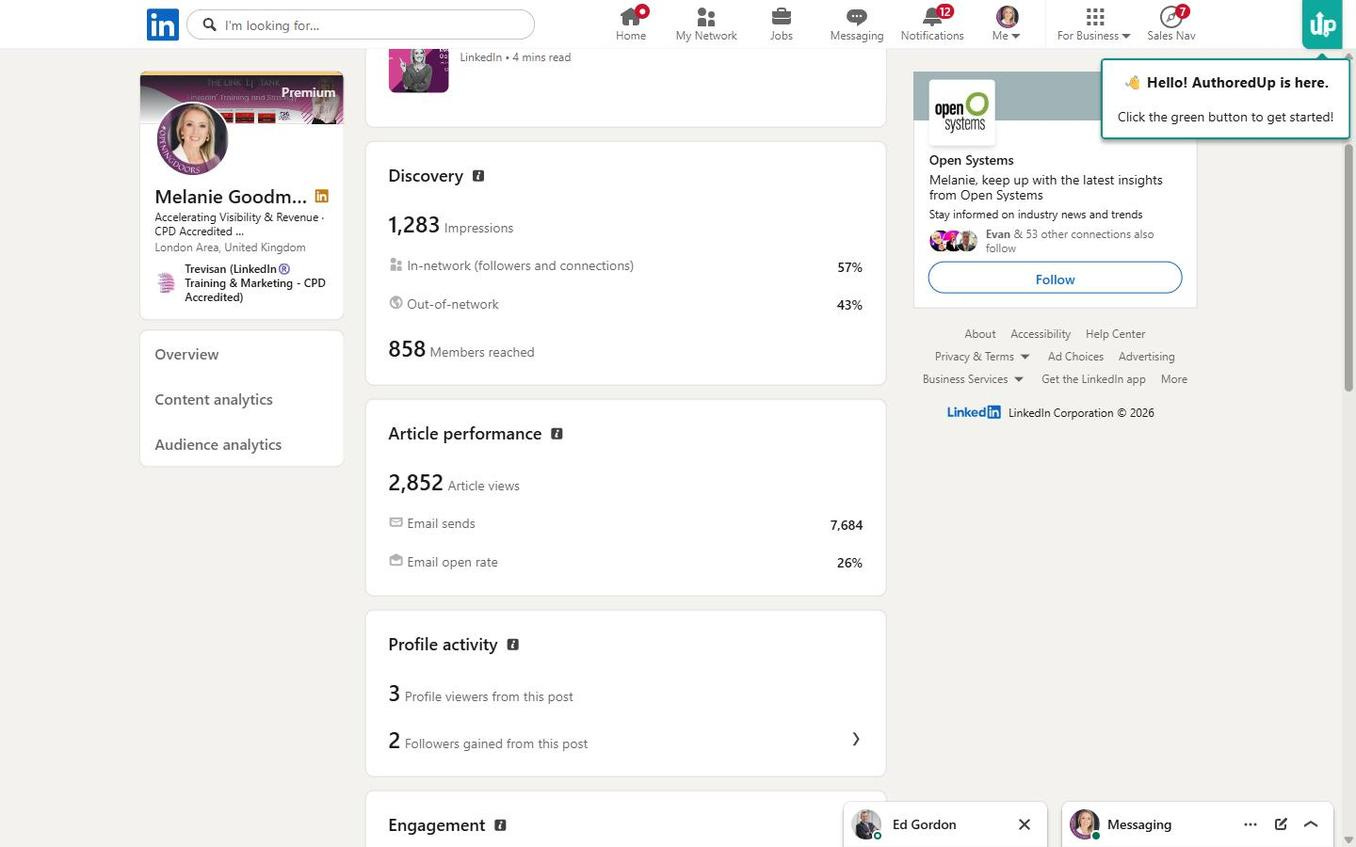
The chart below is the same data as a funnel. Two things stand out: roughly 4 in 10 subscribers were not emailed at all, and more people read the edition on LinkedIn than opened the email (2,852 article views vs an estimated 1,997 email opens at a 26% open rate).
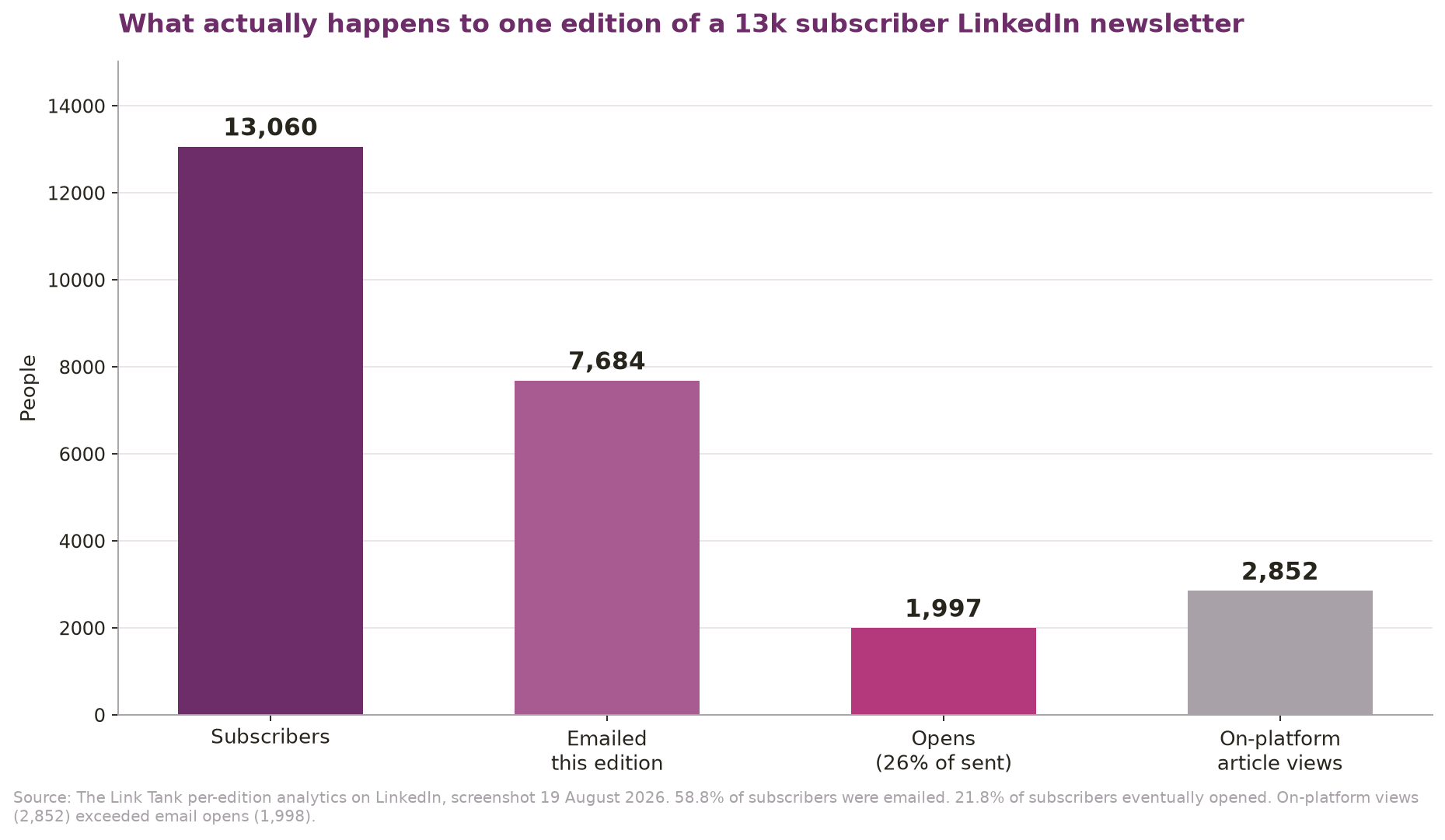
The takeaway: the “subscriber count” is not a mailing list. It is closer to a follow graph. If you want your edition read, you still need it to work as a post on the LinkedIn feed and as a searchable article.
I logged the declared cadence for every newsletter in the top 58. Monthly leads (26), weekly is close behind (21), biweekly (6), daily (4).
One “daily” newsletter is in fact seven weeks behind, so the declared and delivered cadences do not always match.
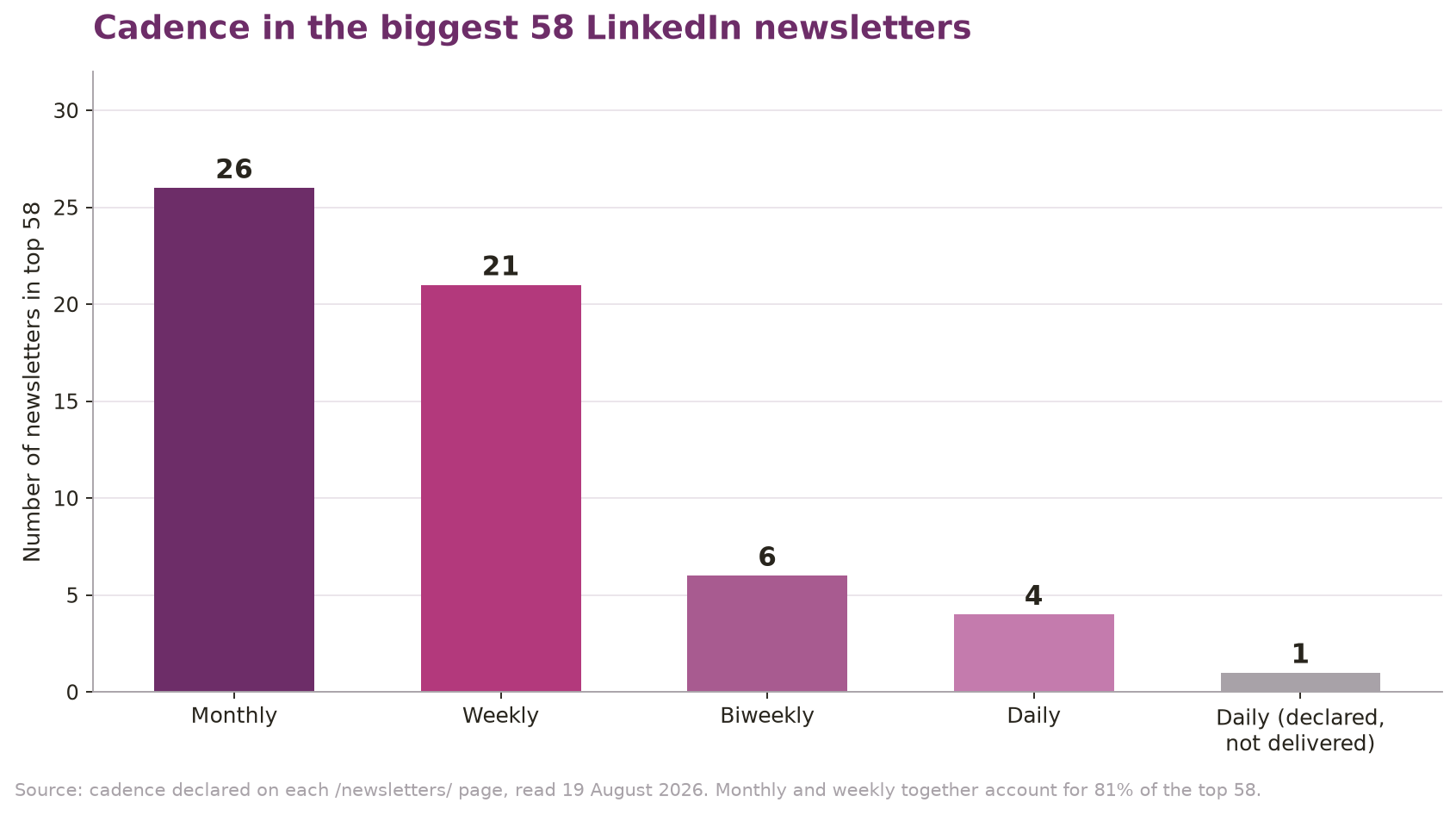
If you are choosing a cadence, the top of the leaderboard is telling you two things. Weekly is the sweet spot for media brands and topic-led shows. Monthly is where operators, executives and busy specialists live. Biweekly is the honest choice if you know you cannot sustain weekly.
Rule of thumb: pick the cadence you can sustain for 12 months on a bad month, not the cadence you can sustain on your best month.
I ran the numbers on the titles of the top 58 newsletters. The average title is 2.93 words. Three quarters are 1 to 3 words long. Only three include the author’s name (Gates Notes, Ask Richard, and one columnist). Twenty-four include a company or brand name.
The pattern is boring, and boring is why it works.
Search still runs on LinkedIn, and Google indexes public /pulse/ URLs within 24 to 48 hours. A title that says what the thing is beats a title that is clever about it.
If you are titling yours: two to four words, topic before personality, no colons if you can avoid them. “LinkedIn Training Weekly” beats “The Melanie Files: Real Talk on LinkedIn”. Save the personality for the deck 😁
When someone follows you on LinkedIn, they are shown an invitation to subscribe to your newsletter. The invitation is not a subscription: the follower still has to accept.
The mechanic matters, because it is automatic and it fires on every new follower. On the Creator Science podcast, Richard van der Blom describes it as LinkedIn “actively promoting a creator’s newsletter to new followers”, and says newsletter editions now outperform regular posts on reach, engagement and conversion, while standalone articles perform at roughly 0.4x normal reach.
The practical consequence: growth is coupled to how well your normal posting works. Feed posts add followers, followers get the subscribe invitation, some subscribe, and each new edition is another chance to convert them. No single “viral” edition is required. A modest weekly increase in followers compounds into a much larger subscriber base over a year.
If you read the LinkedIn Help page on newsletters, you get a one-paragraph summary. Here is the fuller mechanic I pieced together by working through the actual product!
Follow triggers a subscribe invitation. When someone follows you, LinkedIn automatically shows the subscribe card.
Subscribing auto-follows. Someone can subscribe without following you first; LinkedIn then adds the follow on their behalf.
Every edition also appears in the feed. It is a post and a newsletter at once. Comments accrue on that post.
/pulse/ URLs are public. Not gated. Google indexes them, and so do the AI crawlers.
There is a five-newsletter cap per member, plus a two-week wait between creating one and creating the next.
Pages need 150 followers before they can create a newsletter. Personal profiles can create one immediately.
Analytics are kept for 2 years. Anything older disappears from your dashboard.
The panel for creating a newsletter has four fields and one dropdown. Title, description, cover image, cadence. That is it. Every strategic decision has to be made before you ever see this screen.
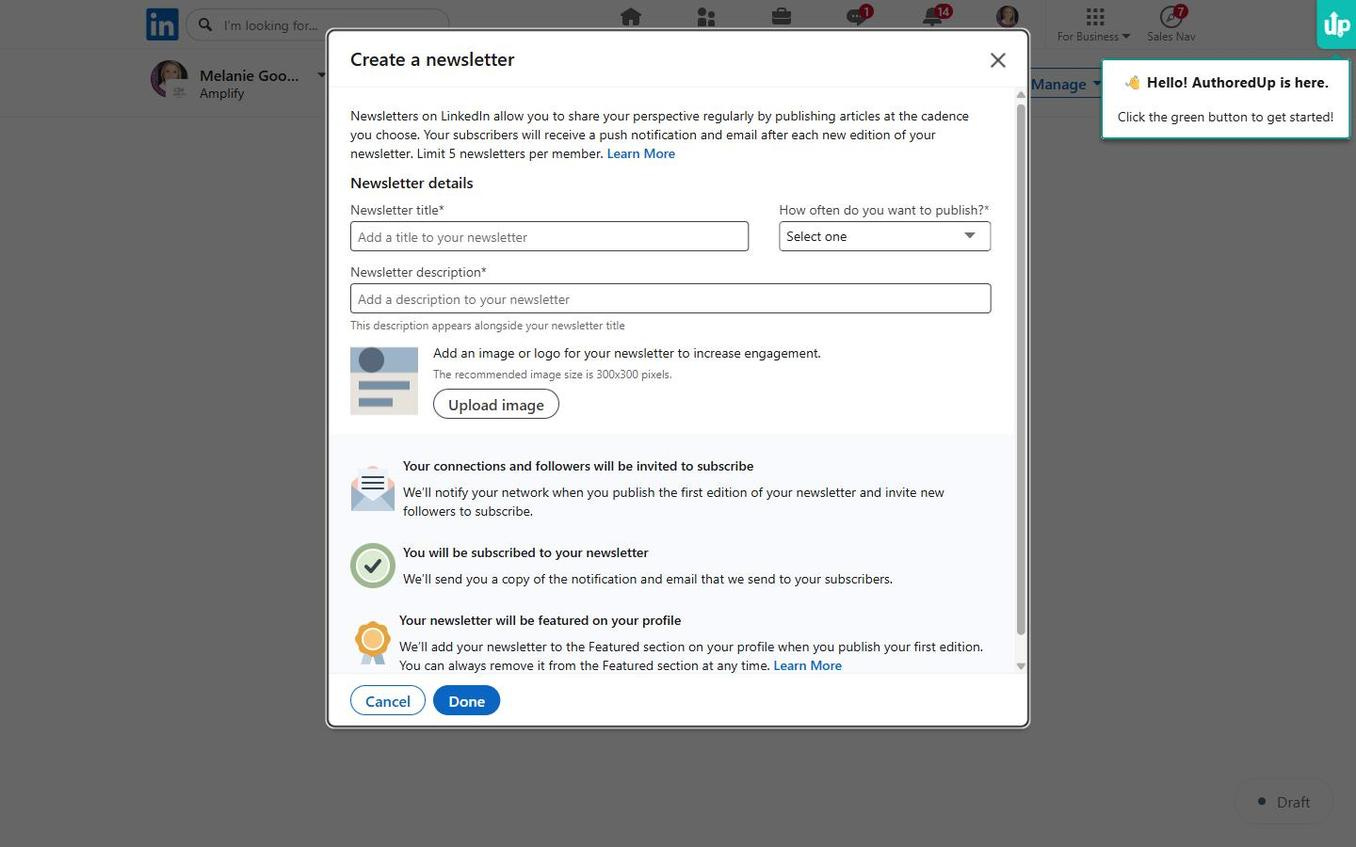
The three decisions the panel does not force you to make properly are the ones that decide whether the newsletter works:
A niche narrow enough to be searchable. Two words is the sweet spot. Broad titles (”The Weekly”) do not surface.
A cadence you can hold on your worst month. LinkedIn shows relative dates (”2 months ago”) on every edition, which visibly ages a stalled newsletter.
A distribution loop that does not depend on the email. Assume ~35 to 60% of subscribers get the email and plan the on-platform post accordingly.
LinkedIn does not expose subscriber emails to the creator. You cannot export your list. You cannot email them from another tool. If LinkedIn removes your newsletter, everyone is gone. Creators have discovered another sharp edge: LinkedIn has quietly demoted standalone long-form articles. They still exist, but Richard van der Blom m measures their reach at roughly 0.4x a normal post, and the platform now steers writers toward newsletters instead.
So the format still exists, but it has been demoted. It is a rusting side door, not the front entrance.
A LinkedIn newsletter is a rented asset with excellent distribution, not an owned one.
The safe pattern: build the LinkedIn newsletter for reach and search, and use the CTA in every edition to pull subscribers to an email list you actually own. Two lists, one topic.
That’s the LinkedIn-Flywheel!
Here is the transparent version of the flow chart. If you can answer yes to all four, start it this month. If you cannot, do the missing step first.
Do you post consistently on LinkedIn already? The newsletter does not create your audience. It converts the audience your posting builds.
Can you write 300 to 1,500 words per edition without dying? You need 12 to 24 editions before growth compounds. That is a year of monthly, or six months of weekly.
Do you have a topic that fits in three words? If the title needs a colon, keep working on it.
Do you have somewhere the subscribers can go if LinkedIn takes it down? Even a simple contact form to a Substack or a website works. Just do not skip it.
If yes to all four: press Create newsletter, pick a cadence you can hold on your worst month and treat the first ten editions as a shakedown cruise.
A LinkedIn newsletter is a landing page with a distribution engine wired into it. The subscriber number on the front is a vanity metric. The subscribe prompt behind it is where the growth is.
Comments
Nothing yet. Say the first thing.
Sign in to join the conversation.