
In general, I write for people who are already mekorists, and I try to persuade them to be less wrong about various things. Believe it or not, among mekorists, I am a big traditionalist. I believe electricity is assur on Shabbos as a matter of law; I believe in da’as Torah; I believe your mezuza is kosher. Sometimes people who aren’t mekorists turn up and are all confused, but I don’t really have a great deal to say to them. It’s like if you are trying to argue the toss over free banking vs. Rothbardian real money and someone turns up and says free markets are patriarchal. OK, whatever, leave me alone.
This is, in part, just because I have been a mekorist for a long time and have forgotten what it’s like not to be one. In fact, I think even when I was Charedi, I was already a mekorist, just not very good at it. Like the average Charedi, I believed Charedi Judaism was a faithful and authentic representation of the religion of Hazal. When I ‘learned’ that the halachic shiur of a kezayis was larger than the olives we have today, I assumed that this was true. When I discovered that it was demonstrably untrue, I assumed that this was simply a matter of correcting the record, and it would all be ironed out in due course. As soon as I realised that this was not so, I stopped being Charedi. To me this is obvious, and I’d rather talk about things that aren’t obvious. However, perhaps it’s time for a short statement of why I am a mekorist.
The occasion for this is that there’s a new kid on frumstack called Tommy Goloboy who’s been shaking things up. He’s spent a lot of time thinking about philosophy before he decided to become frum, and he argued himself into thinking that Judaism is true. With the state of things as they are, orthodox Judaism is lucky to have anyone who can write consecutive sentences, but Tommy is a few steps above that, and any decent Jew can only wish him the best of luck with his attempt to build a viable modern hashkafa that can accommodate advances in science and metaphysics. He’s kind of a basic lib, but that’s not such a bad thing these days, compared to the alternatives. However, while cognition is one thing, different intellectual fields require different skill-sets, and Jewish law is not a field where he is very competent yet. In response to my schmooz with Hacham Mordechai last week, Tommy had the following comment:

Tommy is committed to the search for truth. He says so, so it must be true. It’s remarkable, then, how much he manages to lie in the space of 14 words. It is, perhaps, telling that the defenders of mainstream halacha are ashamed to admit what mainstream poskim actually say. Here is Rav Rimon:
Now, let’s go one by one through the various points at the seder when matza must be eaten, and see how much matza must be consumed each time:
The first kezayit: This consumption of matza fulfills the Torah obligation of eating matza on Pesach night. Therefore, it is proper to follow the stringent view and eat three-quarters (or at least a half) of a matza.
One should bear in mind that this first kezayit must be eaten within a time frame called “kedei akhilat peras” from the moment he recites the berakha. There is much discussion surrounding the definition of this time frame, the most accepted view is four minutes. It would seem, however, that this discussion is irrelevant for practical purposes, so long as one eats at his normal rate of consumption without any interruptions, bearing in mind that the one “goal” before him at this moment is the consumption of a kezayit of matza.
The second kezayit: (eaten together with the first) As we saw towards the beginning of our discussion, this second kezayit is eaten only as an added stringency (and its level of obligation is therefore even less than that of a rabbinic enactment). As such, we may be lenient with regard to its size, and eat only one-third of a matza. We may add a further leniency, to view the three-quarters of a matza eaten for the first kezayit as consisting of two kezeitim (one-third of a matza each), and thus eat three-quarters of a piece of matza for both kezeitim. This view is cited in the name of Rav Elyashiv and Rav Nissim Karelitz (Siddur Pesach K’Hilkhato chapter 8, note 24).
Korekh: This obligation is “miderabanan” (rabbinic legislation), as a commemoration for the manner in which the korban Pesach was eaten in the Bet Hamikdash. Therefore, we may adopt the middle position (which assumes that the measurements have not decreased in size - see earlier in our discussion) and eat half a matza. One for whom even this involves difficulty may eat one-third (see Mishna Berura 486:1).
Afikoman: Although strictly speaking even one kezayit suffices for eating the afikoman (Shulchan Arukh 477:1), one should optimally eat two kezeitim (Mishna Berura ad loc.). Therefore, what we said earlier regarding the second kezayit applies here, as well. Namely, one may eat three-fourths (or at least two-thirds) of a matza and view it as consisting of two kezeitim. If, however, one feels that such an amount would constitute excessive eating (”akhila gassa”), he may eat half a matza, or at least one-third of a matza (see Mishna Berura 486:1).
So, if you want to be lenient and you find it difficult, you can get away with eating 2 matzot, but if you are doing it properly it’s a bit more than 3. Here’s Peninei Halacha.
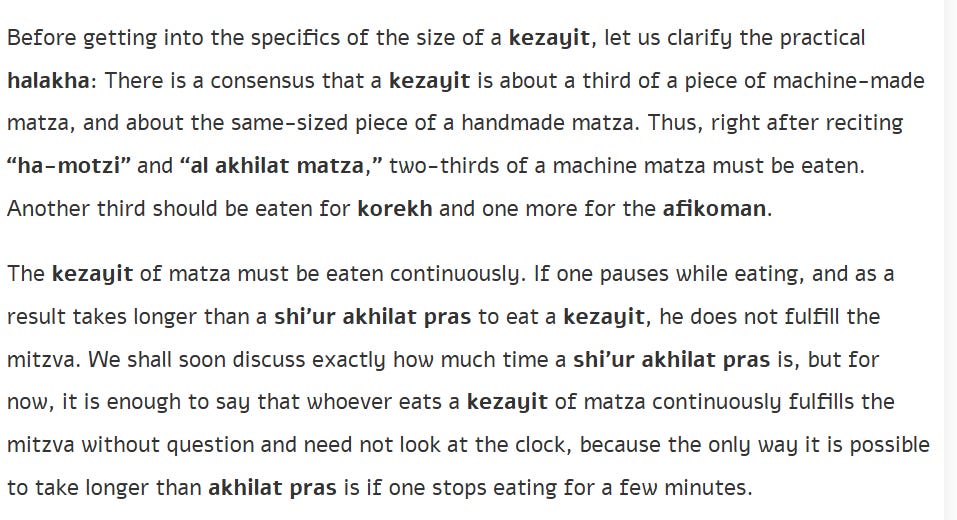
Now, these are moderate figures. What do extreme types do?
Therefore, the ideal correct procedure is the following four-step process (see S.A. O.C. 475:1). Please note that some people will find step 4 rather difficult, so an alternative step 4 is provided later.
1. He makes the HaMotzi on all three matzos.
2. Then he drops the lower whole matzah and recite the blessing of Al Achilas Matzah on both the upper whole one and the broken matzah below it.
3. He then breaks a kezayis from both of them, wraps them together, and consumes a kezayis from each one simultaneously. Yes, that is correct: place both kezeisim in the mouth together.
4. Both kezeisim are then chewed well and split, within the mouth, in half–one kezayis on each side. Then one is swallowed, followed by the other.
If one reads the Shulchan Aruch carefully, the indication would seem that both kezeisim should also actually be swallowed together. However, both the Magen Avraham and the Mishnah Berurah (475:9) write that it is only necessary to have them in the mouth together, chew them, and separate them in the mouth, but it is not necessary to swallow them together–one after the other will suffice.
Anyone who has any familiarity with yeshivish or RWMO communities will know that that ‘I should try to have 30g of matzah on Pesach’ is not a remotely accurate statement of communal norms.1 We can leave aside the true nuts, those who, to take one of a number of different practices, crumble up their matza in a big pile so they can insert it all in the mouth and swallow at once. In general, someone who does not at the very least eat 1/2 of a matza within a set time frame (or ‘continuously’ if you are being lenient) will be told in no uncertain terms that they have failed to fulfil their obligation from the Torah, and they will be expected to do a lot more than that if they wish to be considered pious.
The mekorist response to all of this is just don’t do that. Eat as much matzah as you want at the seder. If you are very sick or very old, or really hate matzah, or are gluten intolerant, then just eat a little, and make sure it is the size of an olive. If you are uncertain how big an olive is, look at an olive. Otherwise, don’t even think about it. The reasoning behind this is simple: the word כזית means ‘like an olive’. Done.
There are two responses that one can make to defend the normie position. The first is to claim that olives used to be much bigger. This is completely, and completely demonstrably, false. Therefore, if you believe it after others have been pointed it out to you, you are culpably ignorant. That’s not great. It’s not good at all that a religion which is supposed, in due course, to lead to global enlightenment is expending resources teaching people obvious nonsense. However, of the two options, it is by far the better one, because the other one is to twist and abuse words to demonstrate why even though the factual argument for the larger kezayit is false, it is still binding law.
One argument used to make this case is that halacha doesn’t come, as the mekorist believes, from accurate interpretation of halachic texts, but (only) by way of mesorah. The problem with this argument is that it’s the absolute worst possible one you could choose for the question at hand. Not worrying about how much matzah you eat at the seder is the mesorah. The larger kezayit is something that is found in books and was completely ignored by the mass of Jewry until the 20th century. The spread of the large kezayit was a process of Jews learning the ‘correct’ halacha from textual study at yeshiva and then returning home to ‘correct’ their parents and anyone else, instructing them to abandon their mimetic tradition and instead start measuring out large, previously unknown shiurim.
The funny thing about the proponents of ‘organic’ halachic development is that they actually have no problem at all with halachic change that is driven by textual scholarship and replaces tradition. Indeed, they demand that we adhere to these changes. They only object when the proposed halachic changes are based on correct and responsible textual interpretation; when they are based on fanciful and obviously incorrect readings, it’s completely fine.
This seems like an outrageous allegation because it so obviously denotes a profound sickness of the intellect. I have been loath to state it as baldly as that, but there really seems no way around it. Time and time again, the Koppel fans make this argument that mekorists ‘don’t understand how halacha works’ because they think it is arrived at by accurate interpretation of texts rather than traditional practice, whilst at the same time demanding adherence to halachic norms that overturned traditional practice based on incorrect interpretations of texts. The only other way of explaining this is that they are just completely ignorant, or don’t understand basic logic, but, aside from the general principle of charity, I think this is not always the correct diagnosis. Rather, halachic-process enjoyers do not object to halachic change based on bad textual readings precisely because it gives them the opportunity to come up with convoluted explanations, to handwave at the ‘halachic process’, to claim that those who prefer a correct reading are unspiritual simpletons who are missing some profound and ineffable truths about the nature of divine law. Changing halacha based on correct textual reasoning doesn’t give room for such explanations, in fact it renders them a little silly, pompous even. Since they are already committed to such explanations, correction of error must be ruled out, always and forever.
Their second argument is that we cannot understand the arguments of Rishonim so we can’t go back and decide who was right and go with that. The problem, again, is that this doesn’t work at all for the matter at hand. It’s completely possible to understand the arguments of Rishonim regarding the size of the kezayit. The Ri points out that in one place it says you can swallow an egg, and in another place it says you can swallow two olives, thus an olive must be half the size of an egg. Note, he didn’t argue that this was the size of a kezayit, an entity that lives in halachic-ontologyland, he argued that this was the size of a zayit, an actual fruit. Rabbeinu Tam had a different argument. He pointed out that the gemara says that an olive is smaller than a dried fig, and from another place it is inferred that 3 dried figs are equivalent to one egg. Thus a zayit must be smaller than a third of an egg. Why were they arguing about this in the first place? Because neither of them had ever seen a zayit.
You have seen a zayit, so you know that Rabbeinu Tam was right and the Ri was wrong. That’s no disrespect to the Ri, any more than siding with the Ri would be disrespect to Rabbeinu Tam. Ri’s proof turns out, in fact, to be a kasha on the gemara. There are a couple of answers to this kasha, but, in any case, no-one ever died from a kasha.
Similarly, we know the Noda biYehuda’s argument that the size of eggs has halved. It’s based on a discrepancy that he observed between calculating the volume shiur for hallah using cubic measurements derived from finger-widths and doing so using traditional measures. The discrepancy was real, but the short answer is that calculating cubic measures from finger-widths is an absolutely terrible way of measuring anything because small discrepancies in the width of a finger end up getting cubed. Again, we know that his solution to the problem is wrong because eggs haven’t halved in size.
And that’s it. That’s literally it. Except it isn’t. So much has been written about how the halachic system works, but it’s all premised on the assumption that halacha does, in fact, work. What we really need is a theory of why halacha doesn’t work. It’s easy to see how errors are made, but why do they propagate and get fixed in the system in general? I’m not saying there are no answers to this question, it’s just that no-one has done any work on it yet because we’ve been too busy with congratulatory backslapping (or, like Faurists, blaming it on Ashkenazim being innately perverse, or Machon Shilo blaming it on galut). But actually it’s a really interesting problem.
Regardless, though, in the meantime, mekorism is the default hypothesis. If you believe complying with halacha is how you fulfil God’s will, then the obvious natural assumption is that halachic instruction based on mistakes are not correctly fulfilling God’s will. If I misread my luach and celebrate Pesach 3 days late, then obviously I failed to fulfil God’s will (even though I may have diminished culpability for any number of reasons). If my neighbour, or all my neighbours, or every Jew in the country, or every Jew in the world did the same thing, then the same thing applies. Try harder next time. It’s conceivably possible that some kind of mechanism might kick in when enough Jews do the same wrong thing that makes it so we actually are fulfilling God’s will, but that needs to be demonstrated, and ‘demonstrated’ doesn’t mean a lot of blabber and unsubstantiated claims of understanding a halachic process that has no tangible relation to actual history.
So that’s what we should do. Learn Torah. Do your best to understand what the texts you are reading mean. If you discover that your current practice is based on a misunderstanding, change it. Of course, you should seek out the counsel of those more learned than yourself, you should actively solicit opposing ideas, you should strive to understand the interpretations you are rejecting. But if you have done that, and you are still convinced that your current practice is wrong, then you should change it, because that’s how you serve God. Perhaps it seems silly to think that God cares whether you eat this or that, pick up this or that, abstain from this or that, but that is something we should have made up our minds about before we became orthodox Jews. If God does mind, then presumably He wants you to do it correctly, as best as you can work that out. Maybe you’ll make mistakes this way, but you’ll make a darn sight fewer mistakes than if you waste your brain contorting it with elaborate, but also spurious and ill-formed theories of why it’s good to do the wrong thing.
If you agree with the above, you’re a mekorist too. Great. There are a lot of details to discuss, and a lot of mistakes mekorists have made to date through over-confident application of immature theories, so let’s discuss them. There are also practical questions of how to make changes without damaging your community affiliation and similar; we should talk about those too. If you don’t agree, though, with the premise, then have a nice day I guess.
Anecdotally, I can add that in the Israeli religious school system, students are taught by default that a kezayit is 50g (almost two ounces).
No posts
Comments
Nothing yet. Say the first thing.
Sign in to join the conversation.