
In 2024, I tried my hand at a fall vegetable garden. Not because my gardening skills were particularly successful, but mostly because I discovered that a safe space of mine had become my hands in the dirt and the smell of tomatoes. This safe space was made by way of attunement. After nearly decades of being severed (read: dissociated) from my own body in the name of social justice, non-profit work, and community care, I’d spent the last few years trying to notice what actually gave me energy and vitality. As a human still undoing the notion that my productivity and efficiency are directly tied to my value—and as a sometimes rather intense person—it was a great surprise to me that the snail’s pace of growing a garden is where I found my peace and calm. Where productivity happens only in the daily rhythm of sun and water. Later, I learned that the bacteria in soil can improve microbiome diversity and increase serotonin production, shown to mimic the effects of antidepressants.
Isn’t it funny how we finally believe what our own nervous systems, our ancestors, and Indigenous folks have always known only once a lab coat and research distill it for us? The resources have been with us all along. As it turns out, dirt—with its serotonin—is infinitely better than the collapsed dopamine distance of that “one-click, buy-now” button.
In truth, the garden itself was more of a squirrel garden. When most things grew to maturity, the little bandits quickly stole them. What was ripening on the vine in the morning would be gone by evening. Many mornings, I’d be clapping and sprinting toward the small garden beds, covered in squirrels. Why that was, I’m not entirely sure—because the core principle of a garden is abundance (spoiler: I know why it was. It’s because I was raised in a culture of scarcity).
One morning, in one of my manic squirrel-shooing fits, there was a bird perched atop a tomato stake, eyeing me closely, head cocked to one side. A small sparrow, puffing her feathers to prove her size, rebellion to my clapping. Why hadn’t she flown away? As I moved closer, the sparrow hopped to another post, then flew low to the chain-link fence. I was a bit mesmerized by the bird’s closeness. Anthropomorphizing and centering myself, as we do, I wondered: was it defiance? Was it strength? Was I somehow special, that the bird could stay so close to me?
Visits from the sparrow continued. She* showed up in the carport, near and beneath my car, on fence posts, in the garden. She’d take short flights from spot to spot. On a gorgeous day, we left the back door open, dripping with golden light. I was out of the house and my partner sent me a video. There she was, that courageous little thing, on the floor of our living room. Upon closer inspection, I could see she only had one leg. It dawned on me—that’s why all the hopping, the lack of long flights, the close proximity to humans. She had no other choice. We decided to call her Smidge, simply because the name—a combination of smudge and midge—seemed to encapsulate the brave and wayward little sparrow.
Another equally gorgeous weekend, with our back doors wide open for most of the afternoon, I eventually closed them and began tackling some Sunday breakfast dishes. Soon, I heard a small, chirping alarm and followed the sound into what we call “the ambiguous room,” a space with no clear purpose. One side of the room is clad with a gaggle of birds of paradise, money trees, monstera, and majesty palms, sitting quiet as Catholics in the pews of my childhood parish. We call this silent green congregation “plant church.” The high pitched alarm was sounding from within the leaves. As I got closer, a tiny hopping thing jumped from one plant to another. It was not a digital sound, it was a chirp from Smidge. I opened the front door to her freedom, and she made her way around the room, stopping at the credenza by the door to give me a sideways glance, and then—fittingly—down to our porch mat, stamped with Ann Lamott’s phrase and our household mantra: Bird by Bird.
She turned and, frankly, chirped in a telling-off way, as if to say, how dare you close that back door?
These visits became more frequent, both in our house (crumbs under the kitchen island) and in the yard. We noticed she’d found the birdseed in the carport, so we made it more accessible. We began to understand that she could not truly fly. Six to ten feet was her maximum distance, and she strategically made her way everywhere. While birds can fly with one leg, when the loss first occurs their equilibrium is affected, as are their strength and overall abilities. I started researching her likelihood to survive and learned that while reorientation to a new way of being may take time, eventually she’d be able to fly longer distances.
At the time her visits began, for a myriad of personal reasons, I was in a fog that continued to get more dense. In December of that same fall she showed up, I experienced the greatest loss of my life so far. That same month, I stopped noticing Smidge in the yard, and she stopped sneaking into the house.
In January just a month following major loss, I was attending an EMDR training. Eye Movement Desensitization and Reprocessing is a structured therapy that helps the brain reprocess traumatic memories, making them less distressing. By focusing on a painful memory with a trained and caring witness, a therapist uses bilateral stimulation (a moving finger back and forth, sounds in headphones, a light bar, palm buzzers). The process orients the brain toward natural healing, similar to REM sleep. Years ago, I participated in my own EMDR treatment involving major trauma and can say without a doubt it changed my life. As I often tell my clients, it is a perfect marriage in my mind, the most “woo-woo” and evidence-based practice there is. I nearly burst out laughing the first time I, as the client, was handed buzzers for my palms and bilateral processing for the first time. This will do… what? I thought.
Until we began. Traumatic memories that had previously brought me to my knees and into deep depression lost their hold—simply by creating a safe environment for the mind and body to “go where they go.” In this natural processing, the mind and body can offer protection, wisdom, new narratives, understanding, safety, or simply the ability to tolerate something once unimaginable. All of it found within your own interior, held by the safety of a (trained, trauma-informed, professionally supported) loving witness.
You may or may not be surprised to know that whatever modality your therapist is trained in, they have either participated on the client side or practiced with peers as client and practitioner during training. We are, as we annoyingly say to our clients and each other, “doing the work”, just as you are. In this particular training, due to the recent loss, I was very guarded as “the client” when we broke into groups and began practicing with one another. While EMDR is designed for trauma across a lifespan, I chose to keep my target memory simple. I was feeling despondent and shameful about having no desire to walk with my dog and partner in the evenings. My goal was simply to reduce the shame around this (big and) small instance.
As part of the EMDR protocol, I was asked to bring up an image of the worst part of the memory. For me, it was my partner standing with our dog and the leash. I felt frozen and despondent, as though I were disappointing both my partner and my dog, confused by my lack of desire to participate in a ritual I typically enjoy. The story I was telling myself was I am lazy, which—due to deeply instilled childhood values—felt like a character flaw, an extreme human deficit. My peer therapist invited me to stay with that image and the sensations in my body. For me, it was tingling in my shoulder and tightness in my throat. She invited me to notice, and the bilateral stimulation and reprocessing began.
In my memory and imagination, I turned to look out the window and saw Smidge.
She was hopping from post to post, the sunset behind her. As the therapeutic process continued, we kept following and noticing the memory and my shame. At a certain point, my mind offered me a realization. The loss I experienced in December felt like a missing extremity. My mind brought back the image of Smidge jumping from plant to plant in my ambiguous room. Of course she took refuge was inside, where it was safe. Of course she was doing her best with segmented flight. Of course she cried for help when she was stuck in a room with no way out. I thought of the admiration I had for her—standing her ground on the front porch, how strategic and smart she was, even at an objective deficit.
Back in the training room, I began to cry. I understood that my loss, less than a month earlier, was a missing extremity for me. I wasn’t lazy. I was human. I was at a deficit, and it was as real and true as Smidge’s missing leg. I was learning how to fly again with a new equilibrium.
I didn’t see Smidge again after that December. I know any number of things could have happened to her, but I like to think she gained the ability to fly longer and farther and was able to migrate south before the winter snows hit- making it, in her own way. I also like to think she showed up in our garden to remind me that my life is not linear, and that we are not machines, though I often try to convince myself otherwise.
In the past week, on the micro level of our own lives, and amid political and cultural events at the macro level, this season can feel untenable. While for some it is the year of the horse, for me, 2025 was the year of the one-legged bird. And as a loophole, I believe 2026 will be the year of Smidge and Evangelene (E is a turtle—for another post), because I am accepting that I am still moving slowly. Which is sometimes confusing for a person who is usually full send.
In the past, I experienced major burnout, predicated on the belief that I had to give every inch of myself to the causes and people my career has exists for. Now, I lean more steadily toward: do what you have, with what you can, where you are, and the Radical Emprints quote, fight with the tools that are uniquely yours.
I know it may feel overwhelming. Our nervous systems slow in response to threat, often to keep us safe. Yet in a world that can feel overwhelmingly despairing, research supports cultivating what is called “critical hope.” Simply put, even the smallest action toward justice- caring for our communities or connecting with our neighbors in tangible ways, can create long-lasting and equitable change. Hope alone cannot relinquish despair, but hope paired with action, or critical hope, can.
We can fly in small, strategic ways with missing extremities. We can do it fatigued and disoriented, one small jump at a time.
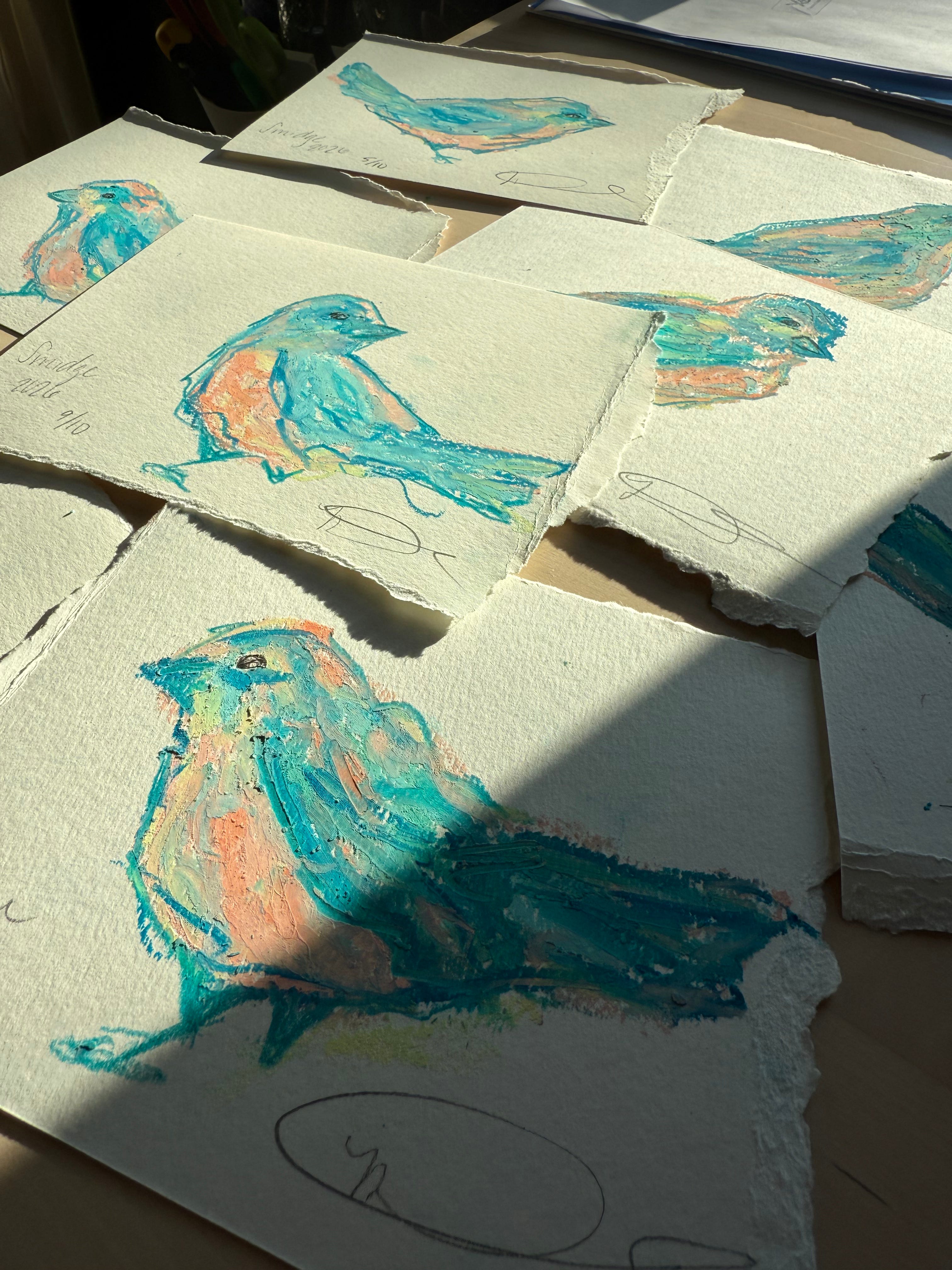
Yesterday, I felt the despair creeping in again. What I’ve said ad nauseam here and in my life is that creating something- even for fifteen minutes- regulates my mood and helps me tolerate the moment. I made a study of Smidge, from memory to paper, in oil pastel and colored pencil.
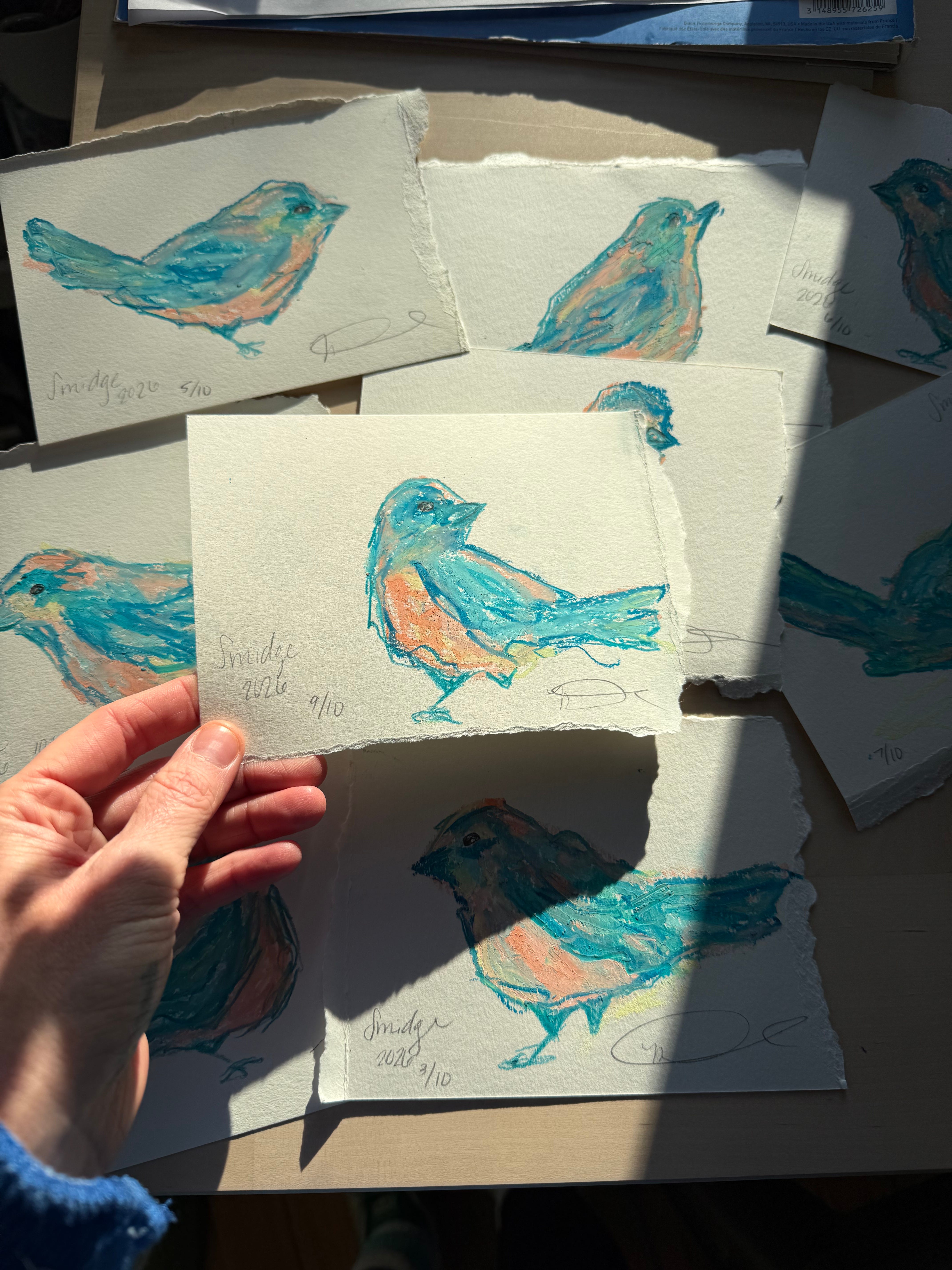
In fighting with the tools that are uniquely mine, I will send one of these Smidge studies- 10 small 5x7” ish works available from this study- to those practicing critical hope. My ask is that you do so by donating at least $25 to a cause or non-profit supporting immigration law, legislative justice, refugees, immigrants, and migrants. You can direct message me here or email megbournewellness@gmail.com with a screenshot of your donation, Venmo receipt, or confirmation.
The drawing can serve as a reminder of the one-legged strength we can gather together. And if your movement toward action isn’t financial, I would truly love to hear about it as well.
Here are a few ideas to spark your own:
Support your local ACLU financially
Spend your money at a local business owned and operated by immigrant or migrant neighbors (big tips and a note of support on the receipt are a favorite move!)
Give to a local non-profit supporting refugee, immigrant, or migrant community members. One I love where I live is Canopy.
Contribute to a bill or to the work of local immigration lawyers
Seek out local alliance and advocacy organizations; in NWA, I look to AIRE.
When you share your action toward critical hope in one of these ways, I’ll mail you your unique drawing of Smidge.
Thanks for reading- bird by bird.
Xo
-meg
P.s I’m still running the Dear Someone: Snail Mail Collective and matching pen pals through the end of February, more on that here.
P.p.s If you’re near Northwest Arkansas, join me on February 4th for an in-person snail mail creating event, get tickets here- just a few spots left.
No posts
Comments
Nothing yet. Say the first thing.
Sign in to join the conversation.