
I have tried to be a journaler many times in my life. I have bought beautiful notebooks with the full intention of filling them. I have committed to morning pages, to evening reflections, to prompted gratitude practices, to stream of consciousness free-writes at 6am when the house is still quiet.
Some of it stuck for a while. Most of it didn’t. And each time it didn’t, I filed the same piece of evidence in the same folder: journaling isn’t really for me.
Ya know the abandoned notebooks, the days missed, the guilt. You start stressing about journaling and that sure isn’t the point.
Then I met Tammy Salas in Paris.
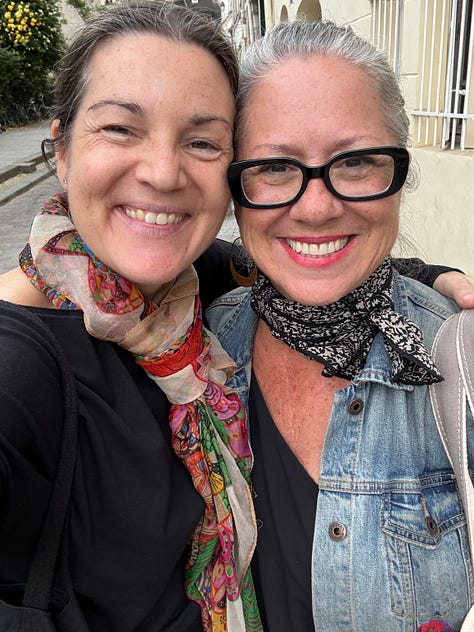
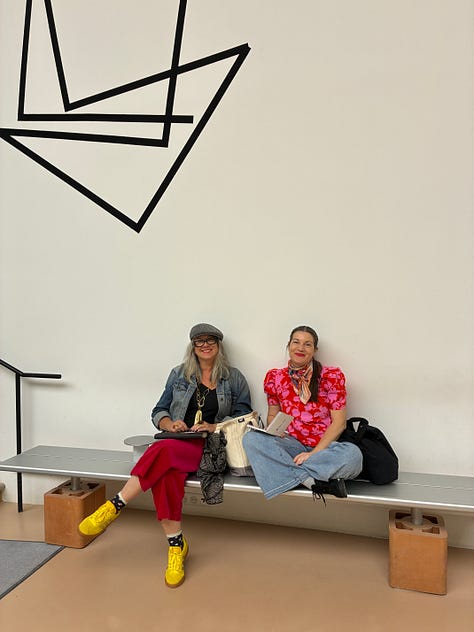
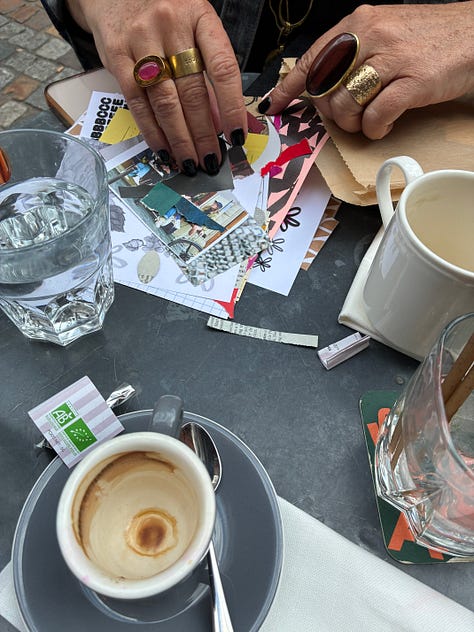
She liked my post on Instagram, I saw we had sober friends in common. We chatted in the DMs and decided to meet for tea at Shakespeare & Company IYKYK. It was so meant to be, and we ended up hanging out a few times and it totally made my trip 10x better.
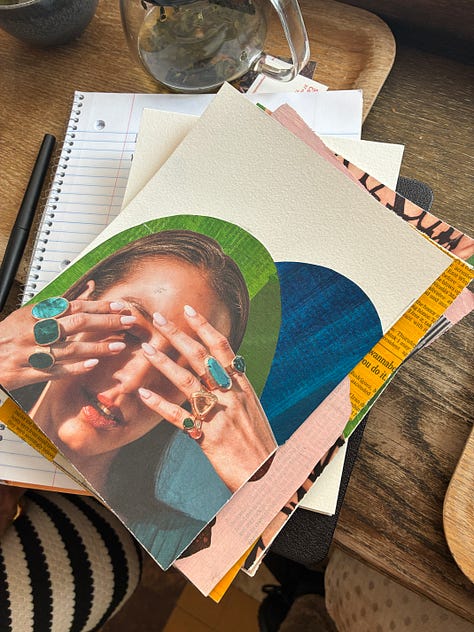
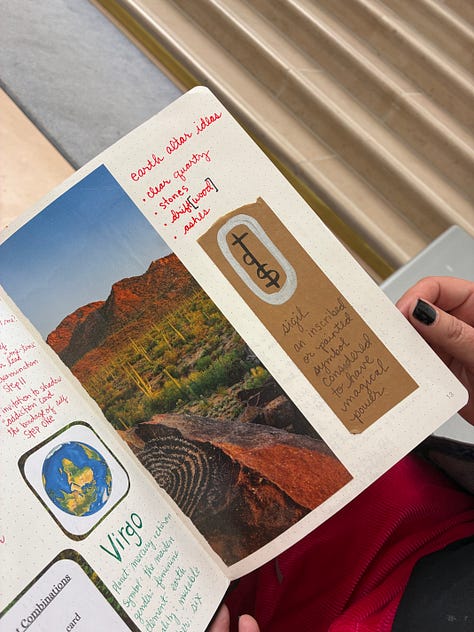
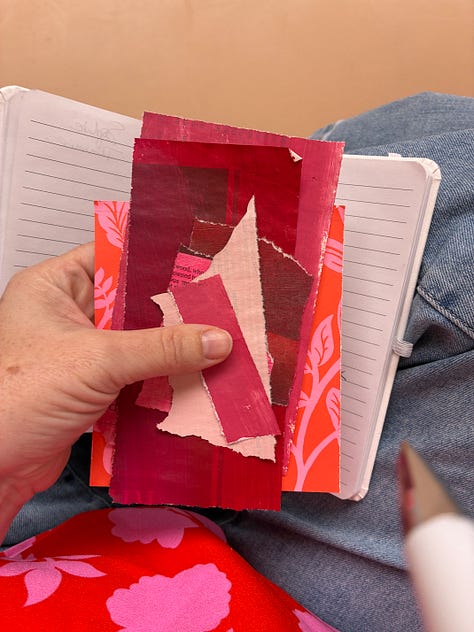
What Tammy does is not what I had been calling journaling. There were no lines of text. No prompts answered in careful handwriting. What there was instead: images torn from magazines, scraps of colour, fragments of words cut and arranged, things glued and layered, texture built up over texture. A visual landscape of whatever was happening inside her, made physical and external and real.
I was obsessed immediately. Not in a “what a lovely hobby” way. In a something-in-my-body-recognised-something way.
I asked here to do a guest post - a ‘how to’ on her version of journaling and it is the best.
She explains it all so beautifully here:
Because what I understood, watching her work, is that I had been trying to journal in a language that wasn’t mine. I had been asking my very verbal, very analytical mind to process itself using the same tool it uses all day long: words in a linear sequence. And my mind — unsurprisingly — had resisted. It already does that all day. It didn’t want to do it again on a blank page at 6am.
The Problem With “Journaling”
The word journaling covers too much ground to be useful as a prescription. When someone tells you to journal, they are not actually telling you how to process. They are handing you a genre and assuming you speak it.
Some people do. If you are someone for whom words arrive easily and writing them down organises your internal world, then traditional written journaling is genuinely good medicine. It externalises thought, creates narrative, gives the analytical mind something useful to do with its energy.
But many people — and I suspect more than are willing to admit it — are not built that way. Their processing does not happen in linear text. It happens in image, in sensation, in movement, in sound, in colour and texture and the physical act of making something with their hands.
These people try written journaling, find that it doesn’t quite land, and conclude that they are not journalers. What they are actually discovering is that they haven’t found their format yet.
This series is about finding the format.
What All of These Practices Have in Common
Over the next four weeks, we are going to look at the full ecosystem of journaling practices — collage and visual work, stream of consciousness versus prompted writing, voice memo processing, somatic and body-based journaling, and movement as a form of reflection.
They look quite different from each other. But they share a common mechanism: they all create a container for something that is happening inside you to become external, observable, and therefore processable.
The nervous system is not very good at processing what it cannot externalise. Unspoken experience stays in the body as sensation. Unwritten experience stays in the mind as noise. The moment something moves from internal to external — whether that is a word on a page, an image glued to cardboard, a voice memo recorded in the car — the nervous system can begin to move it through.
This is not a metaphor. It is the physiological basis of why expressive practices have been used for healing across every culture that has ever existed.
You have probably already found your format without realising it. The voice memos you send to a friend that are actually you thinking out loud. The notes app spiral at 11pm. The walk you take when something is too big to sit with. The playlist you build when you don’t have words.
This series is going to help you name it, understand why it works, and do it with a little more intention.
Again, if you haven’t already check out Tammi’s work here.
This essay is part of the series All the Ways to Journal — a series on creative expression, nervous system regulation, and finding the journaling practice that actually fits your mind and body.
Next: Essay 2 — The Case for Collage Journaling: why working with your hands bypasses the inner critic and what happens in your nervous system when you make something instead of write something.
The paid audio companion to this essay — a guided hypnosis for dropping into the sensory, visual mind — is available to subscribers here.
No posts
Comments
Nothing yet. Say the first thing.
Sign in to join the conversation.