
On Wednesday, April 1, President Trump addressed the nation. Iran, he told Americans, had “not a thing” it could do to stop U.S. air power. “They have no anti-aircraft equipment,” he said. “Their radar is 100% annihilated. We are unstoppable as a military force.”
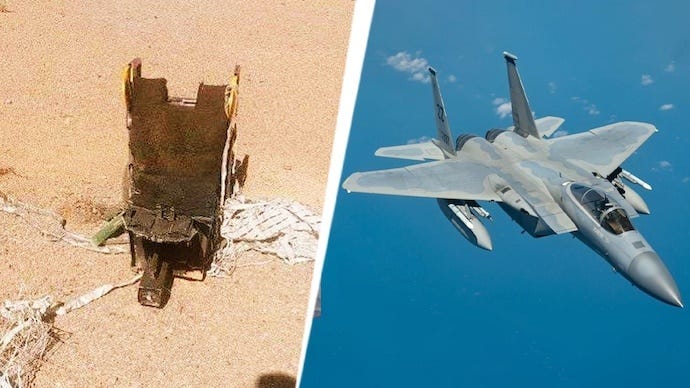
Two days later, an F-15E Strike Eagle was falling out of the sky over central Iran.
One crew member was rescued. The other is still missing. Iran offered its civilians the equivalent of $60,000 to find him — dead or alive.
This is what air superiority looks like when the people declaring it are wrong.
Thanks for reading Agendapedia! This post is public so feel free to share it.
On a single day, the United States lost two aircraft to Iranian fire.
The first was an F-15E Strike Eagle — a two-seat fighter jet based out of RAF Lakenheath in the UK, assigned to the 494th Fighter Squadron. The Islamic Revolutionary Guard Corps (IRGC) claims it was brought down by a new advanced air defense system. U.S. officials confirmed the shootdown to CBS News, Axios, and NBC. CENTCOM notified the House Armed Services Committee. The Pentagon sent an email to the Associated Press acknowledging it.
The second was an A-10 Thunderbolt — the famous “Warthog” — scrambled to help find the F-15E crew. It was struck by Iranian fire near the Strait of Hormuz. The pilot managed to fly the damaged aircraft to Kuwaiti airspace before ejecting. He survived. The plane did not.
Two U.S. Black Hawk helicopters sent in as part of the search-and-rescue mission were also hit by Iranian fire. Crew members were injured. Both helicopters made it back.
This is the first time since Operation Epic Fury began that a manned U.S. aircraft was shot down by enemy fire. The last time a U.S. fighter jet was downed in combat was during the 2003 invasion of Iraq — over 20 years ago.
What makes this significant isn’t just the loss of two planes. It’s the wall of official statements that preceded it.
The day before the F-15E was shot down, CENTCOM Commander Admiral Brad Cooper told the world: “We don’t see their navy sailing. We don’t see their aircraft flying, and their air and missile defense systems have largely been destroyed.”
Trump had been saying the same thing for weeks. Hegseth had been saying the same thing. The narrative was set: Iran was defanged. The skies were American.
And before April 3, every time Iran claimed it had shot down a U.S. jet, CENTCOM waved it away. “All U.S. fighter aircraft are accounted for,” they said. “Iran’s IRGC has made the same false claim at least half a dozen times.”
Then came a day when they couldn’t say that anymore.
The April 3 losses didn’t happen in a vacuum. They are part of a mounting ledger that the American public has barely been shown. Here is what this war has cost in aircraft alone:
Aircraft Quantity Lost Est. Cost
F-15E Strike Eagle (enemy fire) 1 ~$90M
F-15E Strike Eagle (friendly fire) 3 ~$270M
A-10 Warthog 1 ~$120M+
KC-135 Stratotanker 4+ ~$320M+
MQ-9 Reaper drones 16+ ~$480M+
TOTAL (est.) 25+ ~$1.3B+
Sources: Axios, Washington Post, NBC News, CBS News, Military Times, SlashGear, The War Zone (April 2026)
That is over $1.3 billion in destroyed hardware — and that figure uses conservative estimates. The real replacement cost for an F-15E today, accounting for modern upgrades and electronics, sits closer to $90 million per aircraft. The A-10 is no longer in production.
The last one rolled off the assembly line in 1984. You cannot order a replacement. Every Warthog lost is gone permanently from a fleet of roughly 162 remaining aircraft.
The A-10 that went down over the Strait of Hormuz on April 3 is irreplaceable. There is no factory that will build another one.
There is a military distinction that the Trump administration has consistently collapsed: the difference between air superiority and the complete elimination of threat. Destroying radar installations and surface-to-air missile batteries degrades an opponent’s air defenses. It does not eliminate them.
Justin Bronk, Senior Research Fellow for Airpower and Technology at the Royal United Services Institute in London, put it plainly after the F-15E went down: even a very effective suppression campaign cannot fully eliminate threat without sweeping the entire territory with ground forces. In Iran’s case, that would mean occupying a country of 86 million people.
That’s the gap between what officials were saying and what was true. Iran retained the capability to strike back — across the region, and against American aircraft. It still does.
Behind the billion-dollar hardware figures are people.
Thirteen U.S. service members have been killed during Operation Epic Fury. As of March 31, 365 have been wounded — the majority from the Army, the rest spread across the Navy, Marines, and Air Force. Six remain seriously wounded.
One weapons systems officer from the downed F-15E is still unaccounted for. Iran denied reports over the weekend that he had been captured. The U.S. military has not confirmed his status. His family is waiting.
Iran is hunting for him. Civilians have been promised a reward. And the men who sent him there told the country there was “not a thing” Iran could do.
The conflict is now over a month old. The death toll across the Middle East is approaching 5,100. The Strait of Hormuz — through which roughly 20% of global oil trade passes — remains choked. Tanker traffic has collapsed. Oil prices are climbing. Trump has threatened to escalate against Iranian bridges and power plants. He says he wants to “take the oil.”
Peace talks have gone nowhere.
And on the same day an American jet was shot down over Iran, Trump told NBC News the incident would have no effect on negotiations. “No, not at all,” he said. “It’s war.”
He is right about that last part.
What he won’t say is the part that follows: if it’s war, then the government owed the public the truth about what that war actually looks like — not a prime-time address telling Americans that Iran had nothing left to fight with, while U.S. pilots were still flying over the country, and the IRGC still had air defense systems no one wanted to publicly admit existed.
The question isn’t whether Iran will strike again. It already has.
The question is: who exactly was the air supremacy narrative for?
Comments
Nothing yet. Say the first thing.
Sign in to join the conversation.